
On September 16, Facebook announced its next-generation standalone VR headset. At 299 bucks—a price aimed squarely at Nintendo Switch territory—it seemed that the running joke about “every year being Year One of VR” might finally become reality. VR appears to be setting out on the road to maturity. It will become an entirely new medium, carrying future innovations of the imagination. Bishōjo games—games centered on beautiful girls—made for this entirely new medium also seem to promise an entirely new experience. Yet when we actually put on a headset, we keep finding ourselves sighing in disappointment. Most of the supposedly new experiences made for this supposedly new medium give off a distinctly rotten smell. We cannot help asking: is VR really an entirely new medium? Have bishōjo games in VR really brought us an entirely new experience?
Or perhaps we can put these two questions more precisely:
-
Does VR mean innovation = radicality?
-
Do bishōjo games in VR mean innovation = radicality?
This essay will approach these questions through a history of the imagination surrounding VR and a history of bishōjo-game criticism. It will then take the VR bishōjo game Project LUX as its example to consider whether this “radicality” is possible at all.
Why Seek Radicality in Bishōjo Games?
Before beginning the argument proper, perhaps we need to set VR aside and first ask: “Why seek radicality in bishōjo games?” Certainly, many players today may feel no need to pursue innovation = radicality. For them, bishōjo games should be an endlessly reproduced everyday world, a haven of comfort where they can consume standardized stories and characters forever. Yet the pursuit of radicality was in fact a current within the history of bishōjo games—one might even call it their essence. This pursuit could also be described as a movement of self-referential “criticism” within bishōjo games themselves.
For most bishōjo-game players today, who take no interest in thought, “criticism” may be an unfamiliar word. But mention the familiar name ErogameScape—“Eroge Critical Space”—and they seem to grasp what criticism means. Criticism, however, is not what most players intuitively take it to be: something like ErogameScape’s scoring system. Its most important expression on that site is, rather, its long-form reviews. This criticism belongs to a tradition of Japanese literary and artistic criticism. To bishōjo-game players, “Critical Space” may feel as familiar as something native to their own field. In fact, it is an import. Critical Space was a journal devoted to criticism, founded by critics including Kojin Karatani and Akira Asada. It occupies a pivotal place in the history of Japanese literary and artistic criticism. Its influence was so great that websites such as CinemaScape—“Cinema Critical Space”—sprang up in imitation of its name and style. The ErogameScape we know is its bishōjo-game counterpart.
The possibility of pursuing radicality = criticism in bishōjo games has therefore long lain within every player’s heart, as well as within the history of bishōjo-game criticism.
The Critical Point of Bishōjo Games
Criticism is an inescapable issue in the history of bishōjo games. And within that history of criticism, there is one utterly inescapable figure: Hiroki Azuma, already thoroughly familiar to readers of theory. The revelatory analyses in his Otaku: Japan’s Database Animals and The Birth of Game-like Realism are major contributions to the history of bishōjo-game criticism. Another important contribution, less familiar to readers in the Chinese-speaking world, is the critical dōjin series—independently produced fan publications—he put together in the early 2000s: The Critical Point of Bishōjo Games.
Only two volumes of this critical dōjin publication appeared. They brought together numerous bishōjo-game writers, including Gen Urobuchi, Masaki Motonaga, and Jin Haganeya. They also gave rise to the classic definition of sekai-kei, the keyword that would dominate otaku-cultural criticism throughout the 2000s. They nurtured writers on otaku culture such as Satoshi Maejima and influenced figures such as Shusei Sakagami, now known to Chinese-language readers for The Trajectory of Key and The Trajectory of TYPE-MOON. Even such familiar names as Tatsuhiko Takimoto and Makoto Shinkai appear among the publication’s contributors. Looking back today, we can readily call this critical dōjin publication a “legend.”
The story of how it came about is also very entertaining. For readers of theory, Azuma’s most memorable bishōjo-game criticism is probably his analysis of loop-based games in The Birth of Game-like Realism. That book began as a serial in Faust, the light-novel literary magazine that enjoyed enormous popularity in the early 2000s. Not long after the serial began, however, Azuma fell out with the magazine’s editor, Katsushi Ōta, over their respective views. The reason is rather jaw-dropping: Azuma was a hardcore Key fan, while Ōta was a TYPE-MOON fan—or, in today’s terms, more nearly a Fate fan. To resist Ōta’s TYPE-MOON faction, Azuma stepped down from the magazine’s criticism column and independently produced the email magazine Hajō genron and the critical dōjin publication The Critical Point of Bishōjo Games. Its first volume contains a spectrum chart detailing how Azuma understood the influences and relative positions of light novels and bishōjo games. This legendary critical dōjin publication had a profound influence not only on bishōjo games but also on light novels and the criticism of both.

The Radicality of the Critical Point
In his celebrated essay on AIR in The Critical Point of Bishōjo Games, “Stopping Short of Moe, Remaining in Incapacity” (萌えの手前、不能性にとどまること), Azuma describes his criterion for bishōjo-game criticism as follows:
Those are my thoughts on AIR. But what does “critical” mean here? Certainly, we would not ordinarily regard AIR as a work possessing criticality. It is merely a “tearjerker” that adequately satisfies otaku desires, merely a successful commodity produced according to the logic of consumption. There may be no critical consciousness in the production and consumption of AIR, nor need there be. I myself do not believe for a moment that the criticality I have discussed here was consciously put forward by Jun Maeda and the other staff at Key; nor do I think most readers have interpreted it as I have here. In this respect, AIR is entirely different from explicitly critical works such as the previously mentioned Beautiful Dreamer, Neon Genesis Evangelion, and Motonaga and otherwise’s Mirai ni Kiss o.
But I insist on the word “critical” precisely because “critical”—in the sense both of criticism and of a critical limit—does not originally mean fault-finding or condemnation. Rather, it should describe the whole range of ingenious creative acts found in literature, art, animation, games, and every other particular genre: acts that attempt to push a genre’s possibilities to their critical point and, in doing so, unwittingly expose its conditions and limits.
The discussion so far has shown that analyzing AIR has deepened our understanding of the essence and limits of bishōjo games as a genre. In other words, at a level not directly connected with the author’s intentions or the player’s experience of playing, this work becomes a passage through which an implicit property of the genre itself is disclosed. It is precisely on account of this property that I call AIR a “critical” work.
The theory of the critical point that Azuma presents here entails precisely this act: pushing the possibilities of bishōjo games to their limit = critical point, so that their essence as a medium becomes manifest. Many readers will already have noticed why the criticism of loop-based bishōjo games in The Birth of Game-like Realism pays so much attention to their “systems”—in other words, to the architecture or structure of the medium. It is another application of this same critical criterion. The pursuit of radicality = criticality in VR bishōjo games follows the same theory of the critical point: it pushes VR as a medium, and VR bishōjo games as a genre, to their limits so that their essence and architecture can become apparent.

The Radicality of Cyberspace
Let us return to our original question: does VR mean innovation = radicality? Or, to put it another way, what would radicality mean for VR? Consumer VR products and the industry surrounding them have emerged only within the last ten years, but sociological and literary imaginings of VR have a long history. Examining these imaginings offers a shortcut to thinking about innovation in VR. The familiar term “cyberspace” stands for this imaginative tradition.
Although “cyberspace” is already a familiar term, it is more metaphorical than “network,” the word we use more often in everyday life. The communications infrastructure supporting cyberspace is not a “place.” As the word “network” suggests, it is a transport network of optical fibers and cables. In his essay “Why Is Cyberspace So Called?” Azuma argues that cyberspace could detach itself from the network structure of its communications infrastructure and become a spatial metaphor because of the technological-utopian imagination invested in the internet by the Californian Ideology, which arose in the United States in the 1960s. This curious marriage of communications technology—an infrastructure built at the level of the nation-state—and left-wing thought created a new continent of freedom beyond physical space. “A Declaration of the Independence of Cyberspace,” modeled on the American Declaration of Independence, exemplifies the Californian Ideology’s vision of this new continent of freedom. Cyberpunk, that familiar genre of literary imagination, is also deeply influenced by this thinking. In literary imaginings of cyberspace, the control that capital and the system exert over individuals is often represented by infrastructure—cables, transportation, buildings—while the free territory from which to resist capital and the system is represented as an illusory cyberspace. These two opposing representations of the same thing reflect the coexistence of radicality and conservatism within this ideology.
There is no doubt that this optimistic vision of cyberspace as a new base for a great left-wing counteroffensive is profoundly childish. Azuma was serializing his essay in 1997, when the internet was not yet as widespread as it is today, and criticizing this childishness still required a certain amount of philosophical speculation. But we live in the present and have watched the internet become a tool for inflaming nationalist sentiment and digitally exploiting individuals. We can experience that childishness firsthand, without any speculative analysis at all.

By Hiroki Azuma.
Short-Circuiting the Symbolic and Radicality
Even today, after the VR industry’s headlong development, people have not truly moved beyond these childish imaginings of cyberspace. Facebook’s requirement that users log into its VR devices with a Facebook account has drawn countless criticisms from players and the industry. One recurring response is the same old discourse condemning restrictions on freedom. Such criticism has still not escaped the structure of the Californian Ideology described above. After the revelations about food-delivery riders,1 even ordinary people who pay no attention to digital labor no longer have illusions about the “system.” Yet criticism of VR still follows the same old liberalism. One could call it doubly childish. Does this mean, then, that there is no longer any innovation = radicality to discuss in cyberspace—or for us, as we discuss VR and the form of VR bishōjo games? Not at all. What we must do here is precisely to turn the old into the innovative, and elevate the immature into the radical.
What does this mean? Let us return to the imagination of cyberspace. The psychologists Sherry Turkle2 and Allucquère Rosanne Stone3 offered the following account of the approaching age of electronic media. They argued that switching back and forth between windows on a screen meant that people could move among different personae. This media structure of multiple personalities brought about a deconstruction of the Cartesian subject and the birth of a postmodern subject. But psychology marching under the banner of postmodernism is undoubtedly suspect. As Žižek argues in his essay,4 the freedom to move among different masks actually implies that behind them exists a subject-position as an empty set, capable of putting on any mask. The theory that sets cyberspace’s multiple personalities against the subject therefore not only fails to threaten the subject’s unity; it reinforces the structure of the subject’s desire on another level. Azuma, however, argues that behind this seemingly childish psychological analysis lies a radical possibility overlooked by Lacanian psychoanalysis.
In the accounts of Turkle and others, Azuma notices a very particular orientation toward the surface. When a player’s character in a text-based multiplayer game, or MUD, is violated, for example, the player also feels violated. When someone in an online chat says they are female and uses feminine language, the person chatting with them will set other considerations aside and provisionally believe this without reservation. Such situations reflect an indifference, in the information age, to what lies behind the screen = in the depths.
In psychoanalytic discourse, surface and depth always constitute the two sides of a dialectic that shapes the subject’s structure. Take cinematic spectatorship as an example. On the one hand, spectators identify with the image = character on the screen through imaginary identification. On the other, they identify with the apparatus outside the screen—the camera, the director, and the gaze of society—through symbolic identification. The structure of the subject’s desire takes shape in this dialectical relation between the visible image on the screen and the invisible symbolic order = symbol outside it. In the information age of cyberspace, however, people have lost all interest in depth. In psychoanalysis, this absence of depth = the symbolic order, this fall of the big Other, always brings about a return in the form of perversion. Žižek, for example, sees a masochistic character in this discourse: the absence of depth results in nothing more than actively welcoming the return of another “master,” named cyberspace. Azuma acknowledges this mechanism of substitution for the symbolic order, but also argues that, in the information age, it no longer takes the form of restoring that order. Instead, it proceeds through “turning the symbolic order into the Imaginary = turning symbols into images.” This short-circuiting of the Symbolic, this theory of a direct connection between an expanded Imaginary and the Real, and the particular attitude toward Lacanian psychoanalysis it entails form a very important part of Azuma’s theory. His famous definition of sekai-kei, for example—the “direct linking of the you-and-me relationship with ontological questions such as the survival of the world”—comes precisely from this critique of Lacanian psychoanalysis.
As the Symbolic becomes Imaginary and depth becomes surface, what emerges is a total surface, a hyper-surface = a hyperflat plane. The new form of subjectivity born on this hyperflat plane is what Azuma calls interfacial subjectivity—the subject of the interface.
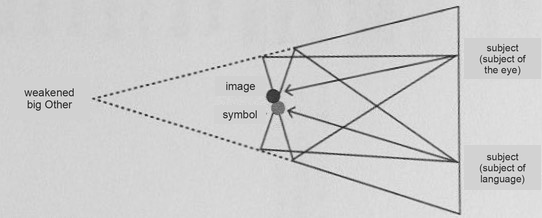
The Radicality of the Interfacial Subject
The interfacial subject Azuma proposes, and its critical attitude toward Lacanian psychoanalysis, actually derive from Derrida. For Azuma, psychoanalysis as a whole is a product of the twentieth-century cinematic apparatus. Moving from the psychoanalytic model of cinematic spectatorship to the cyberspace of the information age means that “seeing and being seen” = “the visible and the invisible” = “image and symbol” are flattened onto the same surface and represented there. This property of belonging at once to image and symbol is precisely what Derrida calls writing (écriture).
Previously, images were visible, while symbols—the symbolic order—were invisible. Once the information age places both image and symbol within the Imaginary, their distinction is freed from the privilege of vision and handled instead by perception dispersed across channels. In other words, what was an ontological distinction between image and symbol becomes a cognitive distinction in how different perceptual channels process writing. For the interfacial subject, this processing of writing across dispersed perceptual channels corresponds, on the one hand, to Derrida’s “space between eye and ear,” and on the other, to Freud’s “uncanny.”
Freud’s concept of the uncanny names a fear different from the unknowable terror of something foreign. It arises when what is most intimate within returns outside in an estranged form. Familiar examples include the uncanny valley of dolls, doubles, and coincidences in everyday life. In one of Freud’s famous examples, the uncanny is explained as follows: you are thinking of a friend you do not want to meet when you happen to run into them. The mechanism behind this everyday coincidence is that you have already registered the person’s presence unconsciously, but your dislike of them has repressed this information, preventing it from becoming conscious. The unconscious, meanwhile, begins processing the information on its own, generating associations about this disliked friend. As you draw closer, your unconscious is thinking about the friend just as you encounter them greeting you. Conscious experience lags behind unconscious experience, and this mechanism produces the feeling of the uncanny.
In Azuma’s interpretation, this repression of consciousness by the unconscious, and consciousness’s lag behind the unconscious, are brought together with Derrida’s “space between eye and ear” to form a media theory of differences in processing speed among perceptions, consciousness, and the unconscious. In other words, the radicality Azuma attributes to the interfacial subject lies precisely in what happens after the privilege of vision dissolves: differences in processing speed among perceptions produce conflicts that disturb and split the dialectical subject. Here, at last, we encounter a theory through which we can interpret a radicality inherent in VR.

Half-Immersive VR and the Disturbance of Perception
Facebook’s release of Quest 2 at 299 bucks marks the VR industry’s movement toward maturity, but it does not mark the maturation of VR technology. Even today, that technology faces many unresolved problems. Representative examples include motion sickness and the performance gap, both familiar to VR players.
Motion sickness here means an effect like carsickness caused by a mismatch between the visual experience of a moving viewpoint in a VR headset and the sense of movement in a stationary body. Its mechanism resembles that of carsickness and the sickness induced by 3D graphics. Only in VR, however, does it become such a widespread problem demanding a solution. Many VR games therefore use teleportation for movement, or drastically narrow the field of view while the player moves, to counteract the sense of motion produced by vision. VR aims at complete sensory immersion, yet to eliminate motion sickness it must restrict visual effects to some degree. This paradox has made motion sickness the greatest obstacle on VR’s road to maturity.
Yet it is precisely because VR stands between maturity and immaturity, in the peculiar condition of half-immersion (“half-dive”), that the radicality we seek becomes possible. VR’s visual effects are already sufficient to deceive consciousness into believing that the body is moving, while it provides nothing at all for the unconscious processing of the body’s sense of movement. This conflict among perceptions, together with the history of vision’s suppression of the other senses, ultimately manifests itself as a thoroughly physiological disturbance in motion sickness, a problem demanding a solution.
Then there is the performance gap. Current computer graphics technology still has some way to go before achieving complete visual immersion. Human binocular vision has a horizontal field of view approaching 200 degrees. At a VR headset’s display distance, the eyes can discern the gaps between pixels even at 8K resolution, while a frame rate of at least 90 frames per second is needed to alleviate eyestrain and dizziness. Achieving a 200-degree field of view requires rendering at 8K and 90 frames per second for each eye. Even the latest RTX 3090 graphics card can manage only 8K at 60 frames per second with DLSS, still far short of the limits of human vision. To address this problem within current rendering capabilities, the VR industry has developed a technique called “foveated rendering.” Its principle is that although humans have an enormous field of view approaching 200 degrees, the portion we can perceive clearly—the area of fixation—is only about 30 degrees. Outside that area, the eye’s capacity to discern things gradually diminishes. This is the cognitive-scientific explanation of what we commonly call “peripheral vision.” It supplies a theoretical basis for laziness = optimization in graphics rendering: lowering the rendering resolution outside the fixation area can greatly reduce the rendering load while maintaining clarity. Under ideal conditions, almost the same effect can be achieved with just 16 percent of the original processing power. The current problem with this technique, however, is that the eyes can move, while the high-resolution area remains fixed at the center of the screen rather than following their focus. Solving this requires eye tracking, but eye tracking in VR has yet to become practical: it is neither affordable for most people nor widely supported by games.
This shortfall in graphics-rendering performance means that VR equipment most people can afford accommodates only the “conscious” portion of vision, without broadly covering the remainder: the “unconscious” = “peripheral vision.” At the same time, however, VR’s head tracking is already quite mature. Hence continuity in the sense of movement conflicts with discontinuity in vision. On the one hand, changes in the conscious portion of vision are linked to movement in a way that accords with our perceptual structure, producing a sense of reality = immersion. On the other, the unconscious portion of vision is not fully covered, and the experience of looking at the world through a periscope does not accord with that structure. As VR players move their heads, they consequently experience the objectification of their own seeing: their vision seems to have become a camera operated by someone hopeless at camerawork. They cannot help mocking their own lousy “camerawork” = “vision.” This experience is very close to the uncanny we discussed earlier. Vision is among the subject’s most intimate senses; yet once the headset is on, vision itself is externalized as a strange object.
This objectification of seeing also accords most closely with the properties of the interfacial subject. Lacanian psychoanalysis places the visible image and the invisible symbol in a dialectical structure of surface and depth, respectively. By contrast, the objectification of seeing means precisely that writing on the surface comes to be processed through multiple channels. Processing vision through multiple channels in this way shatters the subject’s dialectical structure and disturbs the boundary between the subject and what lies outside it. It becomes a representative instance of the radicality we have been describing in VR as a medium.
The analysis so far gives us a provisional answer to the question, “Does VR mean radicality?” In terms of the imagination of cyberspace, and of the ultimate goal toward which the VR industry is moving, VR is merely a contemporary replay of the Californian Ideology that sustains that imagination. In itself, it has no radicality to speak of. But actual VR technology has not reached its stated goal: it remains in a condition of half-immersion. What has produced this condition is precisely the suppression of the other senses by the visual culture exemplified by the cinematic apparatus. In this immature VR, visual simulation has advanced ahead of the simulation of the other senses; the difference in speed between their processing channels ultimately makes perceptions conflict with one another and disturbs the subject. Perhaps these “technical problems” will all be solved in the near future. What we value here, however, is what VR exposes again while they remain unresolved: the relationship between subject-formation and the epistemes produced by the senses that dominate different historical periods. This is also what Azuma meant in treating psychoanalysis as a product of the cinematic apparatus.
Project LUX
Let us now turn to this essay’s final task: analyzing how VR bishōjo games manifest radicality through their expressive form.
Project LUX, released in 2017, is the first VR work from Spicy Tails, the independent game-development group led by the well-known light-novel writer Isuna Hasekura. Before this, Hasekura also made the WORLD END ECONOMiCA series, which is well known in the independent visual-novel scene. Coming to this 2017 work now, in 2020, you may find it very dated. Its graphics lag far behind; it has six-degree-of-freedom (6DoF) head tracking but no controller tracking; and its controls offer so little interaction that many VR players prefer to call it “VR animation” rather than a “VR game.” Indeed, the official website calls it “Spicy Tails’ first VR animation.” Such an indistinct boundary is hardly new to bishōjo-game players, who are already accustomed to calling these works games. It corresponds to the familiar “games like novels” and “novels like games” discussed in Azuma’s The Birth of Game-like Realism.
To return to the point: although Project LUX is badly behind the times in its graphics and systems, its script is outstanding. This does not simply mean that it has an excellent plot. What stands out most is that it turns its own technical backwardness to use in shaping the entire script. In this sense, Project LUX is a thoroughly Game-like Realism sort of work.

The Objectification of Seeing in Project LUX
The story of Project LUX goes like this. In the future, the vast majority of humanity lives in cyberspace. Cybertechnology has advanced so far that people can fully share others’ memories and even their personalities. Only Lux, a young artist, has continued to resist cyberization, living alone in her flesh-and-blood body in a secluded seaside cottage. As cybertechnology blurs the boundaries between individuals, the creative abilities of cyberspace’s inhabitants deteriorate further and further. Lux, the young artist, makes an ideal supplier of cultural consumer goods. To contact her in her isolation and commission work from her, the inhabitants of cyberspace dispatch the protagonist whose role the player will take. Acting as their agent, he enters a prosthetic body, visits Lux in the physical world, and offers her commissions.
Most of the game is filled with the agent and Lux chatting about everything under the sun, talking about life, and flirting. In this sense, Project LUX is a fairly conventional slice-of-life bishōjo game. But that is not its most distinctive feature. The player is shown clearly, right at the beginning, that this everyday flirtation will end in tragedy.
At the beginning, the player does not simply take the agent’s role and embark on a sweet everyday life of flirting with Lux, as the account above suggests. On entering the game, the player first arrives at a trial concerning Lux’s tragic killing. The defendant is our agent. The player, however, does not take the role of the accused agent, but that of a juror using cybertechnology to re-experience the agent’s memories and establish what happened. This cybernetic re-experiencing is undoubtedly a metaphor for the VR headset we are wearing. Here we encounter the same structure discussed in the sections on VR’s radicality: through a metafictional form that acts as a metaphor for VR itself, the player in this VR bishōjo game simultaneously takes two roles. One is the agent flirting with Lux; the other is the juror silently re-experiencing it all.
At first glance, this meta-structure looks more like the dialectical structure of psychoanalysis. Taking the agent’s role is imaginary identification with a visible character; taking the juror’s role is symbolic identification with an invisible gaze. As this re-experiencing continues, however, the meta-structure’s clearly defined boundary begins to blur. That is because re-experiencing through VR is simply “too much like actually being there.” “Too much like actually being there” means that, compared with psychoanalysis’s visual model = the cinematic apparatus, even a VR game as technologically backward as Project LUX can still pull the player into its space. It may lack controller tracking and haptic feedback, but at least it has unrestricted 6DoF head tracking, and both its interactions and its flirtation with Lux are actively staged around head movement. Here, the most elementary sense of head movement breaks down psychoanalysis’s dialectical logic of the visible and invisible. Even if players consciously try to use vision to maintain the boundary between their two roles, juror and agent, they cannot prevent the transcendent part of themselves as jurors from slipping into the surface space of flirtation with Lux—not after moving their heads to select topics of conversation with her, turning from side to side to experience her spatial audio, and even nuzzling against her little hand.

Disturbance Between Two Identifications
As the truth of the case gradually emerges, this descent from a transcendent level, this objectification of seeing, this disturbance of the dialectical subject reaches a new height. It turns out that the inhabitants of cyberspace commissioned Lux’s work in order to harvest the energy generated by the individual passion within it, and use that energy to wage war in cyberspace. The agent’s job is therefore not merely to commission Lux. He is also a tool through which cyberspace’s inhabitants use memory-sharing and re-experiencing to monitor and track her. When Lux discovers the truth, she breaks down. She realizes that whoever wins the war will forcibly cyberize her, turning her into electronic livestock from which creative energy is continually extracted. Electronic copying will also destroy the singularity of her being herself, allowing the inhabitants of cyberspace to share and re-experience her. Rather than lose the uniqueness of being herself, better to die and let death inscribe her singularity in history.
In her despair, Lux therefore chooses suicide. Before shooting herself, she embraces the agent—in other words, she embraces you, the player. What Lux finds most unbearable is not, in fact, the destruction of her own singularity. It is the destruction of the singularity of her memories of meeting you, and of this relationship that might perhaps be called love. Lux’s memories with you are unique, but once the agent returns to cyberspace, they will inevitably be shared there, experienced by other people as their own memories.
“How dispiriting it would be if other people peered into this feeling that belongs only to you and me.”
These words, spoken just before Lux’s life ends, compel us to put a question to every player moved to tears by this emotional scene: You, crying now—are you the agent or the juror?
Analyzed in this way, Project LUX reveals a very ingenious structure. It first places players within a meta-structure, making them jurors at the meta-level, coldly observing the interactions between Lux and the agent. Then, through the nonvisual interactions of VR and its depiction of flirtation with Lux, it draws players irresistibly down into cozy everyday intimacy with the girl. They forget their task as jurors and descend into the agent’s position at the object-level. Once players are so immersed in this everyday life that they cannot pull themselves away, the plot deftly turns somber. On the one hand, its gravity intensifies their emotional relationship with Lux; on the other, self-referential dialogue continually reminds them of their task as jurors. Amid everyday intimacy with the girl and a tragic romance with her, players are constantly trapped in the predicament of not knowing whether to understand their own emotions as those of the agent or of the juror. On the one hand, players lament that their romance with Lux has ended in tragedy. On the other, the chief culprit behind that tragedy is none other than the player. The person the player should blame is the player.
This self-reference breaks down logical levels; this simultaneous belonging to multiple positions on the surface disturbs the dialectical subject. It can be said to reflect perfectly the radical character of VR as a medium.

The Narrative Trick in Project LUX
But Project LUX does not stop there. If players make the correct choice at the game’s only decision point—whether to stop Lux from killing herself—they can reach a hidden ending. In this ending, after the trial, the agent returns not to a prosthetic body but to his flesh-and-blood body, which has long been kept frozen. At the seaside cottage, he is reunited with a “resurrected” Lux.
The Lux in the suicide scene, it turns out, was merely a prosthetic body remotely controlled by the real Lux. Although Lux has always resisted cyberization, living alone in a flesh-and-blood body was too lonely. She had therefore prepared the prosthetic body required for cyberization, but kept putting off the decision to take that final step. The agent knew about her substitution trick5 without memory-sharing exposing it to the jurors and other observers because, when Lux embraced him in the suicide scene, she wrote the plan on his back with her hand. The form of memory-sharing in this game—in other words, the form presented through VR—does not include the “being touched” part of touch.
This means that Project LUX uses VR’s character as an immature medium to construct an exceptionally ingenious narrative trick. On the one hand, VR gives players a sense of immersion involving their whole body and mind. On the other, it cannot fully simulate every perception. This half-immersive condition, poised between immersion and nonimmersion, creates a blind spot for players concerning “being touched.” It makes possible a narrative trick unique to VR.
The Asymmetry Between Touching and Being Touched
The reason for calling this narrative trick unique to VR is that it manifests an asymmetry between touching and being touched. An objection may arise here: doesn’t Project LUX lack controller tracking and feedback? Where, then, does its touch come from? Project LUX does indeed lack controller tracking and feedback, so it has none of the vibratory “touch” we usually mean. But the touch we mean here is elicited by other senses, just as ASMR can use sound to evoke a tactile experience at the outer ear. In other words, it is touch achieved through vision.
Let us return here to the nature of VR, and to Azuma. More than a decade on, Azuma’s essay “Why Is Cyberspace So Called?”—cited repeatedly here—has been reinterpreted as a theory of the touchscreen. At the center of this touchscreen theory is the inseparability of vision and touch, a property Azuma calls tactile-visuality. Azuma notes that when GUI developers first proposed the graphical user interface, they often described it as something that seemed to let users “touch” the computer’s core—its code. There is no doubt that code, which has no physical substance, cannot actually be “touched.” Yet the developers’ use of this “metaphor” reflects the inseparability of vision and touch, their capacity to complete one another. Here we find precisely the same logic as in interfacial subjectivity. Invisible depth = code = the Symbolic is flattened onto surface = image = the Imaginary, allowing direct manipulation of code in visual form. Dragging a desktop file into the Recycle Bin with a mouse, for example, visually represents the command del C:\Desktop\text1.txt. If tactile-visuality was not yet obvious enough in the age of the mouse and keyboard, the touchscreen embodies it more directly. In other words, for those of us living in the touchscreen age, touch does not necessarily require feedback such as “vibration.” Vision’s capacity to complete touch makes it possible to achieve touch through vision.
VR is absent from Azuma’s theory of tactile-visuality because, for him, it is merely the ultimate expression of visual culture. In our account, however, VR is a medium in which perceptions disturb one another, and so it embodies this property even more fully than the touchscreen. Oculus has already implemented hand tracking based entirely on image recognition on the $299 Quest 2, and applications and games supporting hand tracking are beginning to appear. The experience of midair “touch” control in VR makes the possibility of touch achieved purely through vision still more evident than the mouse and keyboard, or phones and tablets that still require contact with a panel. Thus, although Project LUX has neither controller tracking and feedback nor hand tracking, from the standpoint of tactile-visuality there is little difference between midair “touch” control and using head tracking to nuzzle a little hand, or body-position tracking to cuddle up to a 3D paper girl.6
Yet while Project LUX can achieve a form of “touching,” the “being touched” on the back involved in its narrative trick remains beyond most VR at present. Equipment such as VR suits is, of course, under steady development, and perhaps this will become possible in the near future. What we value here, however, is precisely how the work reflects and exposes the conditions of VR’s current immaturity. In this ingenious narrative trick, the early achievement of touch through vision produces blind confidence in VR’s technical maturity, making people forget the conditions required for “being touched.” The 3D paper girl can feel you holding her, but you cannot feel her holding you. This asymmetry between touching and being touched, this shift to processing touch through multiple channels, is precisely where Project LUX manifests the radicality of VR as a medium.

The Critical Point of VR Bishōjo Games
At last, we can answer this essay’s final question. Do bishōjo games in VR mean radicality?
VR as a medium remains immature, in a state of half-immersion. Within this immature medium, the VR bishōjo game Project LUX occupies an even more backward position, owing to its early release and the limited technical capabilities of an independent development group. Yet the work shows a high degree of awareness of the properties of its medium and of its own technical limitations. It turns these inadequacies and this immaturity to use, deftly weaving them into its script through metafiction and narrative trickery. It satisfies players’ desire to cuddle up to a beautiful girl while also trapping them in a predicament in which the subject is disturbed. This intricate and radical structure not only exposes the essence and limits of VR bishōjo games as a genre; it also brings to the surface an asymmetrical tactile-visuality unique to VR that Azuma overlooked.
Taking these features together, we can say without hesitation that Project LUX fully deserves to count as a critical point in the history of bishōjo-game criticism, and as a milestone in the VR-game criticism that may yet emerge. Perhaps the most fitting name for it is precisely this—the critical point of VR bishōjo games.
References
-
Hiroki Azuma, Why Is Cyberspace So Called? + (サイバースペースはなぜそう呼ばれるか+), Kawade Bunko, 2011.
-
Hiroki Azuma, “The Birth of the Tactile-Visual Plane” (触視的平面の誕生), Genron β 21, 2018.
-
Hiroki Azuma, “The Birth of the Tactile-Visual Plane (2)” (触視的平面の誕生(2)), Genron β 22, 2018.
-
Hiroki Azuma, ed., The Critical Point of Bishōjo Games (美少女ゲームの臨界点), 2004.
-
Sigmund Freud, “The Uncanny” (不気味なもの), translated into Japanese by Norihide Suto and Hiroshi Fujino, Complete Works of Freud, vol. 17, Iwanami Shoten, 2006.