Selected for the Pre-Festival of Lab on Roof’s “Rags Drum 2022.”
You wake up to find that everyone around you has become a monster. This is how Phoenix: Resurrection begins, and it is the central selling point of The Song of Saya. Gen Urobuchi undoubtedly borrowed far more than this from Osamu Tezuka. But if we want to pin down what the two works have in common, The Song of Saya’s one explicit reference to the manga already says it all. After Sakisaka kills his neighbor and rescues Saya from him, she realizes, uneasily, that he has begun to turn against humanity for her sake. To persuade Saya to “accept him completely,” Sakisaka brings up Phoenix—“a manga I read once”—and points out the resemblance between his own predicament and that of the protagonist of Resurrection. He then describes what the latter did: “That man who fell in love with something nonhuman finally gave up being human, and in doing so fulfilled his love.” This is both Sakisaka’s promise to Saya and his definition of the entire work: at this moment, he is Urobuchi’s incarnation. To fall in love with something nonhuman, then give certain things up in order to be with her: unlike the protagonist of Resurrection, that really is all Sakisaka does.
The Song of Saya is, after all, a work of pure love.
The differences between the two works, however, emerge much earlier. The opening CG in The Song of Saya—its first illustrated scene—also shows other humans transformed into monsters. But unlike Resurrection, this is not the first thing Sakisaka sees on waking. We are immediately told that “I have been living like this for more than three months now.” Urobuchi has chosen to begin at a point when the abnormality caused by the accident has already become the norm: “I gave up resisting long ago and accepted the facts.” Clicking “Start,” the player abruptly intrudes upon this normality. Only afterward, through the protagonist’s account, do we gradually learn about the accident in the background.
The same trope thus serves entirely different narrative functions. In Phoenix: Resurrection, the catastrophe and the amnesia that follows—an event—establish a compelling mystery around which the protagonist organizes his actions. It is, quite literally, the first mover of the main narrative. Moreover, once we “recover our memory” along with him, we discover that the reversal of perspective itself marks a major turn in a complete chain of events. With its “help,” he can resolve conflicts and grievances that had previously been insoluble. In The Song of Saya, by contrast, the accident barely gets a part. Perhaps the only reason Urobuchi bothers to mention it in so concise a work is that a premise cannot come from nowhere. The abnormal normality at the root of everything—a situation—does, after all, need a logical pretext to justify its appearance before the player.
There is an interesting distinction here. At the risk of coining new terms, let us call it the opposition between a starting point and a starting plane. The former, as we have said, is an event; and in physics an event happens to be defined as a mathematical point in four-dimensional spacetime. The latter has a network structure: it is the result of projecting the basic premise onto the protagonist. We can define it as the set of all relations that arise from the underlying situation and surround the protagonist when the narration begins.1 The story develops from this entire plane, and readers naturally begin to form expectations about how its various elements will change.
Initial conditions are largely independent of the laws governing how particular things evolve, as in an ordinary dynamical system. We can therefore imagine that, in most cases, the opening need not impose much constraint on the pattern of subsequent developments. Indeed, in the ordinary business of writing, an opening may well be no more than a convenient route to scenes already conceived. For The Song of Saya, however, the reverse is true in one particular sense. Experienced readers will find an implicit structure unfolding within its starting plane, with that plane itself as its prototype. This structure—or framework; better still, matrix—sets the bounds for all subsequent plot developments, or their possibilities, and gives them a common space in which to evolve. We will even see that if we take the “initial conditions” supplied by the opening and let them operate according to the logic of pure love, the game’s three endings correspond naturally and exactly to all the possible plot developments derivable under these constraints.2
To make this claim more precise, let us return to the opening. The player is shown three expository scenes in succession. Sakisaka first talks to his former friends at university, then goes to the clinic to see his female doctor, and finally returns home to Saya, who is living there. Along the way, we meet every important character who will appear later, all from his perspective. In turn, we learn how everyone except Saya sees him. The information gathered in this sequence can readily be assembled in the following diagram:
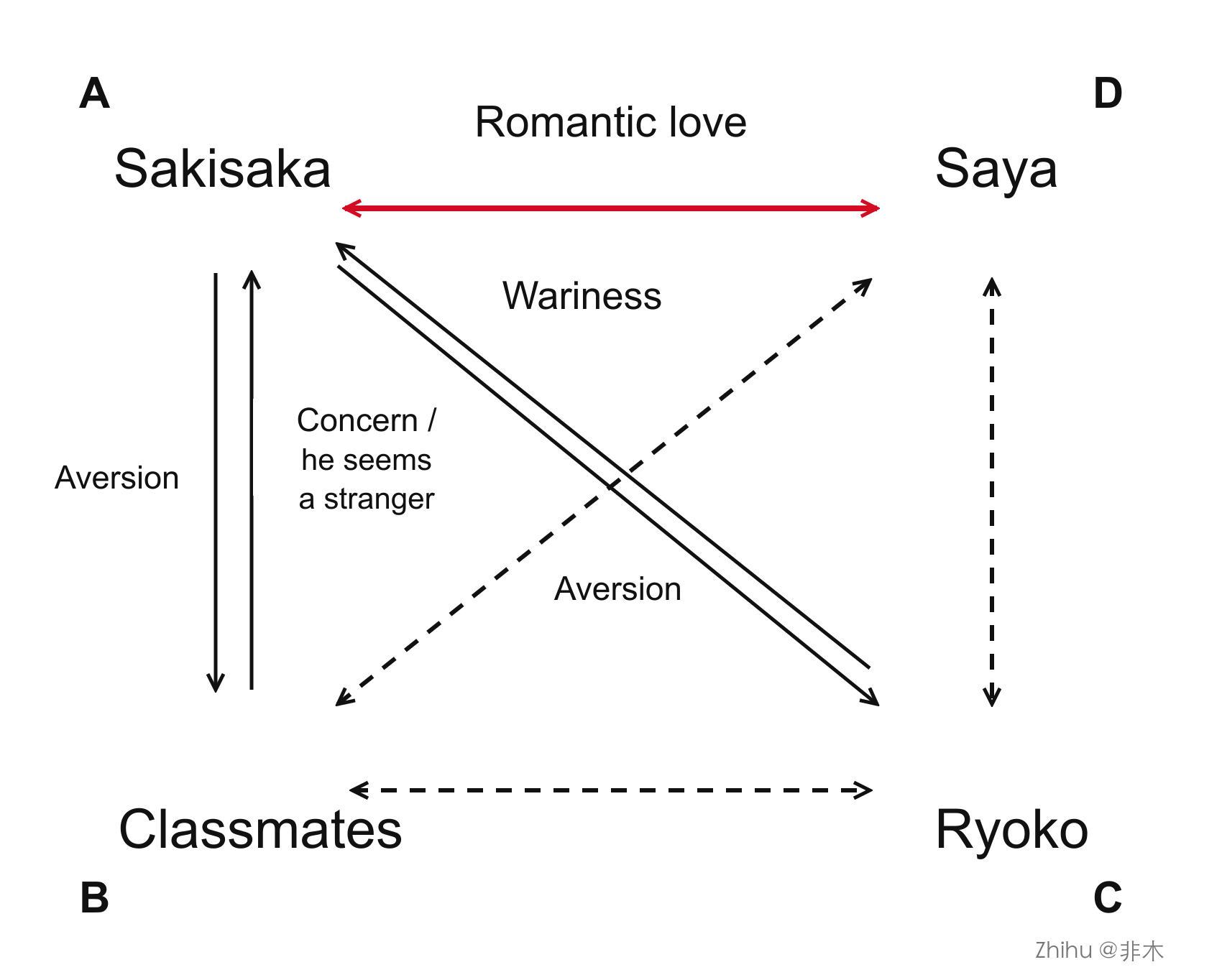
English relabelling of Fei Mu’s original diagram. Source: Zhihu @非木.

Diagram legend. The four nodes occupy the corners: A, Sakisaka, upper left; B, Classmates, lower left; C, Ryoko, lower right; D, Saya, upper right. Solid arrows show relations established at the opening; dashed arrows show possible relations not yet established.
Direction — Line and label
- A ↔ D: Red solid two-way arrow: Romantic love.
- A → B: Black solid arrow: Aversion.
- B → A: Separate black solid arrow: Concern / he seems a stranger—the classmates’ view of Sakisaka.
- A → C: Black solid arrow: Aversion.
- C → A: Separate black solid arrow: Wariness.
- B ↔ C; B ↔ D; C ↔ D: Three black dashed two-way relations, without emotional labels.
The diagonal crossings are not nodes.
As we can see, the principal characters fall naturally, according to who they are, into four distinct units of action, or actors. An actor is an individual or a group whose members share similar motives, functions or capacities, goals, and ways of acting, distinguishing it from the other units.3 Everyone except Saya is on guard around Sakisaka. His former friends may be more concerned about his health, but every player knows that, from Sakisaka’s own point of view, he has no use for this extra curiosity and attention. On the contrary, anything that might expose Saya to the world threatens him. For now, then, Saya is the only character with whom he retains a “positive relation”—, marked in red. Every other relation is a potential source of conflict.
The diagram tells us more than that. Only the three relations centered on Sakisaka—, , and —have actually been established. Yet once all the principal actors have appeared as nodes, the possibilities of all the other relations, shown as dashed lines, are activated along with them. A convenient mathematical fact makes this possible: even if we restrict the graph’s “available” edges to , the resulting structure, a subgraph of the complete graph ,4 is still connected. Since all the characters can, in theory, come to know one another through Sakisaka, and since they do have motives for approaching and investigating him, we have no reason to assume that they will not, in fact, come to know one another this way. In other words, the entire complete graph is ultimately available.
What is more, there are only four important actors in the work, and the completed contains every possible relation. We can therefore go further: the stage-matrix really has been given in full from the outset. The moment we enter the game, we are handed the key to unfolding every subsequent plot structure. Playing on only strengthens this conviction, as the intensifying conflicts eventually make one ending5 fill out exactly the complete graph that serves as the matrix.6
To a certain extent, The Song of Saya follows a plot logic resembling formal derivation.
Interlude: Questions and Answers
1. Q: Why rather than, say, ? Is there something special about four?
A: There may be no necessity to it. But is the simplest of all the “nontrivial” choices. To take two examples: has only three edges and little dramatic scope, while , with its ten edges, is too complicated for a work as short as The Song of Saya.
As for the second question, the twofold symmetry of four makes a favored framework for many conceptual systems based on dualism. Graham Harman has observed that similar fourfold structures appear in many of the world’s philosophical traditions—his own object-oriented ontology is one example. They generally arise from the intersection of two binary oppositions: .7 The Song of Saya also takes a dichotomy as its point of departure, so the appearance of four is unsurprising. Strictly speaking, of course, it does not fit Harman’s account, since it has only one dichotomy: human–nonhuman. It obtains its four nodes by a different strategy: relativizing the same binary opposition, then applying it to itself a second time.
Specifically, Sakisaka and Saya plainly form the basic human–nonhuman pair.8 But Sakisaka combines human and nonhuman elements, so in another sense we can place him, together with Saya, on the side opposed to humanity. For the sake of their love, he does eventually choose that position himself. The empty side of this second opposition, founded on the same pair of concepts, then requires two further nodes. Sakisaka’s classmates and his doctor serve this function. In short, the generative formula for The Song of Saya is .
2. Q: In what sense is The Song of Saya a work of pure love?
A: It is a work of pure love because it possesses all the core features of one kind of Japanese pure-love fiction. We need not get bogged down in exact definitions here. What matters most for us is that its portrayal of romantic love meets two conditions:
-
Meta-ness. Pure-love works are, fundamentally, emotional devices. Readers invest their emotions in reading, immersing themselves in a fantasy romance and temporarily escaping life’s troubles. In the reading contract between author and reader, romance itself is sold as the ultimate antidote. Everything about the romance in a pure-love work is therefore decided at the meta-level: it is logically prior to the work itself. This is what I mean by meta-ness. Consider, for example, what the synopsis of a pure-love work usually contains. Besides the identities of the hero and heroine, it will often assure us that their romance is a certainty. After all, they are designed for each other. The Song of Saya is no exception. Indeed, Urobuchi is unusually bold and direct in laying pure love’s meta-ness out in the open.9 He trusts this reading contract enough to make the protagonists’ extraordinary romance part of the background. A later flashback sketches their first encounter, but we do not need an exhaustive account of how Sakisaka and Saya fell in love: it simply does not matter. Their togetherness is the foundation of everything, not a conclusion that needs to be justified by some external logic.10
-
Purity. The function of pure-love works drives their authors to portray an Edenic ideal of love. Yet this state cannot be described directly.11 The only workable method is to construct it in reverse, through its opposite: to express the harmony of a loving relationship through the negation of conflict. “Pure love means love without quarrels” is a roughly accurate summary. Even if conflict does arise, for a “pure-love couple” it can only come from outside, and it will ultimately be overcome. Or their own character flaws may bring the relationship to an impasse, but transformative events will give them a chance to put everything right. The protagonists can always be relied on to seize those chances to improve themselves, resolving the conflict while taking their love to a higher level. In short, pure-love works permit no plot development that genuinely damages love—infidelity, for example. Instead, they often feed on adversity, demonstrating love’s power by successfully conquering its various enemies. This is the strategy The Song of Saya adopts. Its premise brings love up against the most formidable opponent of all: morality itself. We cannot help being reminded of the Marquis de Sade’s sovereign men, whose ceaseless aggrandizement likewise makes stepping stones of ethics and virtue. Perhaps this passage from Sakisaka’s inner monologue gives concrete force to our somewhat playful analogy:
With her burning love for me, Saya condemned that woman called Yoh to the flames. You only had to look at Yoh’s wretched state to see how fiercely, how ardently Saya loved me.
Somewhere along the way, I had begun to welcome Saya’s gifts.
No wonder so many people find The Song of Saya morally sickening.12
Let us return to the question of structure. If anything emerges from the discussion above, it is a teleology of pure love. The Song of Saya constructs a framework in which the protagonists’ love is opposed to certain forces. As a work of pure love, its first task is therefore to show how love defeats those forces in the conflicts that follow. But this demand applies to works in general; we cannot simply impose it on a visual novel. The nonlinearity of visual novels makes them, by necessity, a combinatorial genre. A visual novel’s fundamental aim is to exhaust the possibilities of a given narrative framework in the richest possible variety of ways. It must discover and realize every interesting development derivable from that framework, taking the story as far as logic permits. For The Song of Saya, one rather unfortunate consequence is that it cannot show only love’s victory. Sakisaka and Saya’s opponents are powerful enough that defeat cannot be ruled out. The work must therefore not only realize this possibility, but place it alongside the successful ending on an equal footing, favoring neither.
How many fundamentally different trajectories, then, are available to The Song of Saya? To answer this, we need to note two things. First, its conflicts are fights to the death. Sheer force is the only means of resolving them: everything eventually escalates into a zero-sum game of “either you die or I do.” Under these conditions, any possible ending is determined directly by the relative strength of the two sides. Second, Urobuchi seems to have resolved to keep all the actors’ fighting capacities at roughly the same level. Sakisaka has three classmates, but two of them, Yoh and Omi, have clearly devoted themselves to the great cause of escalating the conflict. Through their deaths, they draw the sole remaining classmate, Koji, ever deeper into the affair until he becomes Sakisaka’s mortal enemy.13 In the end, The Song of Saya is really “an arena for four,” with the balance of power as even as its premise will allow.14
To sum up: the ending depends directly on the relative strength of the two sides, and this in turn is determined entirely by the relative numbers of allies and enemies. That fact is crucial for us. It means that we now have enough information to derive every outcome of The Song of Saya. The matrix left Sakisaka few ways out to begin with. They amount to the following four cases. Here denotes the set of allies and the set of enemies;15 the remaining letters come from the diagram above.
- , with nonempty;
- , ;
- , ;
- , .
All four options are determined by two independent variables, and , which correspond exactly to the only two choices the player makes in the entire game.16 On this count alone, we are already most of the way there. All that remains is to read the endings of The Song of Saya out of these options, one by one:
- Since Sakisaka and Saya’s relationship is given in advance, option 1 actually corresponds to the dissolution of their love. Naturally, this cannot literally occur in a pure-love work. Urobuchi’s solution is to hold their love in abeyance, preserving option 1 without violating the logic of pure love. The result is the first ending, “White Room.” It is easy to see that all subsequent conflicts are held in abeyance along with it: as we have said, Sakisaka and Saya’s relationship is the point of departure for everything that follows.
- Option 2 unquestionably means victory for Sakisaka and Saya. Koji must face both of them alone and, under the principle of balanced strength, has no chance. Indeed, option 2 corresponds exactly to the ending that shares the work’s title, “The Song of Saya.” Yoh takes the gun Koji obtained from Ryoko out of play at the cost of her life; Sakisaka and Saya then kill him together. Although Ryoko reconstructs the truth from Ogai’s notes, she is powerless to change the outcome.
- Option 3 is completely isomorphic to option 2 at the structural level, but remains only a theoretical possibility. Ryoko cannot reach Saya on her own.17 Only by following Koji as he investigates Sakisaka can she reach Saya. But then her position is bound to put her on Koji’s side, contradicting the premise.
- Option 4 corresponds to “World’s Sanity”: victory for the “villains,” because Ryoko’s shotgun directly breaks the two-against-two balance of power. And so, in the actual course of the story, Koji is the only survivor of the final battle. Everything about Saya is ultimately buried.
At this point we can say, without exaggeration, that we have unlocked all the narrative secrets of The Song of Saya. We may not have addressed enough of the details, but once the broad outlines are clear, spelling out what each detail does is mere legwork. Let us dispense, then, with a lengthy examination of the minutiae and end instead with a familiar question:
Q: Is The Song of Saya a tragedy?
A: No, because it is a visual novel.
Editorial note: The source’s 奥涯 and 奥司 refer to the same doctor, Masahiko Ogai (奥涯雅彦), identified in Nitroplus’s original character material.