By ilan · November 15, 2020

This article was a prizewinning entry in the opening and closing festivities of Lab on Roof’s Scavenging Strategy: Rags Drum 2020.
I. Introduction
Prey takes place in a near-future world with an alternate history. In this timeline, humanity discovers and makes contact with an extraterrestrial life-form known as the Typhon. The space station Kletka is built as research into the Typhon develops. Ownership of the station and rights to its research change hands several times before TranStar Industries purchases and privatizes it in 2025. TranStar takes over Typhon research and, in 2030, rebuilds Kletka and renames it Talos I. The setting for the story is now largely in place.
As the child of TranStar Industries’ founders, Catherine and William Yu, the protagonist Morgan Yu naturally joins the company in 2027 to research an experimental device called the neuromod. Morgan is transferred to Talos I in 2032. Over the next three years, Morgan volunteers to become the principal clinical test subject for neuromods, a technology that plays an important part in the construction of Prey’s fictional world. How, exactly, does Prey construct and represent a posthuman subject through its depiction of a fictional technology? This is the starting point of the present review.

II. Posthuman Technologies as Models for the Neuromod
The neuromod—short for Neural Modifier—is a pistol-shaped injector consisting of an emitter aimed at the center of the eyeball and two long needles aimed at its edges. When the device is used, the two needles appear to enter along the eye socket. The serum they inject travels through the optic nerve (or visual cortex), triggering a reorganization of the brain. In the process, the neuromod generates a “map” of the user’s brain, compares it with a stored synaptic pattern, and deduces the changes required to produce a match. To create a neuromod, an initial scan is taken of a brain that already possesses the desired knowledge or has mastered the desired skill. In subsequent use, it partially reconstructs the user’s brain to match the pattern previously stored within it.[1]
The technology’s ability to capture and reshape the structure of the human brain means that all knowledge and skills are transformed from unquantifiable abstractions into concrete, digitized, tangible entities. The game provides a simple example of what a neuromod can do: one created by scanning a pianist will give its user all of that pianist’s skills, as though the user had always known how to play. It can even gather information from people whose physical condition no longer allows them to perform the relevant actions—for instance, those who are critically ill or have acquired a disability. In such circumstances, brain scans and the construction of neuromods allow their knowledge or skills to live on and develop.
If we break the neuromod down as a technology, we find a composite built on existing posthuman technologies. Its very existence also concentrates the ethical questions those technologies raise. Neuromods give Morgan a longer lifespan, a stronger body, and more specialized combat skills. This form of human enhancement through neural modification and reconstruction is undoubtedly a symbol of real-world genetic engineering. The most obvious feature they share is that both can be understood as a disruption of, and transgression against, the “natural order,” tinged with transhumanism.[2] This perspective stems from Darwinism’s challenge to Aristotle’s doctrine of the “eternity of species.” Yet Darwin denied that evolution had a guiding impetus: everything was a temporary product that emerged from random processes. This randomness is abstracted into a kind of “natural order,” and genetic engineering, as an artificial intervention in that natural randomness, becomes an act that disrupts it. More fundamentally, at the heart of disputes over the natural order lies a struggle over who holds the power to “choose” the course of human evolution. Here, the “natural order” becomes a boundary limiting the extent of human “self-transcendence.” In relation to this boundary, genetic engineering’s effects on the body go far beyond the progressive significance of conventional technologies. It raises a series of political and philosophical questions, which will be developed below.
The neuromod’s side effects also implicitly symbolize another technology: neuropharmacology. The removal procedures Morgan undergoes in the game inevitably cause disordered memories and partial memory loss, while repeated neuromod use also has a considerable effect on Morgan’s personality. These closely resemble the specific side effects produced by neuropharmacological interventions in the real world: unexplained convulsions, memory loss, suicide, violence, and brain damage. Beyond these side effects, the instantaneous and limited nature of the neuromod’s operation, along with its political and emotional effects brought about through changes to the material body, also links it to neuropharmacology. In the construction of self-worth, drugs and neuromods offer similar shortcuts. Establishing such a route not only raises the issue of “cosmetic psychopharmacology,” analogous to the problems of genetic engineering,[3] but also points to a similar impairment of subjectivity.
The foregoing analysis shows that keeping the discussion at the level of technology itself offers no definitive answer and instead raises further questions. To understand how the posthuman body is constructed and represented, we must go further and seek additional theoretical help.

Dialogue — official English, as shown
Danielle Sho: If you can, make sure he doesn’t get off the station.
Source-capture reading: “If possible, please make sure he can never leave the space station.” The source marker reads Fitness Center Window (1 m). The source HUD shows health 100, suit integrity 100, psi 100, a flashlight indicator, and Morgan’s equipped wrench. Its GAMERSKY watermark is part of the original capture.
English-capture state: The same request is shown, but the window marker and wrench are out of view. The HUD shows health 100, suit integrity 91, psi 34, with an ability icon. This is a different playthrough, not a pixel-for-pixel language replacement.
Editorial note: The source alt text identifies this scene as “Aaron Ingram in the Psychotronics containment chamber.” The identification has been corrected to match the image.
III. Dividing and Constructing the Body
Research into the body is hardly uncommon. Since the latter half of the twentieth century, it has grown into a broad, interdisciplinary field encompassing the body’s relations to culture, sexuality, power, and much else. This research has extended into the philosophy of technology, where it focuses on the relationship between body and technology.
In Bodies in Technology,[4] Don Ihde distinguishes two “bodies,” which he calls “body one” and “body two.” Body one is the body of Merleau-Ponty’s phenomenology, “active, perceptual, and emotional in its being-in-the-world”: a phenomenological body that grounds our corporeal existence.1 Such a body is “first-person” and “active.” Body two is the body of postmodern discourse, socially and culturally constructed in Foucault’s sense. Its materiality is obscured by “psychological, political, and cultural inscriptions and reconstructions forcibly imposed on the body.” Such a body is “third-person” and “passive.” A “third dimension”—technology—runs through bodies one and two, complementing both.
Prey makes ingenious use of this deconstruction of the body through neuromod technology. As the plot develops, multiple bodies gradually emerge, each superimposed on the figure that preceded it; together, they constitute the fundamental elements of Morgan’s construction in the game. At the opening, Morgan is placed in a series of tests requiring simple actions. At this point, Morgan is in a “blank state,” suffering memory loss after the previous removal procedure, with no further neuromod procedures yet performed. In this state, the tasks can be accomplished only through the basic body present in the world. To press a button, Morgan’s “real” body must perform a sequence of actions: move forward, stop at the console, raise an arm, and press the button. The materiality and agency of these actions are unavoidable in the test; this is how body one, within the threefold deconstruction, is brought into play. In another test, which requires hiding, crouching behind a chair can prompt a researcher to remark, “She actually hid behind the chair.”2 This surprised rhetorical question suggests that the test is not intended simply to mobilize body one, cutting it out of the discussion and setting it aside. It foreshadows the gradual revelation of the multiplicity of bodily signs as the game proceeds.
The first manifestations of body two appear shortly after the opening and generally persist throughout the game, right up to its ending. They are dispersed and multidimensional, but find their most concentrated expression in the Operators January and December. During the neuromod experiments, TranStar researchers exploit the memory loss described above to trap Morgan in a loop of the same day, conducting comparative tests of different neuromod modules. Morgan gradually realizes what is happening and takes measures to resist. January and December are Operators secretly constructed during this period. Their main purpose is to serve as backups of Morgan’s memory, helping Morgan escape the ongoing, partly coercive, inhumane experiments and ultimately put an end to the problems that have arisen in Typhon research.
The game does not clearly show how December and January were constructed. Judging by the results, however, these Operators not only inherit the memories their creator Morgan possessed at those moments, but also resemble Morgan in personality to some extent. One conjecture is that their decision trees were built using the memory-scanning component of neuromod technology. Their actions can therefore be understood as how Morgan at those earlier moments would respond to the present situation. Operators constructed in this way are clearly tied to particular moments in time. Faced with the same situation, January and December take completely different moral positions and approaches; at a certain point, January even kills December to ensure that its own plan is carried out. These Morgans, appearing in Operator form, are slices along a complete timeline, marked by an evident discontinuity. They constitute a body influenced and shaped by the particular field surrounding Morgan. With their second-person and passive characteristics, they are a perfect embodiment of body two.3 Other forms of body two are scattered throughout Talos I as well: Morgan’s past voice recordings, emails, and documents, as well as exchanges with survivors. Objectified by a delayed and disembodied observer, this is what Ihde calls the “virtual body.”4 Within it, fractured “experience” becomes the principal site for the construction of a new subjectivity.
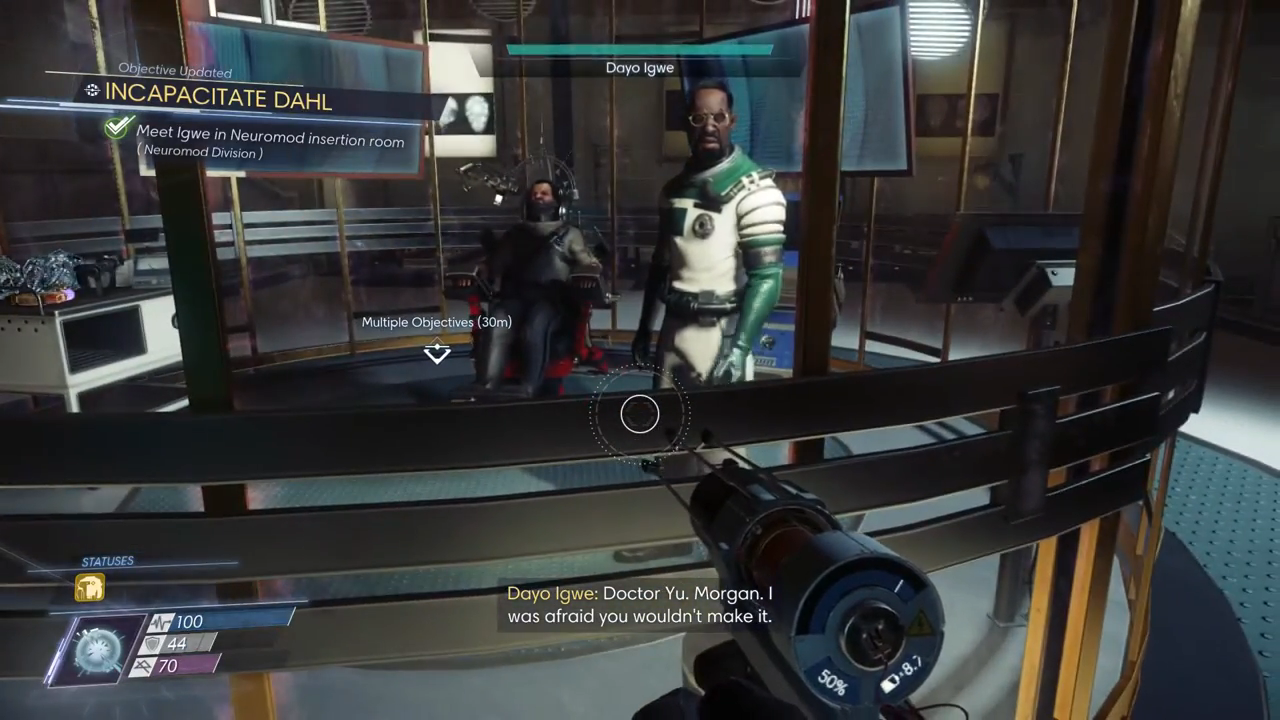
Dialogue — official English, as shown
Dayo Igwe: Doctor Yu. Morgan. I was afraid you wouldn’t make it.
Objective Updated — Incapacitate Dahl
Completed: Meet Igwe in Neuromod insertion room. (Neuromod Division)
Other English-capture labels and state: Dayo Igwe appears beneath the top health bar; the waypoint reads Multiple Objectives (30 m). Statuses accompanies a yellow suit-shaped icon. The HUD shows health 100, suit integrity 44, psi 70, an ability icon, and a weapon display reading 50% and 8.7.
Source-capture reading: “Dayo Igwe: Doctor Yu. Morgan. I was just very worried you wouldn’t come.” Its objective banner reads “Objective Updated — Subdue Dahl”; the checked step reads “Go to the neuromod insertion room to meet Igwe. (Neuromod Division).” The HUD shows health 73, suit integrity 93, psi 80, an ability icon, and weapon counters 42 / 397; the GAMERSKY watermark is retained in the original. The English capture preserves the greeting and completed meeting step, not the original camera position, equipment, or HUD values.
Editorial note: The source alt text describes “Morgan and Alex Yu in the laboratory.” The identification has been corrected to match the image.
IV. Disembodiment, Embodiment, and “Body Three”
What Ihde’s division of the body fundamentally investigates is how technology and sociocultural factors affect embodiment and disembodiment. In D. R. Koukal’s view, Ihde is in fact distinguishing a “phenomenology of embodiment” from a “phenomenology of disembodiment.”[5] The phenomenology of embodiment examines how technology modifies or enhances the body’s perceptual capacities; the phenomenology of disembodiment examines how technology “projects” the body and thereby objectifies it.5 Ihde points out: “Embodied and disembodied phenomenologies analyze the ways we experience being a body or being a virtual body. What I have tried to show is that these two experiences differ, and to show that difference in different ways within a lifeworld woven by technology.”1
This opposition between embodiment and disembodiment is expressed chiefly in the relationship between bodies one and two. “The body in action, here, supplies the central reference point for my body. This is the body of real life, as opposed to the more passive or marginal virtual body that shifts toward a quasi-disembodied perspective.”1 For Ihde, when technology acts on the body to transform or enhance perception, for example, it is an embodied technology. When it objectifies, marginalizes, or turns the body into an image, it is a disembodied technology. This mode of analysis is often used to address virtual and real bodies in cyberspace, but it cannot accommodate every situation commonly studied in relation to technology and the body. Critics argue that its binary division merely modifies and repairs the subject–object structure established by Descartes without escaping its confines. In response, Melissa Clarke calls Ihde’s “third dimension” “body three”: the technological body. Within body three, technology and the body interact. Body three itself constitutes technology and is, in turn, constituted by it.[6]6
The emergence of body three truly breaks with a one-dimensional explanation of the body. Beyond this, Andrew Feenberg also proposes an “extended body,” which is “not only the body that acts through a technical mediation, but also a body that signifies itself through that mediation.”[7]7 This sense of extension is more closely attuned to the ontological characteristics of posthuman existence. As N. Katherine Hayles writes in How We Became Posthuman: “the posthuman view thinks of the body as the original prosthesis we all learn to manipulate, so that extending or replacing the body with other prostheses becomes a continuation of a process that began before we were born.”[8]8
In Prey, body three is likewise represented through bodies one and two. To see this, Morgan must return to the testing space discussed in relation to body one. An email mentions that Morgan once passed the entire test perfectly using powers acquired through neuromods. After obtaining the relevant neuromod ability upgrades, Morgan can choose to return to the testing space, repeat the earlier tests, and attempt to reproduce what the email describes. This arrangement guides Morgan, now equipped with knowledge of the technology, toward reasoning backward through the test’s design: the same outcome is rejected when achieved through body one but accepted when achieved through neuromod abilities. Only now can the full logic of the test finally be pieced together. Its significance lies in distinguishing the eras before and after the emergence of body three. Constructed through the internalization and concretization of technology, body three also appears elsewhere in the game. For example, after Morgan learns too many Typhon abilities through neuromods, Talos I’s automated security system identifies Morgan as a hostile target and attacks. In this process, the security system’s criterion shifts from a human–nonhuman distinction to one between low and high levels of Typhon technology. This also symbolizes a shift from an orientation toward body one to an orientation toward body three.

V. Constructing Morgan Yu
In analyses of conventional cyborg figures, dividing the body often places disembodiment in the position of the central signifier. The divergence between virtual space and the material world tends ultimately toward the transhumanist concretization of virtual existence. Body one, as a physical existence, becomes merely something to be replaced by a more efficient machine or some other virtual representation. The material body is disparaged as a fetter, a burden, superfluous flesh, while the virtual will achieves immortality in cyberspace.
Yet Prey’s construction of Morgan Yu breaks precisely with this conventional judgment. At the beginning of the game, Morgan—body one, without any a priori knowledge—is placed in Talos I. After this, the “original” virtual Morgan(s)—body two—begin to appear around the real Morgan. The entire course of the game is, in fact, an unceasing practice of technology. Morgan acquires different abilities by installing different neuromods, internalizing technology through interactions with the surrounding environment. This internalization is, in turn, manifested in those interactions, and body three is gradually constructed in the process. In this gradual, sequential construction, the separate presentation of bodies one and two proves that different bodies can exist in different spaces while experiencing the same reality, each possessing its own independent subjectivity. This has already, to some extent, dismantled the opposition between disembodiment and embodiment in the construction of the body. With the final construction of body three, the blurring of boundaries and the dismantling of a semiotics of opposition are fully realized. Hollinger holds that this “connection between humans and machines fundamentally eliminates the centrality of the human body, as well as the sacred icon of the essential self,” thereby completely deconstructing the modern, humanist dichotomy between body and technology.[9]1
Morgan’s construction thus breaks completely free of the binary models of disembodiment and embodiment, the phenomenological body and the cultural body. Just as the figure of Morgan takes this form, the philosophy of technology should perhaps likewise move toward a broader, multidimensional approach to the relationship between body and technology. That direction is the study of body technologies and body politics. As with the “extended body” discussed in relation to body three, all technology implies the intentionality of “the body using technology.” In Morgan’s construction, every technology appears through the learning of “skills (techne)” by means of neuromods.[10] Viewing technology from a perspective not centered on technical artifacts allows us, in fact, to recognize more clearly the effects of an intrinsic isomorphism between technology and the body. The body can be regarded as the site where all technology originates and develops: it generates not only technology within the body—that is, body technologies—but also technology that accompanies the body—that is, external technological systems and technical artifacts. This perspective not only effectively avoids either–or dualism and the narrowness of research confined to particular technologies; it also offers fresh ways of thinking about the relationship between body and technology, and about the body itself.
References
The source bibliography is retained below, with formatting standardized. Bracketed editorial additions identify verified titles and editions without silently replacing the historical entries.
- prey.fandom.com
- Lee M. Silver, Recking Eden: Cloning and Beyond in a Brave New World (New York: Avon, 1998), pp. 256–57. [Editorial identification: the title is Remaking Eden: Cloning and Beyond in a Brave New World, first published in 1997; see Princeton’s author profile. The source’s 1998 edition date and cited pages are retained.]
- Armin Grunwald, ed., Handbuch Technikethik, pp. 290–92. [Editorial identification: these pages fall within Johann S. Ach and Beate Lüttenberg’s “Human Enhancement,” pp. 288–92, in the 2013 first edition, J. B. Metzler, Stuttgart.]
- Don Ihde, Bodies in Technology (Minneapolis: University of Minnesota Press, 2002).
- D. R. Koukal, review of Bodies in Technology, Technology and Culture 43, no. 4 (2002): 837–38. DOI.
- Melissa Clarke, “Philosophy and Technology Session on Bodies in Technology,” Techné: Research in Philosophy and Technology 7, no. 2 (2003): 120–24. [Editorial note: this pagination appears in the PDC edition; the Virginia Tech PDF uses pp. 94–101.]
- Andrew Feenberg, “Active and Passive Bodies: Comments on Don Ihde’s Bodies in Technology,” Techné: Research in Philosophy and Technology 7, no. 2 (2003): 1–6. [Editorial note: pp. 1–6 match the author-hosted PDF; the Virginia Tech PDF uses pp. 102–9.]
- N. Katherine Hayles, How we become Posthuman: Vitural Bodies in Cybernetics, Literature, and Informatics, University of Chicago Press, 1999, p. 3. [Editorial identification: the correct title is How We Became Posthuman: Virtual Bodies in Cybernetics, Literature, and Informatics.]
- Veronica Hollinger, “Cybernetic Deconstructions: Cyberpunk and Postmodernism,” Mosaic 23, no. 2 (1990): 29–44.
- S. Lettow, “Somatechnologies: Rethinking the Body in the Philosophy of Technology,” Techné: Research in Philosophy and Technology 15, no. 2 (2011): 110–17.
Original publication notice: This article is the author’s original work. Reproduction without authorization is prohibited.