By Shi Wenzi · November 18, 2020
This article was a prizewinning entry in the pre-event celebration for Lab on Roof’s “Rags Drum 2020.”

Preface
The spine-chilling black hole in that “plop toilet” could almost stand alongside “the man who kidnaps children” and “the bottomless swamp deep in the forest” among the greatest terrors in my imagination. —“Memories of Toilets,” The Sun and the Maiden1
We can readily see the humor in Tomihiko Morimi’s works at a glance. When we first begin reading, for instance, the first thing Morimi does is explain words he has created that look extraordinarily abstruse and unfamiliar, such as “four-and-a-half tatami.”2 It feels as though he is offering nonsensical explanations in a solemn tone. Beginning to read Morimi also brings a sense of novelty, even unease: new readers feel they have suddenly wandered into a world that is ordinary yet peculiar. The feeling is even somewhat like reading Kafka’s The Metamorphosis. But as we read on, we discover that it is nothing of the sort.
Yet if we take the question of why Morimi’s works are funny on its own, it is hard to answer in a few words. We might attribute their humor to his rich imagination, but that does not explain the mechanism by which the humor is generated. After all, a writer can use his craft to produce humorous sentences that make readers unable to resist laughing. This shows that he can clearly establish an empathetic connection with them, but he need not actually understand where that connection comes from. All he needs to do is put the amusing ideas that occur to him down on paper. The central concern of this essay, then, is to unravel a certain resonance between author and reader at the level of humor.
Humor and Theories of Humor
In tracing the sources of humor, we cannot bypass the most fundamental question: what exactly is humor?
The Chinese word for “humor” in modern use comes from the English humor. It describes something deliberately intended to make people laugh. Its meaning does not specify what causes the laughter, but it must, by some means, prompt the recipient of information to display sudden pleasure. Accounts of humor’s causes fall into three main theoretical categories: superiority/contempt theory, relief theory, and incongruity theory. Superiority theory grounds humor in resentment, contempt, and superiority; relief theory attributes it to the release of tension and psychological repression produced by social constraints; incongruity theory holds that humor arises from “inconsistent, unsuitable, or incongruous parts or circumstances, considered as united in one complex object or assemblage, or as acquiring a sort of mutual relation from the peculiar manner in which the mind takes notice of them.”3 Incongruity theory can account for the vast majority of humor. This does not mean it is absolutely correct. Still, we cannot deny that it has been put to use in many specific theories of humor, giving us a powerful analytical tool. My analysis of Morimi’s works uses incongruity theory while also drawing on the other two theories.
When we classify humor, we find that different kinds give us different feelings. We often notice, for instance, a certain difference between humor in novels and the humor of everyday short jokes. Both give readers or listeners a sense of pleasure, but humor in novels seems far more complex. Consider the following examples:
Little Robert asked his mother for two cents. “What did you do with the money I gave you yesterday?”
“I gave it to a poor old woman,” he answered.
“You’re a good boy,” said the mother proudly. “Here are two cents more. But why are you so interested in the old woman?”
“She is the one who sells the candy.” —“good boy”
“She won’t want to come back to a place like this.” No sooner had I said this than Sensei let out a loud fart. It was so loud that even Sensei was startled, and he could not help letting out an “Eh?” —The Eccentric Family
Comparing these two examples, we see that in the joke the boy has actually given the old woman money to buy candy, not to help her. Readers quickly grasp the point through this turn in the plot. By contrast, a passage embedded in the context of a literary work contains a distinctly different kind of humor. It is richer and more complex, so much so that when we extract a passage on its own, its humor seems decidedly crude. This is because we have overlooked how humor manifests itself in the elements of the novel. The portrayal of Sensei here, for example, is bound up with his characterization; its humor extends beyond the passage to the work as a whole. Put another way, humor often arises not merely from a sudden change or shift in relevance, but also from something comic.
Looking at both its causes and its classification, we find that humor is a complex product. Rather than offer further explanations of its causes, this essay seeks to analyze humor from several levels and perspectives: the individual passage; the work as a comedy in its entirety; elements running throughout the works (“custom-defined nouns”);4 and literary ideas.
Humor at the Level of Cognitive Pragmatics—Morimi’s Works as a Succession of Short Jokes
Many passages from Morimi’s works retain a strong sense of humor when excerpted. The humor in some individual passages therefore does not depend on the surrounding text. The simplest approach is to take these passages out and study them separately. The principal theoretical basis for this analysis is the relevance theory proposed by Sperber and Wilson in Relevance: Communication and Cognition.
Relevance theory proposes that linguistic communication is a cognitive process that must rely on inferential thinking. It contains two principles: the Cognitive Principle (people tend toward optimal relevance in cognition) and the Communicative Principle (acts of communication should be presumed to have optimal relevance in themselves).5 In other words, speech, as a purposeful activity, is an ostensive-inferential cognitive process. In this process, both parties tend to seek optimal relevance at the lowest cost, and believe the other party has the same tendency. The degree of relevance depends on cognitive effects—that is, effects on the existing context—and the difficulty of processing.
From the perspective of relevance theory, communicators often provide the necessary information while recipients infer the intentions implicit in it. When recipients receive information, they usually begin by inferring the communicator’s intention on the basis of maximal relevance. As the communicator supplies more and more information, recipients continually adjust their inferences to arrive at optimal relevance. Many humorous effects arise from the difference between the maximal relevance previously inferred and optimal relevance. This difference constitutes an incongruity. The theory can accommodate and analyze almost every humorous passage. In Morimi’s works, for example, we find the following kinds of humor, though these are by no means exhaustive.
(1) Humor Arising from Differences in the Context of Expression
This is what I have become, but let me say at the outset that I was not born this way.
Just after I was born, I was, on the contrary, purity itself. [Passage omitted] … Why have you come to this? Is this the reckoning for your life?
Some people will probably say: you’re still young, after all; life holds endless possibilities.
What utter nonsense. Young people must not be spoiled. —The Tatami Galaxy
The humor here works as follows. The first two paragraphs describe the sorry state the narrator is now in. When the third turns to other people’s words of encouragement, we would normally expect the narrative to take a positive turn—the familiar movement of first bringing something low in order to raise it up. At the very least, the narrator ought to appreciate their good intentions in comforting him. In other words, the maximal relevance as readers understand it is that the fourth paragraph will offer a positive narrative. Instead, it refutes the hopeful words of the third paragraph. The protagonist’s assessment of his own situation has reached the point of hopelessness, beyond all remedy. Contrary to expectation, optimal relevance lies in expressing his desperate situation.
(2) Humor Arising from Densely Layered Figures of Speech
“Use too much, and every dish turns into curry.” This succinct description cut straight to the heart of the matter. The situation was serious enough to require a mature adult to warn us, “You must control the amount.” To think curry powder was so dangerous! I could almost see the curry demon lurking deep in the forest. —“The Curry Demon,” The Sun and the Maiden
The initial quotation, “Use too much, and every dish turns into curry,” clearly contains hyperbole. Ordinarily, we do not use figures of speech in such density, particularly by nesting one inside another. Here, however, the passage uses hyperbole and then figuratively recasts a statement that has already been exaggerated. This is highly unusual. From the perspective of relevance theory, its way of using figures of speech does not conform to the Communicative Principle, because it seems highly redundant at the level of meaning. When readers consider maximal relevance, then, they will assume that the “curry demon” matters a great deal: that “curry demon” has a deeper meaning than “dangerous”—the more vivid meaning produced by the figurative comparison. Appearing where it seems redundant, an expression like “curry demon” instead takes on a childlike charm.
(3) Humor Arising from the Unexpected Reuse of Nouns
“The Idaten Kotatsu is another nuisance.” “The Idaten Kotatsu?! A kotatsu is a kotatsu—what has Idaten got to do with it?” “A bunch of oddballs carry a kotatsu around campus. They appear and disappear without warning, so it’s called the Idaten Kotatsu.” —The Night Is Short, Walk on Girl6
This passage explains the origin of the name “Idaten Kotatsu” through dialogue. Idaten is a Buddhist deity known for his running. Combining “Idaten” and “kotatsu” into a new term is already a very unexpected move. In this passage, readers are more inclined to see it as an expressive device than as the actual creation of a new word, because the name does not sound like a serious term. Unexpectedly, Morimi goes on to repeat “Idaten Kotatsu” frequently. Only then do readers realize that it is already being used as a name. Optimal relevance consists in calling the kotatsu carried around campus the “Idaten Kotatsu,” rather than seeing the expression merely as a figurative comparison.
Morimi’s novels use this device extensively elsewhere, too, with expressions such as “four-and-a-half tatami,” The Stubborn King, and “proxy war.” Continually piling these novel nouns on top of one another greatly enhances the story’s expressive force.
It is worth noting that although relevance theory can analyze the humorous elements in the vast majority of passages, it cannot overcome one limitation: ultimately, it analyzes how a passage affects context and cannot grasp the larger entities that exist as elements of a novel. That is, this kind of analysis always branches outward. It does not connect all the events involving a single character, and pays insufficient attention to the context the text constructs. It is therefore rigorous but also limited. I use relevance theory here to offer one way of explaining the mechanisms that generate humor at the most basic level.
Analyzing Humor through the Comic—Morimi’s Literature as a Kind of Comedy
As Hegel says, “Any contrast between essence and appearance, or between purpose and means, can be called laughable if it reveals a contradiction or disproportion that consequently leads the appearance to negate itself, or causes the opposition to come to nothing in its realization. But the comic makes a deeper demand.” If we regard a work as a collage of insubstantial humorous episodes, we will naturally overlook certain aspects of it as a whole. The most important of these is the comic.
In Hegel’s thought, substantiality is the totality of universally rational moral powers, the highest good in law and subjective morality. Subjectivity, by contrast, does not contain the objective content of ethical substance, but is merely a standard of good and evil generated within the individual. In comedy, “subjectivity” is the principal factor, while substantiality is kept out of view. In tragedy, it is substantiality that operates.
Viewed through Hegel’s aesthetic theory, The Tatami Galaxy is not a typical example. If we take the “rosy life” in the protagonist’s mind as a form of substantiality—an idea concerning social status and personal value—then we can say that substantiality is present throughout. At first, the protagonist feels himself far removed from actual value, and there is even something tragic about this. As the story progresses, however, a tremendous change takes place: it depicts the absurdity of continually pursuing substantiality. Through an absurd form of induction, it repeatedly plays out tragedies with the same ending—or what the protagonist considers tragedies. Only when he finally views all this from the perspective of a parallel space-time of infinite four-and-a-half-tatami rooms does he understand that the “rosy life” he longs for does not exist. In short, the comic quality of The Tatami Galaxy consists not merely in comedy itself, but also in the dissolution of a certain tragic paradigm.
Hegel briefly discusses three kinds of content that can be the subject of comedy. These are also worth discussing in the context of Morimi’s literature, and I will analyze them in detail here.
(1) The purposes and character traits portrayed in comedy are entirely without substantiality, yet contain contradictions and therefore cannot realize themselves. In The Tatami Galaxy, the protagonist’s longing and greed for a nonexistent “perfect rosy life” are one source of the comic. Because this “perfect rosy life” is abstract and nonexistent, and because he has also relinquished his satisfaction with his current life for its sake, he not only fails to reach his goal but gives up too many valuable things and opportunities. The comic situation lies in the fact that, after he discovers that he cannot attain an ideal state of life, his exchange with Ozu is reversed in the final cycle: the two speakers take each other’s lines.
In the earlier cycles, the protagonist still yearns for a perfect life:
I demanded to know what fun he got out of [making sport of]7 lovable little me. Ozu wore his usual goblin-like smile and chuckled. “This is my love for you.” “I don’t need this filthy stuff,” I replied.
By the end of the story, the protagonist realizes that what he has been pursuing is empty and illusory. He can cheerfully disregard this failure, feeling that he stands above it.
“Enough talk. Let me pay!” “Why are you so eager to pay?” I gave him a sly grin. “This is my love for you.” “I don’t need that filthy stuff,” he replied.
(2) Individual characters intend to realize purposes and traits that have substantiality, yet, as individuals, they are instruments that work entirely against their realization. We find this form of the comic in Morimi’s works, but ultimately it is dissolved, and readers are deliberately led to misread it. In The Night Is Short, Walk on Girl, for instance, the Underpants Ringleader vows not to change his underpants until he finds the girl he has fallen for. This seems to fit the category, but from beginning to end it never actually affects the plot of his meeting the girl. Of course, if we examine the details of the animated adaptation, we can find situations in which “the individual works against the realization of his purpose.” The animated adaptation of The Night Is Short, Walk on Girl, for example, adds a scene in which the protagonist tries to retrieve his trousers from Rihaku’s tram. Just then, the tram pulls away. Unable to get his trousers, he appears before the heroine naked from the waist down. Having gone to immense trouble to reach her, he is punched into the water by her “Fist of Friendship,” leaving a bad impression.
Why do we find so few clear instances of this form of the comic in Morimi’s works? One important reason is that Morimi’s literature does not give prominence to overly pointed social issues. It often centers on the individual, and its endings, too, are often not tragic. When creating characters, especially male college students, Morimi never ridicules the group because of some behavior of theirs—he was one of them himself, after all. But neither does he evade some of their more outrageous conduct. He often begins by giving the story this comic quality, as most stories do, before treating it in a positive way. His ultimate hope is to find an ingenious way of bringing readers to sympathize with these characters rather than ridicule them freely from the outside.
(3) External contingencies bring about intricate changes in the situation, allowing purposes to be realized. Both the characters’ inner traits and their external circumstances become comic contradictions, leading to a comic resolution. We can readily see that every cycle in The Tatami Galaxy is ultimately handled this way. The decisive turn always hinges on two elements: “Akashi is afraid of moths” and “the protagonist has the Mochi Bear she lost.” Both of these arise by chance.
Morimi is also adept at combining coincidence with conspicuously complex relationships among characters to produce a comic scene. At the end of The Eccentric Family, for example, when the tanuki hold a council of elders and elect their “Nise-emon,” the people in the private dining room next door turn out to be members of the Friday Club, preparing to feast on tanuki. They have moved their banquet here at short notice because of the earlier chaos. When Yaichirō turns into a huge tiger in his rage, he destroys the partition between the rooms. This coincidence gives Yasaburō an opportunity to rescue his mother and makes the atmosphere of the prose lighter and more humorous. The following scene ensues:
Everyone in the private room next door, from the elders to the senior officials, was huddled together. At the warning cry, “The Friday Club is here!” the room filled with inarticulate wails. In their panic, the tanuki reverted to their true forms, and countless balls of fur appeared in the room. It was like a carpet writhing across the floor. Professor Yodogawa burst in among them, shouting, “Sorry! Sorry!” Without meaning to, he sent quite a few furballs flying with his feet. —The Eccentric Family
Chance incidents are not merely a form of the comic; they are a device commonly used in stories of any kind. As we can see above, Morimi’s literature does indeed use these “incidents” to reveal something novel.
“Custom-Defined Nouns” and a Richly Developed Narrative Structure
Having analyzed Morimi’s literature broadly through individual passages and the work as a whole, we need to examine some of its distinctive features in greater detail. To my mind, a prominent feature is the use of “custom-defined nouns.” Earlier, I used relevance theory to analyze the incongruity of their appearance, but that was an examination of their meaning within an individual passage. Their role, however, is not limited to the moment they appear in the text. They also serve the narrative of an entire work, and even of all the works. They are not merely isolated figures of speech within passages, but elements of the novel’s narrative. Some examples of these “custom-defined nouns” follow.
(1) Nouns Explained Once and Used Repeatedly
Examples: “the Fist of Friendship,” “the Underpants Ringleader,” “the Friday Club,” and so on.
Do you know the Fist of Friendship? When people have no choice but to swing a fist at the face of someone beside them, they clench it tightly. … But now, loosen your fist, and try making one with your four fingers wrapped around your thumb. All at once, that hard, powerful fist loses its confidence and becomes as full of affection as the paw of a beckoning cat. … Her older sister had taught her the “Fist of Friendship” when she was little. Her sister said, “… Only with the Fist of Friendship can you live gracefully in this world and open up a beautiful, harmonious life.” A beautiful, harmonious life. Those words touched her deeply. And so she has the special move known as the “Fist of Friendship.” —The Night Is Short, Walk on Girl
This passage at the beginning of the work explains what the “Fist of Friendship” means: a way of throwing a punch that is “full of affection.” The “Fist of Friendship” portrays the heroine as an innocent who longs for beauty and harmony. The account is lively, amusing, and convincing. Later, when she encounters Mr. Tōdō’s harassment, the words “Fist of Friendship” allow her to remain graceful while also expressing her decisiveness. As an expression, it is novel, too.
(2) Nouns Explained Repeatedly and Used Repeatedly
Examples: “Pseudo–Denki Bran,” “cat ramen,” and so on.
“The recipe for Denki Bran is a closely guarded secret. An employee of the Kyoto Central Telephone Exchange once tried to reproduce its flavor. After endless experiments, at his wits’ end, he miraculously invented Pseudo–Denki Bran. Because it came about by accident, its flavor and aroma are completely different from those of Denki Bran.” —The Night Is Short, Walk on Girl
Poured into a glass, the Pseudo–Denki Bran was as clear as water, with a faint orange tint. I took the glass in my hand and sniffed gently, and for a moment I thought an enormous flower had appeared before my eyes. —The Night Is Short, Walk on Girl
This mysterious Pseudo–Denki Bran receives extensive treatment in The Night Is Short, Walk on Girl, emphasizing its air of mystery. It is no longer a particular liquor but something Morimi has created. In the drinking contest with Rihaku, Pseudo–Denki Bran acquires another layer of value: it is understood as a fragrant flavor that brings warmth to life. This further reinforces its distinctive properties. Then, in The Eccentric Family, something called a Denki Bran factory appears. It is treated as an ordinary part of their world and left unexplained, immediately heightening the novel’s fantastical quality.
From these examples, we can infer a certain pattern for “custom-defined nouns.”
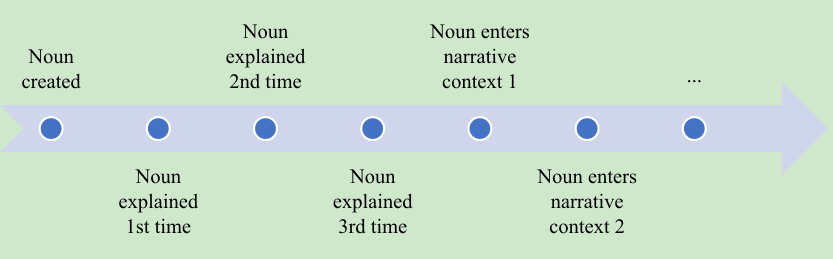
When a noun is created, it first has a certain literal meaning. “Idaten Kotatsu,” for example, is, as the name suggests, a kotatsu that runs about. The head of the festival office explains that it is a real headache for the office: this gives it its first explanation. When he discovers that the Idaten Kotatsu is being used to write the script of The Stubborn King, it receives a second explanation. At the same time, it also enters multiple narrative contexts: the series of events that unfold when the heroine happens upon the group; the soy-milk hot pot on the kotatsu; Higuchi using it as a base from which to resell books for profit; or the romantic figure of the Underpants Ringleader as he writes his script there.
What, in concrete terms, do nouns of this kind do? We might begin with an ordinary noun referring to a material object. Consider a “door key.” When it appears in a text, what comes to mind is probably something that opens a particular door, consisting of a long part that goes into the lock and a short, thick part that we hold. This is abstract information drawn from our previous encounters with keys. Similarly, when we see the sentence “He walked up to the door with a door key in his hand,” we usually assume that he is about to unlock the door. This, too, follows from our experience of keys as objects. In other words, besides what it refers to, a noun contains many properties we have attributed to it. The noun thus becomes a carrier of numerous properties.
A “custom-defined noun,” meanwhile, may initially be a combination of two existing nouns. That is, it may already contain some of the properties originally possessed by both nouns. But this does not mean it has many properties. On the contrary, it is an unknown to readers, because it has not yet been explained: everything experience suggests remains only a possibility. “Custom-defined nouns” sometimes also narrow a definition. The “Idaten Kotatsu,” for instance, refers specifically to that one kotatsu. This allows all these referents to be understood as entirely new things. As they are described and participate in the narrative, they are continually endowed with new properties. In a sense, this device is more commonly used in characterization, but Morimi applies it extensively in depicting the people or things to which nouns refer. Objects ought ultimately to serve characterization. Yet Morimi sometimes treats objects as narrative subjects in their own right, keeping the people to be portrayed through them out of plain sight. Ultimately, he spreads the objects’ sense of wonder throughout the social environment the work depicts. This device may be a source of the bizarre, kaleidoscopic quality of Morimi’s works and their distinctive sense of incongruity.
A Tentative Case Study of Humor and Theme—The Tatami Galaxy
When we analyze the humorous features of Morimi’s works, close reading of the text itself is not the only approach. The themes running through the works also contain humor: self-mockery that may extend to the readership, or a sense of superiority over the characters. Because their themes differ, each work may require separate examination. Here, then, I will attempt a case study of The Tatami Galaxy.
The Tatami Galaxy exemplifies the college-student subject matter that Morimi uses so widely. It mainly depicts a protagonist who expresses a longing for a “rosy college life” but actually lives what he considers a thoroughly miserable one. He believes that his most important problem is his troublemaking friend Ozu. Only through one cycle after another does he finally realize that he can never attain an ideal state that does not actually exist. Giving up this ideal and enjoying life in the present instead is one answer The Tatami Galaxy offers.
Having a college student as the protagonist directly expresses a predicament college students face in their lives. Throughout the work, the root of that predicament is depicted as an extreme imbalance between idealism and reality. As we found through Hegel’s theory of comedy, the ending of The Tatami Galaxy breaks with the tragic narrative and strengthens its comic quality. Before the ending, however, the protagonist experiences a continual tragedy of “time lost beyond recovery.” In the first half of each story, he even resembles “the most wretched college student, caught up in one upheaval after another.” This draws out and awakens a shared experience. On this basis, readers slip into feelings of superiority or self-mockery while taking satisfaction in an answer the work offers that seems entirely reasonable: accept the gap between reality and the ideal, and enjoy reality.
This one-size-fits-all answer does provide a kind of humor, but it actually contains a dramatic ambiguity. The Tatami Galaxy posits “endless four-and-a-half-tatami rooms” through which one can learn all of one’s own possibilities. Only after the protagonist has continually wandered through them and observed all manner of lives he could lead does he finally recognize that he has no way of reaching an unattainable ideal state. His ideal differs from all ideals that can be pursued: it is merely a perfect state already known to be beyond reach. In reality, however, ideals are often attainable. What needs to change then is our frequent inability to move forward courageously. It is not as simple as casually making peace with ourselves. We could say that if these concepts are conflated and applied to real life, in extreme cases this leads to a fatalism that cancels one’s own agency.
From another perspective, the ideas expressed in The Tatami Galaxy seem to imply a critique of systems that construct a single standard of evaluation. The work also seems to try to express a hope that a multicultural consciousness might act on individuals. The ideal of “perfection” is defined and constructed by power. The ultimate response to its unattainability may be to pay it no heed and construct a pluralistic system of values. This concerns an awareness of the debate over pluralism in Japan, a country that has long been monoethnic.8 The diverse civilizations brought by globalization have made Japan increasingly conscious of the question of a “multicultural society,” and this seems to lie hidden within the theme of The Tatami Galaxy. Within the university system as a whole, the protagonist occupies something like the position of an “outsider.” Just as the perfect life is forever out of reach, the outsider can never become a member of the Japanese ethnic group.
The problem here, however, is that The Tatami Galaxy addresses its expectation to the “outsider.” This resembles a sermon urging accommodation—a forced acceptance of existing social conditions. It does not attempt to construct a multicultural society but to change the mindset of individuals excluded from the community. If readers grasp this idea, humor then comes to arise from a form of cynical mockery: it does not solve the problem, but instead feigns self-deprecation and strikes a pose of cynical irreverence.
Conclusion
Humor is a complex field of analysis, and its causes have yet to receive a fully unified explanation. Drawing on the three major theories of humor, this essay has therefore tried to proceed systematically through analytical theories and approaches from the micro to the macro level: relevance theory at the pragmatic level (the principle of optimal relevance); Hegel’s aesthetic theory at the level of the comic (comic quality); Morimi’s techniques at the narrative level (“custom-defined nouns”); and a case study at the thematic level. It has attempted, through these separate discussions, to reconstruct in full the humorous elements that appear in literary works. This process shows that works can manifest humorous elements at every level, and that the causes and effects of these elements are distinct yet advance one another. For individual works, humor at the micro level may be similar, while the more macro-level humorous elements seem increasingly particular. At that point, some case-by-case analysis may be needed to explain them.
References
- Cai Hui and Yin Xing. “A Review of Western Theories of Humor.” Journal article. Waiyu Yanjiu [Foreign Languages Research], 2005, no. 1: 5–8, 15.
- Wang Qinling. “A Cognitive-Pragmatic Study of Humorous Utterances.” Thesis. Fudan University, 2005.
- Liu Yang. “Humorous Incongruity and Resolution in Harry Potter from the Perspective of Relevance Theory.” Thesis. South-Central Minzu University, 2011.
- Wang Zefang, Zhang Xiaobo, and Li Jun. “An Analysis of Humorous Discourse in Talk Shows from the Perspective of Relevance Theory.” Journal article. Zhongguo Baoye [China Newspaper Industry], 2020, no. 6: 78–79.
- Li Teng. “Interpreting Verbal Humor in English Jokes from the Perspective of Relevance Theory.” Journal article. Nongjia Canmou [The Farmer’s Adviser], 2020, no. 3: 226, 291.
- Wang Ying. “An Analysis of Verbal Humor in Friends from the Perspective of Relevance Theory.” Thesis. Xi’an International Studies University, 2019.
- Hegel. Aesthetics. Monograph. Beijing: The Commercial Press, 2006.
- Zhang Tianqi. “On the Aesthetics of Drama in Hegel’s Aesthetics.” Thesis. Shandong University, 2019.
- He Wenhui. “A Preliminary Inquiry into the Thought of Hegel’s Aesthetics.” Journal article. Xiju Zhi Jia [Home Drama], 2015, no. 11: 256–257.
- Sheng Baihui. “Tracing the Origins and Spiritual Content of Expressionist Art.” Journal article. Wenhua Chuangxin Bijiao Yanjiu [Comparative Study of Cultural Innovation], 2019, vol. 3, no. 8: 16–17.