The Scavenging Strategy: Rags Drum 2020 Annual Essay Competition Results list this article as an accepted submission for the pre- and post-festival selections.
0. Introduction
Over the past two or three years, labels such as “yún viewer” and “yún gamer” have kept cropping up in Chinese-language internet communities. The prefix yún (云) literally means “cloud.”1 Generally, these expressions appear in discussions of ACG—anime, comics, and games. Take the “yún viewers” of an anime: the label usually refers to people who offer their own opinions, views, or insights about it without having watched it themselves, or without having watched it all. Sometimes, though, the “yún-X” family of labels is not limited to the explicit expression of opinions, views, or insights. The label “yún JoJo superfan,” for instance, sometimes describes people who know next to nothing about JoJo’s Bizarre Adventure itself but love playing with JoJo memes or declaring their love for the work.
In fact, people and phenomena of this sort are familiar in many other settings, and have even left interesting traces in different societies and cultures. Quite a few people in our fathers’ generation, for example, were “yún poets” during the poetry craze of the 1980s—at least, that was certainly true of many of those swaggering young lads who tried to get dates by writing poetry. In the Western world, the very publication of Pierre Bayard’s How to Talk About Books You Haven’t Read suggests, at the very least, that “yún readers” are hardly a rare breed. Among humanities graduate students around the world, some degree of “yún research” is actually the norm: who really reads every one of the hundred or even several hundred references listed at the end of a thesis? Clearly, these labels point to a kind of behavior. It is because an agent has performed a corresponding act of “yún behavior” that we call them a “yún-X.” If we want to analyze these labels conceptually and discuss the questions they raise, then, a better starting point is yún behavior itself. This concept will be the main focus of the argument here.
What, then, is “yún behavior”? This article answers the question in two ways. First, most thinking on the subject so far seems to have stopped at giving examples. A better answer would be ontological: it would explain which set of essential conditions makes yún behavior what it is. Here I offer a detailed ontological analysis to identify those conditions, aiming for enough clarity to make deeper discussion possible. A second worthwhile approach is to ask what we seek to accomplish when we use terms for yún behavior. Starting from these pragmatic aims, I analyze the pattern of inference implicit in them and point out its incoherence in real-world contexts. This reveals an internal heterogeneity in the concept of yún behavior as it operates in actual settings, within a unified ontological framework. That heterogeneity reveals an ambiguity in our use of “yún behavior” and related terms that we cannot afford to ignore.2
1. The Ontology of “Yún Behavior”
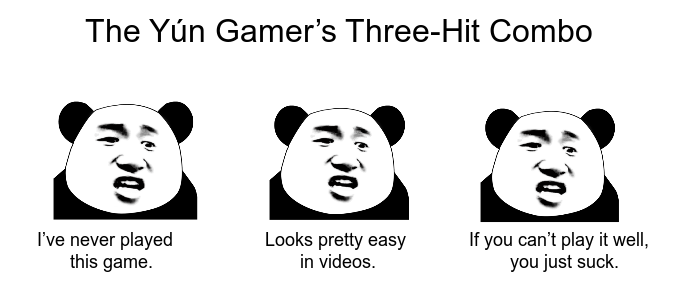
When examining an expression popular in internet communities, there is no better way to present it than through a visual example. In our time, memes are often the best indicators of what an expression does in use. The “Yún Gamer’s Three-Hit Combo” meme below shows how this concept is ordinarily used. Merely “giving examples” may help us get an initial grip on a concept, but it cannot make us truly understand the reality the concept represents, much less why that reality is what it is. In this section, then, I will work from a range of examples toward a general framework specifying the necessary and sufficient conditions for any act to be regarded as yún behavior.
1.1 Absence of Participation
Whether we are talking about an anime’s “yún viewers” or a game’s “yún gamers,” the first key point is that these concepts refer to a state in which someone has not actually participated in an associated activity. An anime’s “yún viewer” has not actually watched it (in full); a game’s “yún gamer” has not actually played it (in full). This absence of participation need not be publicly known. In many contexts, whether a subject has actually participated in an activity is a matter of inference rather than established fact.
1.2 Quasi-Commentness
Second, since we do not call ordinary people “yún-X” merely because they are indifferent to anime or games and therefore have not participated, yún behavior generally needs to show that the work matters personally to the agent in some way. This might take the form of “pontificating,” as in the image above; offering an opinion while pretending to have watched an anime; or deliberately expressing likes and dislikes while creating ambiguity through nonverbal acts, such as snapping discs, reposting on Weibo or Twitter, displaying purchases, and so on. What these acts share is that, to varying degrees, they constitute comments on works. Here, the works in question are both the objects of the associated activities and the works that yún behavior comments on. Although not every act of yún behavior can be considered a comment in the literal sense, all such acts at least function as comments in some sense. This gives us the second key point: yún behavior must exhibit at least a comment-like character—“quasi-commentness”—with respect to the work it concerns.
1.3 The Community as Public Context
Third, a further key point follows naturally from the first two conditions: a public context is necessary for the typical ascription of yún behavior.3 Yún behavior is different from hearsay. It must normally occur in a public context, where agents other than the person acting ascribe the description “yún-X” to that person; only then is the person’s act genuinely yún behavior. Suppose I have never watched Glasslip, but have heard about its reputation. One day, while alone, I see its title and cannot help saying, “This is a piece of shit.” Nobody else hears me talking to myself. In these circumstances, my utterance would normally not count as yún behavior; at most, it would be an opinion based on hearsay. But if I say the same thing in a QQ group chat whose other members have all watched Glasslip and all think it is a fine work, I am very likely to be regarded as a yún viewer.
Of course, there are further complications. Not just any public context will do for the ascription of yún behavior. Suppose I shout “Glasslip is a piece of shit!” in a university classroom. Everyone else in my class is a normie whose knowledge of anime stops at Miyazaki, while I am a gloomy fat otaku who knows anime inside out, has an obnoxious personality, and gets shunned by everyone. Just to oppose me, they might unanimously declare the anime a masterpiece and accuse me of being a “yún viewer.” In these circumstances, my remark is unlikely to be yún behavior. This thought experiment shows that, in the public setting required for ascribing yún behavior, those applying the “yún-X” label to the agent must at least be qualified to some degree.
But this does not mean that, in discussing these cases, we should treat “having watched Glasslip” as the only qualification required. In fact, actual participation in the associated activity is neither sufficient nor necessary for being qualified to apply the “yún-X” label. Consider this extreme case: three people, none of whom has actually watched Glasslip, start talking about it and agree that it is a piece of shit. I join the discussion. Not knowing their opinions beforehand and having great faith in the anime studio P.A.Works, I say that Glasslip is an excellent work. Instantly, all three start accusing me of being a “yún viewer.” Since I really have not watched it, and their assessment accords with the prevailing opinion across the major anime criticism communities, my act is clearly yún behavior.
Now consider a broadly similar case with the opposite outcome. I have not watched Glasslip, and I say that it is an excellent work. The other three have all watched it and think it is a piece of shit. But I am a “veteran anime fan” with more than twenty-two years of anime-watching behind me and considerable influence on many social platforms, while the others are just “newbies” who only started watching anime this year. The following is then very likely to happen: because of my experience and influence, as long as I do not reveal that I have never watched Glasslip, the other three will not accuse me of being a “yún viewer.” On the contrary, they may even begin to doubt their own taste.4
Clearly, finding a general standard may be very difficult; these qualifications are more likely to take a variety of forms. I will therefore simply use “qualified member” to cover agents who possess particular qualifications in a particular context. We can leave open such questions as what characteristics qualified members need and how to identify them. The public context required for the ascription of yún behavior can thus be described as follows: ascribing this kind of behavior requires a community of qualified members.
1.4 The Violation of Basic Beliefs
Fourth, we also need to consider the actual process by which yún behavior is ascribed. Suppose I make some comments about an anime on a forum of anime Brahmins.5 Ordinarily, even if I have not really watched it, I am unlikely to be regarded as a “yún viewer” as long as my remarks do not conflict with certain basic beliefs held within the community. These basic beliefs are not the same as the community’s mainstream opinions about the work; in many cases, they are beliefs about facts. If, for example, I say, “Miuna Shiodome, the heroine of Glasslip, is a well-drawn character,” I am very likely to be regarded as a “yún viewer.”6 If, however, I maintain that “Glasslip is the greatest masterpiece of all time,” I am more likely to be regarded as a troll. Of course, a substantial body of epistemological literature has already pointed out that there is no such clear-cut division between beliefs about facts and inferential beliefs expressing opinions. In some circumstances, inferential beliefs are basic too, and an agent who violates them may likewise be regarded as a “yún-X.” For instance, when “yún viewers” generally endorse an inferential belief , the community of qualified members may take not- as a basic belief, so that any act affirming will be regarded as yún behavior. In this sense, it is difficult to draw a boundary around basic beliefs. We can only describe them functionally: basic beliefs are beliefs such that, once an act violates them, the agent will be regarded within the community as not having participated in the activity associated with that act.
1.5 The Relation Rule
Finally, one problem remains: how can we describe more clearly the relationship between yún behavior, its associated activity, and the work it concerns? Doing so will also help us extend our conceptual analysis of yún behavior to a more general domain. The first key point we discussed was that yún behavior refers to a state in which the agent has not participated in an activity. But what exactly is this activity associated with yún behavior, in which the agent is “supposed to” participate? More precisely, how can we determine, in general terms, the associated activity of any act exhibiting quasi-commentness? In analyzing how these acts function as comments, I briefly mentioned that the associated activity involves the work that yún behavior comments on. That is not clear enough for the purposes of an ontological analysis. Now that we have clarified what a public context entails, we can give an account in terms of social construction by a community of qualified members. For a given act , a community of qualified members , an activity , and the work involved in that activity, is the activity associated with if and only if the following condition is met:
: functions in some way as a comment on , and collectively accepts that the agent’s participation in is a necessary condition for performing this act.
I call this condition the relation rule, . It describes, in any context, the activity associated with an act that exhibits at least quasi-commentness. Let us continue with Glasslip to clarify the relationship. Suppose I make the statement “Glasslip is a masterpiece.” My act of speaking is then a comment on the work Glasslip. Now suppose there is a forum made up of experienced, independently minded anime Brahmins. This community collectively accepts that a necessary condition for making the statement “Glasslip is a masterpiece” is that the speaker actually participate in the activity of “watching the anime Glasslip.” The activity associated with my act of speaking is thereby determined.
It is especially important to note that using to determine the association between act and activity is not redundant. Its main purpose is to cover, as far as possible, the different cases that arise in different contexts. We should not simply assume that the activity associated with can always be summed up as “watching/appreciating/playing the work,” since there is no one-to-one correspondence between an activity and the work involved in it. Imagine the following scenario: in January 2019, the well-known actor Chen Kun reposted a Weibo post about the anime film Fate/stay night [Heaven’s Feel] (hereafter HF), recommending the work. Unaware of certain earlier news about Chen Kun, a netizen sees this repost and writes on the forum platform Tieba: “He’s just doing this for the money, right? He’s a yún viewer, isn’t he?” Many respondents might well rebut this ascription of yún behavior by citing a Weibo post in which Chen Kun recommended Fate/Zero (hereafter FZ) several years earlier. His act of “reposting and recommending” functions as a comment on the HF film. Yet in this example the associated activity need not be “watching HF”: merely “recommending FZ” in the past is enough for that to serve as the associated activity. Such examples are not rare in practice. When public figures’ acts of commenting enter niche subcultures, the association between act and activity becomes looser and more casual, which in turn makes us more cautious about applying “yún-X” labels to public figures.
Conversely, among more specialized, hardcore enthusiasts, the associated activity required for an act may be more demanding and more complex, especially when the act concerns a work in a series. In a dedicated Tieba board or forum, for instance, the activity associated with commenting on the 2006 Fate/stay night anime may involve more than watching that anime. It will often also involve playing the source game, and may even extend to familiarity with other works in the same series. In highly specialized communities, a cursory acquaintance with a work may itself invite accusations of being a “yún viewer.” To accommodate these different contexts, I have therefore described the association between act and activity in as something constructed by a group.7
1.6 Conclusion
The analysis above outlines yún behavior sufficiently for us to offer the following ontological account. For any agent and that agent’s act , is regarded as an instance of yún behavior if and only if the following conditions are met:
occurs in a community composed of qualified members;
exhibits at least quasi-commentness with respect to a work ;
There is a version of in community that determines the activity associated with on the basis of condition ;
has not participated in , the activity associated with ;
violates the basic beliefs collectively accepted by community .
Note that this set of conditions does more than specify a real-world boundary between “yún viewers” and “non-yún viewers.” Like most social objects shaped through speech acts, yún behavior and its derivative concepts depend on constantly changing pragmatic habits for their determination in practice. The conditions proposed here should instead be understood as the metaphysical ground of “yún behavior.” They address its metaphysical essence in the most general sense. As we can see, that essence is not as simple and readily understood as the opening meme might suggest. An ontological analysis generally needs to encompass all instances as far as possible, which is why we must offer this somewhat complicated set of conditions to get a grip on it.
2. Heterogeneity in Pragmatic Aims
Another way to answer “What is yún behavior?” is to ask what people seek to accomplish by using these terms. Consider the question: when a speaker calls someone a “yún-X,” what are they really trying to do? The intuitive answer is that, since “yún viewer,” “yún gamer,” “yún fan,” and so on are all pejorative labels, the speaker aims to disparage someone. What, then, is the target of the disparagement these words express?
In the overwhelming majority of cases, calling someone a “yún-X” is directed not at a particular agent as such, but at that agent’s behavior. In a community of seasoned anime fans, it is my speech act—“Miuna Shiodome, the heroine of Glasslip, is a well-drawn character”—rather than me, the agent called “Animu Amateur,” that gets me labeled a “yún viewer.” Anyone else who says something similar is very likely to be regarded as a “yún viewer” too. The pragmatic aim of ascribing yún behavior is thus evident: it demands that certain acts performed by someone regarded as a “yún-X” be treated as unreasonable, at least in a particular context. Given that yún behavior always exhibits at least some quasi-commentness, we can be more precise: regarding some of an agent’s acts as yún behavior is meant to disqualify those acts as reasonable commentary.
In some derivative uses, treating certain groups as “yún-X” can also serve as an indirect comment on the work itself. We sometimes encounter statements such as “Only yún gamers would like this game” or “Most of the people who are always talking about this game are yún gamers.” Their substantive function is not to describe a state of affairs—usually that is not what interests the speaker—but to express a negative assessment of the work in question. Since a “yún gamer” is someone who has performed an act of yún behavior concerning a game, and yún behavior is not reasonable as commentary, the “yún gamer’s” liking for that game is itself unreasonable. In these circumstances, saying that “only yún gamers would like” a particular game logically implies, at a minimum, that there are no reasonable comments expressing a liking for it. The game that “only yún gamers would like” is therefore, in fact, a “piece of shit” that is not worth liking for any qualified commentator. In short, whether we directly classify acts as yún behavior or use labels such as “yún-X” to express an indirect assessment of a work, we rely on the same pragmatic aim at the level of metacommentary: yún behavior, considered as commentary, should be regarded as unreasonable, even beneath consideration.
This pragmatic aim presupposes a highly intuitive pattern of inference, which I call “firsthand experience to qualification for commenting,” or E2C. This pattern is substantially in keeping with common sense: it insists that actual experience of something is a necessary condition for evaluating it. “No investigation, no right to speak”; “What we learn from books still feels shallow; to know a thing fully, we must put it into practice ourselves.”8 E2C also has an evident connection with many traditional topics in epistemology. At the very least, it implies that experience is indispensable to the acquisition and justification of knowledge. Although our discussion here need not concern itself with these annoying philosophical disputes, we still need to recognize that, in the ontological analysis we have given, E2C turns on whether condition (4) is met. Yún behavior is to be disqualified as reasonable commentary precisely because the agent performing it has not actually participated in the associated activity—that is, the agent has not actually experienced the work being commented on. Conversely, E2C can also be seen as a diagnostic tool. Although participation in the associated activity cannot guarantee the reasonableness of an act of commenting, lack of participation can completely disqualify the act as reasonable commentary.
Yet in many instances of the ascription of yún behavior, E2C does not consistently function as a diagnostic tool. The very presence of condition (5) in the ontological framework above implies the possibility of counterexamples. Condition (5) allows for the following situation: even if an agent has not actually watched an anime or played a game, their act will not in fact be regarded as yún behavior as long as the content of its commentary accords with certain basic beliefs that go without saying within the community. In other words, as long as the content expressed by an act is sufficiently unremarkable, the act will not be disqualified as reasonable commentary, regardless of whether the agent has actually participated in the associated activity.
The current phenomenon of “parroting” in Chinese-language internet communities provides a good illustration. Whenever a much-discussed work appears in these communities, comments made early on reappear in large numbers, over and over, in discussions of the same topic. This applies to both positive and negative assessments. In recent years, examples of positive assessments have often involved Nintendo’s first-party games. From The Legend of Zelda: Breath of the Wild to Animal Crossing: New Horizons, which is still hugely popular at the moment, every Nintendo game that reaches beyond its usual fan circles receives a great deal of “bandwagon” praise. Many of the agents offering that praise have not actually played the games—something especially evident in engagement-driven accounts’ efforts to “ride the trend.” For a negative example of “parroting,” we can look to the spread of hostile comments following the negative assessments prompted by the Girls’ Frontline beta-testing incident a few years ago. Many agents who had not actually experienced the incident used problems with the beta as grounds for negative judgments. There were even disproportionately many self-proclaimed “third-beta veterans.” Both sets of examples share the following feature: at least in the context where the comments were expressed, many agents’ acts were very likely not to be regarded as yún behavior, even though those agents had never actually participated in the associated activity. When I post “Anyone who isn’t buying Animal Crossing, get out of the group” under an Animal Crossing video on March 25, 2020, or tell someone on Tieba in August 2016 that “MICA Team’s third-beta fiasco made me sick,” my behavior seems so commonplace, so unremarkable, that it does not conflict at all with the community’s basic beliefs. My behavior is therefore not yún behavior.
How should we understand these counterexamples to E2C? I think that, if we are unwilling to overturn E2C wholesale—after all, we should not lightly discard our common sense—what the counterexamples reveal is the internal heterogeneity of the concept of yún behavior. This heterogeneity arises because, in actually applying terms such as “yún-X,” we implicitly commit ourselves to two versions of E2C of different strengths. The strong version treats “firsthand experience” as a necessary condition for a comment’s reasonableness: only if an agent has really watched an anime or played a game can their act be reasonable as a comment, or can they be qualified to make a reasonable comment. Strong E2C is the version addressed by our counterexamples, and it is what this pattern of inference demands in principle.
A weaker version is also common in actual pragmatic contexts. Weak E2C accepts the transmissibility of “firsthand experience”: an agent invokes another agent’s experience, even experience passed on through several intermediaries, to meet the necessary condition for a comment’s reasonableness. In this case, so long as one is certain that the other agent really did participate in the associated activity, the agent making the comment automatically acquires the qualification to make a reasonable comment. Such transmission clearly has to satisfy further restrictions, of course. It is easy to see that the agent whose experience is invoked needs to be reliable to a considerable degree within the particular community. Nor can the necessary condition for reasonableness be met through the transmission of experience for every kind of comment. The crucial restriction is precisely what condition (5) shows: where the agent really has not participated in the associated activity, the transmissibility of experience can support only comments whose content is commonplace and unremarkable. Any content that goes beyond the community’s basic beliefs may lead to the agent being “called to account.” If the agent cannot establish that they actually participated in the associated activity, the act will naturally be regarded as yún behavior. This requirement that “the content of a comment should be unremarkable” also explains why weak E2C does not conflict with the ontological framework we began with. The content it allows corresponds to acts that do not meet condition (5); thus, even if they meet condition (4), they will not be regarded as yún behavior.
The strong and weak versions of E2C directly produce an unavoidable heterogeneity within the concept of yún behavior. When we say that an act is yún behavior, what are we saying? Under strong E2C, we are more inclined to say that the agent did not actually participate in the associated activity and that the act is therefore not reasonable as commentary. Under weak E2C, we are more inclined to say that (i) the agent has not invoked reliable experience; or (ii) the experience invoked cannot support the content of the corresponding comment; or (iii) the content expressed violates the community’s basic beliefs, while the agent’s actual participation in the associated activity cannot be established. Following the strength of E2C, I call the former the strong version of yún behavior and the latter the weak version. Clearly, strong-version and weak-version yún behavior are not equivalent. The concept often exhibits this heterogeneity in its actual application.
Finally, let us consider a possible objection. The objection holds that the so-called weak version of yún behavior is made up. It is merely deception that slips through because of an oversight. If, for every act of commenting without exception, we asked whether the agent had participated in the associated activity, the only version left would be the strong one. This objection imagines a situation possible only in principle. Even if I merely posted “Anyone who isn’t buying Animal Crossing, get out of the group” under an Animal Crossing video on March 25, a conscientious inspector would scrutinize the entire record of my actions throughout my life, then label me a “yún gamer” on the basis that I had not actually played Animal Crossing.
I think this objection overlooks what is crucial about yún behavior as a social kind: its socially constructed character. To say that, under ideal conditions, there would be only one possible form of yún behavior is like saying that, under ideal conditions, money would not have the function of a general equivalent. In a setting of extremely limited scale, completely transparent information, and very few kinds of commodities, money is indeed unnecessary as a general equivalent. Social kinds such as yún behavior, and their instances, are of course “made up”: what makes them is the social reality in which they exist. People’s frequent failure to investigate participation is itself part of that reality. The whole point of investigating a social kind is to consider the characteristics it exhibits in different real-world settings. And the reality of yún behavior is precisely that, in a variety of settings, we quite often ascribe its weak version to others.
3. Conclusion: Exploring Yún Behavior’s Possibilities and Limits
The internal heterogeneity of yún behavior reveals not an ontological self-contradiction but an epistemological challenge to metacritical views. In today’s Chinese-language internet communities, labels such as “yún viewer” and “yún gamer” are taken as pejorative almost without a second thought, and the corresponding yún behavior is dismissed just as thoughtlessly as unworthy of mention. But its internal heterogeneity requires us to be clearer about what we mean. If we take a “yún viewer” to mean simply “someone holding forth about an anime they haven’t watched,” then, as a matter of fact, most people have been a “yún-X” at some point in their lives. Or if we take yún behavior to mean “comments made without having watched the anime,” then, as a matter of fact, we are not as opposed to it as we think: we not only accept yún behavior but even use it as a basis for further inference.
The key is to recognize the difference between the two versions when we habitually condemn yún behavior. Perhaps we really should reject weak-version yún behavior wholesale. But condemning strong-version yún behavior across the board means overlooking its possibilities as commentary. Humanity has accumulated a vast ocean of ACG works over the past few decades. Most people can actually experience only the tip of the iceberg, but that does not prevent us from commenting beyond our own experience in certain circumstances. Even if I have not actually played either Muv-Luv Alternative or NEKOPARA Vol. 1, I can quite reasonably judge from their ratings on Bangumi that the former is better than the latter as a galgame.9 This possibility is not without boundaries, of course. In discussing the transmissibility of experience, I offered a few rough, unanalyzed restrictions. Those are not yet enough to constitute a real account of yún behavior’s limits as commentary. We therefore need to bring further theoretical resources to bear on its possibilities and limits, including various existing “annoying” philosophical disputes—over knowledge by acquaintance, group agency, epistemic externalism, and so on. These will help us achieve the greatest possible clarity in the service of improving criticism itself.
Supplementary Explanations
-
A clarification of concepts. Yún behavior is the main concept examined in this article. Strictly speaking, “yún behavior” refers to a kind of behavior, so we can only say that a particular act by someone is yún behavior, or that the act belongs to the kind yún behavior. In the main text, however, I have used expressions such as “ascribing yún behavior to an agent.” A more accurate formulation would be “ascribing the property of being yún behavior to the agent’s act.” For simplicity, I have not drawn particular attention to this, but a more rigorous analysis requires the distinction between yún behavior and the property of being yún behavior, or yún-behavior-ness.
“Yún-X” is an umbrella term for specific labels such as “yún gamer” and “yún viewer.” For the purposes of the argument, however, my use of “yún-X” in the main text reflects the following definition: any agent is a yún-X if and only if has performed an act and is an instance of yún behavior; alternatively, any agent is a yún-X if and only if has performed an act and has the property of being yún behavior. These two ways of defining the term are equivalent in this article, but they are not interchangeable in every context. The main consideration is that the former seems to involve more social construction, while the latter places greater emphasis on the property of being yún behavior as the metaphysical ground of the fact that “ is yún behavior.”
-
Recently, “yún-X” has also become a harmless form of self-mockery. Many people, for example, freely admit to having “yún-cleared” a game.10 Such self-mocking uses usually express no opinion about the work and are therefore unrelated to the yún behavior discussed here. To respect actual pragmatic habits, I thus emphasized “typical ascription” in bold in that paragraph, to indicate that this discussion does not consider these atypical, self-mocking uses.
-
For any given act of commenting , there are potential associated activities . These potential associated activities meet the following condition: for any activity , if there is a possible context in which is an associated activity, then is a potential associated activity.
Let be the set whose elements are all the potential associated activities, so that . Let be the set of activities associated with in context , and the set of activities associated with in context . If and differ with respect to context, then and , but .