By hephaestus · November 21, 2018
English-edition note: Unless an English source is identified separately, quotations below are newly translated from the wording quoted in the Chinese article. Image companions distinguish official English game dialogue from direct translations of the Chinese screenshots.
We Do Not Need Interpretation; We Need an Erotics of Art1
Exploring the relationship between analytical psychology and the Persona series—and indeed the Shin Megami Tensei series—undoubtedly helps us understand the foundations of the worlds Atlus builds. Such work should certainly not be dismissed as futile. Yet whenever I read these interpretations, something feels amiss. What does interpretation amount to? Quoting the definitions of “persona” and “shadow” from Psychological Types? Explaining the “collective unconscious” through a text written to examine the relationship between poetry and psychology? Have we lost our way? Are we still capable of returning to interpretation’s starting point? Extracting that knowledge, analyzing those concepts one by one, tirelessly setting out the story’s basic premises—is there a task more primal, more essential than these? I am in no position to judge whether these interpreters are heading in the wrong direction. I offer this modest essay only as an attempt to awaken what Mr. Moretti calls awe. I hope that interpretations of worthwhile work will no longer settle for patting themselves on the back over spotting a reference or two. I have no wish to claim that my own essay is superior; I simply long to see minds far more capable than mine refuse to be confined to a single path. To borrow the admonition literally: if we see only the speck, how are we to find the beam?

“suil, suil, suil arun, suil go siocair agus suil go cuin”2—just as whoever sings these lines can hardly help wandering away from home like a drunk, the Phantom Thieves, though they have homes, are often adrift in Schopenhauer’s boat, with nothing to rely on. After all, the game once set out to tell of a wanderer’s great deeds. On that subject, reverse the story of the man the Muse tells Homer about—Odysseus. A seeker of home arrives on a distant, tumultuous battlefield and joins friends from foreign lands in resisting the gods’ control over mortals. It is just as Tennyson sings: “Some work of noble note, may yet be done, / Not unbecoming men that strove with Gods.”3 As in the epic of Odysseus, what the characters in Persona 5 pursue is true freedom, beyond the confinement of the flesh and the manipulations of fate.
In an interview with Famitsu (see the September 2015 issue), Katsura Hashino, the series’ producer since its third installment, speaks of this installment’s “inner otherworlds called Palaces” and “the power of the ‘picaresque hero’—a figure people long for but who does not exist in the real world.” He made the point again on toco toco TV: “I wanted to give the game the feel of a picaresque novel.”

English-edition image note: The interview’s published English subtitles have been rendered on the frame for this edition.
If we examine this term and the works associated with it, picaresque is generally held to come from the Spanish picaron, originally meaning something like a rogue, a hoodlum or a scoundrel, and traceable to the Vulgar Latin adjective piccare.4 In a broad sense, tales of wanderers that defy traditional chivalric romances, such as Don Quixote, can be counted as works of this genre. In the strict sense, however, Lazarillo de Tormes should be taken as its beginning. Players who have been through this adventure may also recognize something of its successors: Guzmán de Alfarache, with its still greater disregard for prevailing morality, or the device in Guevara’s and Lesage’s The Limping Devil of climbing a church spire to survey the ugliness of an entire city. In his interview, Hashino also spoke of the importance he attached to looking down over the city: as he reflected in a restaurant on the top floor of a high-rise, he could see Tokyo clearly, and himself hurrying through it. In the game, one day ends and another begins, always against a bird’s-eye view of Tokyo. As players are drawn further into events through these views, they come to see that “man is a wolf to man,” to realize that “when people gather into a mass, the beasts and devils that have lain dormant within each of them are unleashed.”

English-edition image companion — source-language UI retained
- Calendar: May, 20XX.
- Dates, left to right: Monday 16; Tuesday 17; Wednesday 18 (enlarged); Thursday 19; Friday 20; Saturday 21 (blue).
- Poll heading: Phan-Site (official English UI); “Phantom Thieves Channel” (direct translation of the Chinese).
- Question: “Do you believe in the Phantom Thieves?” (official English UI); “Do you believe in the Phantom Thieves of Hearts?” (direct translation of the Chinese).
- Result: YES — 06.3%.
- Anon, direct translation of the Chinese comment: “Which company is this promoting?”
The protagonists of picaresque literature begin in lowly circumstances, yet often manage to climb into the upper ranks of society. Teaching themselves as they go, they master deception, flattery and similar arts, ultimately becoming people who dominate others, use them up and exploit them. Once harmed by society, they now repay their age in kind. Picaresque novels mock the so-called chivalric virtues of piety and loyalty celebrated by chivalric literature. From the perspective of the bankrupt and the thwarted, in the language of the streets and with a thoroughly worldly touch, they sketch a society ruled by ruthless opportunists and greedy, pedantic priests and aristocrats.
As for what this game inherits from the picaresque novel, the development team gave the Phantom Thieves a shared background: they are all “people who have been robbed of a place to belong.” They cannot fully fit into the small circles around them, nor can they wholly accept certain established social values and moral principles. They possess talent and admirable qualities, yet are branded outsiders and isolated from the social circles of their surroundings. But as that curious designation, “picaresque hero,” suggests, the Phantom Thieves are adrift and thwarted, yet hold fast to their convictions; they hate evil without losing compassion for the weak. Unlike the protagonists of traditional picaresque literature, who use their tricks to seek wealth and status, the thieves punish the wicked in high places with powers beyond the everyday world, then return to their former daily lives as ordinary people.
Taking Persona Beyond Jung’s Domain, I Heard a Song
“Everything is different from us; that is why everything exists.” In Fernando Pessoa’s name, pessoa is Portuguese for “humanity,” and shares a Latin root with persona.5 This poet, writing through heteronyms and answering self-doubt, schizophrenia and hysteria with silence and poetry, brings to mind Kierkegaard and his countless pseudonyms. He also prompts another question: could thinking—that capacity to communicate with oneself, to examine oneself, to refuse confinement to a single perspective—be the source of the Persona protagonists’ special power? Is this attitude, this desire to acknowledge differences and embrace distinctions, an idea the series has held and tried to convey since its third installment?
In an interview at the end of 2013, Hashino revealed something about the game: “The characters struggle to live in modern society, each bound in some way, troubled and in pain. When they overcome their trials and break their shackles, the powerful release and encouragement that bring players laughter and tears are precisely the message we want to convey.” After the SCEJA press conference on September 1, 2014, he described it again on the official website as “a story of young people living in contemporary society and their struggle, set in a metropolis.”
“In this day and age, quite a few people do not know how to move forward and carry troubles large and small. Simply inheriting the existing rules or values may not bring happiness, but making up one’s mind to break out of the present situation is difficult too.”

As a work once characterized by what Hashino called “picaresque romance,” with its emphasis on the stories of “criminals,” the game owes much of its present form to a question he asked: “If Arsène Lupin appeared in the modern world, how would he affect society?” Unlike the protagonists of earlier games, who are caught up in events, these protagonists feel an “impulse to break out of the present situation” and strive to “keep things from heading toward ruin.” They try to attract society’s attention, seeking a kind of recognition that even they cannot quite define.

“Why,” said he, “why should I retain a definite form and feature? Why not avoid the danger of a personality that is ever the same? My actions will serve to identify me.” Then he added, with a touch of pride: “So much the better if no one can ever say with absolute certainty: There is Arsène Lupin! The essential point is that the public may be able to refer to my work and say, without fear of mistake: Arsène Lupin did that!”
—“L’arrestation d’Arsène Lupin” (“The Arrest of Arsène Lupin”), translated by George Morehead.6
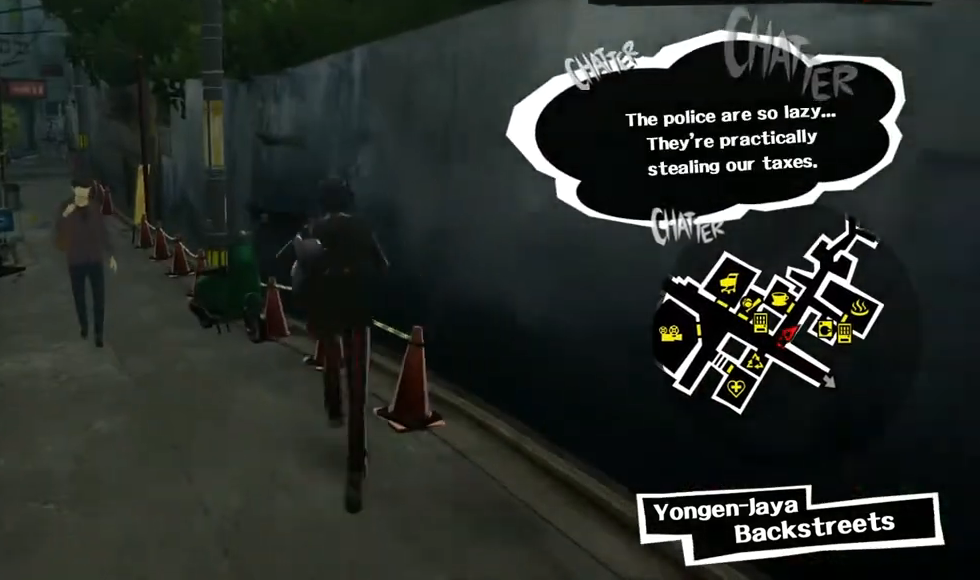
English-edition image note: The official-English game frame calls the police “lazy”; the prose below preserves the Chinese article’s “useless.”
On entering Tokyo, we hear a passerby complain: “The police are useless—they’re practically stealing our tax money.”
“This country of ours is already twisted. Aren’t there any half-decent politicians? There’s no damn hope living in a country like this.”
“Did you hear that? There are orders and powers in society that you cannot stand up to.” (The café owner.)
“We refuse to acknowledge fully, either to ourselves or among friends, that aggressive, self-protective, repulsive, lustful frenzy is inherent in the organism. Instead, we tend to beautify, whitewash and reinterpret reality, while blaming some disagreeable person for the fly in the ointment, the hair in the soup.”7
“What I think you ought to consider is this: if all humanity became corpses whose souls had been overwritten, what problem would that pose? Humanity would lose its sense of beauty and its nobility of spirit, but it would also lose the capacity to understand that nobility. If so, what would be wrong with it?”
After finishing Persona 5, are you capable of answering this question that Project Itoh puts to modern people through the mouth of the One? Perhaps one of the game’s attractions is that the rebellion it advocates is not about overthrowing some fictional tyranny or defeating formulaic stock characters whose destinies have already been written. Its temperament is closer to that of Socrates, who would rather lose the favor of the people and be condemned by the state. What it truly despises is the age’s degradation and corruption, the petty souls who will not think about the crushing weight upon them and the void. Unfortunately, this aspiration too can only be realized through powers beyond reality.
A talented teacher abuses students; a celebrated painter steals inspiration… We busy ourselves punishing one brazen evildoer after another. Yet when we finally enter the hall of the “false god,” we discover that neither the king in his castle nor the captain of the ark, thoroughly wicked though they are, is the demon king responsible for the world’s corruption and distortion. They are merely prisoners who have moved from a cage without desire or hope into captivity within their own distorted desires. The public fear the wicked but do not long for heroes. They resent the existing constraints and rules, yet live by them. They lack the courage to change things and are unwilling to bear the consequences. Better to submit to the manipulations of “gods” or “fate” than to pursue elusive dreams or freedom. Who, then, longs to meet in the place where there is no darkness?
“A god is born / The rest die / What truly is has not arrived, has not departed / A mistaken transformation. Now we have another eternity / But the one that departed was better.”8


“The first stage of the mythic journey, which we call the call to adventure, signifies that destiny has summoned the hero and shifted the center of gravity of his inner life from the confines of society to an unknown region… It is often a place of strange, ever-changing figures, unimaginable torments, superhuman feats and boundless joy.”9
Whether it builds its fictional world out of analytical psychology or brings its visual style closer to urban life in an effort to distinguish itself from traditional JRPGs, the game’s story still follows the structure of a heroic epic, while making a show of breaking with convention. It is the so-called coming-of-age ceremony, or a kind of rite of passage: separation—initiation—return. Tearing off “personas,” subduing and mastering Shadows, entering Palaces to change people’s states of mind… These elements abound in symbolic imagery and borrow from ancient story structures and ways of thinking.
“The wind blows south, then turns north, circling without end, returning to its old course. Rivers flow into the sea, yet the sea is never full, and the rivers return to their sources.”10 Perhaps this is where Persona 5 differs most from traditional heroic tales. Whether the traditional hero finally returns home or departs, struggle and sacrifice always earn their rightful reward: peace and harmony, or renewal. Yet the car receding into the distance at the game’s end instead reminded me of Ishmael stealing glances at the sailors over their meal: “These men who had survived a thousand perils in raging winds and waves, who hunted whales without fear, all showed a little sheepish unease as they sat around the table.”11 In that uneventful ending, I did not feel that the world had been “renewed.” Pedestrians still come and go; society runs as usual. The false god is gone; the Phantom Thieves, too, will inevitably pass into strange tales. Behind the lively laughter lies the ordinary. Society grows worse without falling apart; the world grows better without becoming a paradise.

“People who indulge their own impulses and individuality will ultimately go off the rails and become the dregs of society.”
Yet whether we end up hating or sympathizing with the story’s many characters, we cannot ignore how they keep asserting their distinctive qualities, harboring their own ambitions and desires as they steer toward different ends. Even the wicked among them are no mediocrities. Swelling desires bring destruction; lives turn from prosperity to adversity; the strong bind themselves through arrogance… The experiences and actions of these varied characters keep bringing to mind Marlowe’s Faustus:
Till swoln with cunning, of a self-conceit,
His waxen wings did mount above his reach,
And, melting, heavens conspir’d his overthrow;12
Perhaps the Phantom Thieves are tragic figures in Aristotle’s sense, brought low “by error rather than wickedness.” Yet once they gain power, they are driven by their own idea of “justice” and act, in part, in pursuit of recognition. It is hard to feel for them that lament prompted by the tragedians’ heroes: that all their cunning is no match for fate. The “guilt” borne by tragic heroes stems from mistaken actions brought about by ignorance or destiny; the Greek term for this error, hamartia, originally meant an arrow missing its mark. The catharsis—the refining and purifying effect—brought about through pity and fear seems ill suited to explaining this game’s appeal.
“Every morning I wake in dread, almost in tears, watching the day slip away with nothing yet accomplished. The longing for happiness will be worn down by fault-finding; the creative spirit surging in my breast will be held back by life’s absurdities. Every night I lie down in bed full of unease; my mind still finds no peace, and wild nightmares make me tremble. The god within my breast stirs me to my depths; it reigns over all my powers, yet cannot influence a single thing outside me.”
“Whatever clothes I wear, I feel the pain of this cramped life. I am too old merely to play, yet too young to renounce desire. What can the world still give me?”13
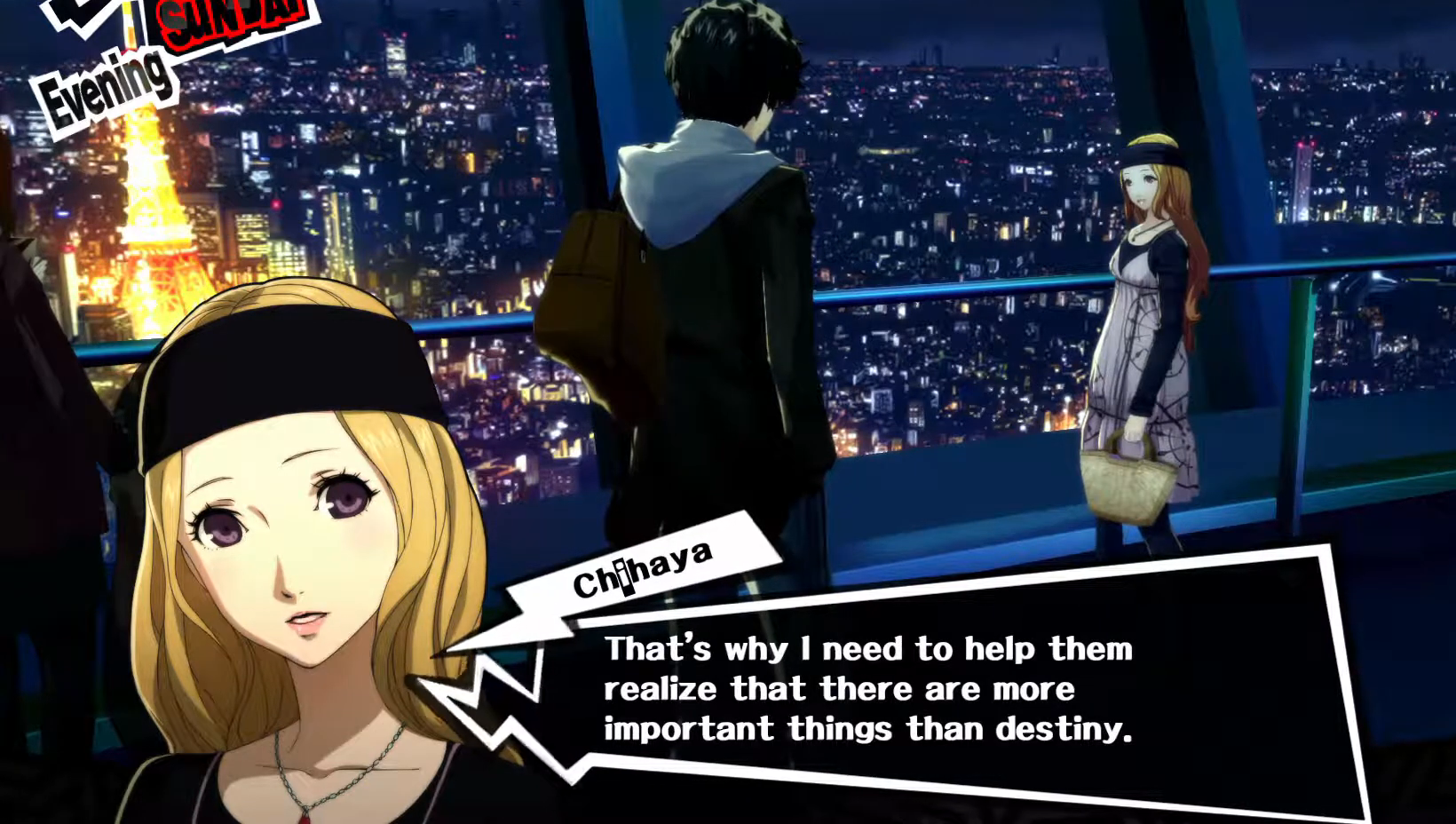
English-edition image note: This official-English game frame contains a different line from the longer Chihaya quotation below.
If we really are to draw some supposed lesson from this game, I think it must be to reject without hesitation, and with contempt, the attitude to life of Goethe’s Faust as he first appears. The game is like Mephistopheles’ attendants, those wondrous phantoms and spirits: it stirs youthful vitality and gives us the courage to break new ground and bear the consequences without flinching. As Chihaya tells Akira: “I am only a fortune-teller, someone who gives advice to people whose hearts are weak, so that they will not be toyed with by fate but will hold fast to their convictions and open up a new future.” We, cowardly and bewildered as we are, may be utterly tired of words that do nothing but exhort us. Yet how could we not need to seek out that zest for life? “I met a young man who intends to set this world right by a method different from mine. But that is an enormous mountain. I cannot go with him, yet I will not say goodbye: we will surely meet again at the summit. He is doing everything he can to accomplish what he wants to do. Everyone, go and find what you want to do.” So says Yoshida.
(our souls) always moving as the restless spheres,
Will us to wear ourselves, and never rest,
Until we reach the ripest fruit of all——Marlowe, Tamburlaine the Great, Scene VII14
- Walton’s elder sister: Margaret Saville
- Frankenstein’s mother: Caroline Beaufort
- Frankenstein’s neighbor: Justine Moritz
- Frankenstein’s cousin: Elizabeth Lavenza15
Thanks to Gcores user LS_Crusader, who pointed out the connection between the Velvet Room’s personnel and the characters in Frankenstein in an overview of the Persona series. I did a little further searching on that basis and have included the corresponding names above.
There is also Zhihu user Tuboshu-sang’s answer to “What distinguishes Kazuma Kaneko’s artwork?” and Persona forum user Kei Nanjo’s post, “A look at Kazuma Kaneko’s design ideas across different works + DDS setting material.” Although Kaneko was not directly responsible for this game’s art, their introductions gave me some understanding of the early series’ tone and Atlus’s own artistic inclinations.
The staff credits uploaded by Bilibili user Clarke—Super High School-Level Bad Luck reduced my workload.
P9 user psv_pengchao’s major series, “Persona 5: A survey and investigation of its world and character settings,” helped greatly to deepen my understanding of the game’s various aspects. I drew a great deal of inspiration from it.
Important starting points for my thinking came from the following: Hashino’s message translated by TGBUS in September 2014; the Dengeki and Famitsu interviews with him translated by TGBUS in February 2015; the video interview with him translated by TGBUS in May 2016; the Famitsu interviews posted on Weibo user Chacha Ange’s blog on February 5 and 10, 2015; the Famitsu interview translated in September 2015 by Sina blogger “Malas—Looking Forward to the New Switch Fire Emblem”; the toco toco interview with Hashino, translated by a YouTube user and then translated and uploaded by Bilibili users “Schrödinger’s Sloth” and “Kajie Cara” in the first half of 2017; A9VG’s exclusive interview with Hashino; and the IGN interview translated by vgtime in June 2017. I looked to these interviews for the sources of the creators’ inspiration. This essay could only have been written on the basis of translations by people who love games.
My own position and abilities may keep me from making that kind of contribution. But we at Lab on Roof are willing to do all we can to offer original work of quality, to convey our thoughts and feelings. For my part, I look forward to being superseded by writing of greater purity and depth, and refuted by wiser, sharper criticism. I hope to walk alongside you and witness our fellow contributors’ growth.