Originally published on Lab on Roof, November 9, 2022.

Editor’s note: This essay was a prizewinning submission to Lab on Roof’s annual call for contributions, the Rags Drum Pre-Festival.
Contents
- Introduction
- Section 1: Opening Remarks
- Section 2: Previous Research and Background Knowledge
- Section 3: Theoretical Framework and Methodology
- Main Argument
- Part One: The Mysticism of Writing in the East
- Section 1: Western Mysticism
-
- Mysticism
-
- Western Forms of Mysticism
-
- The Mysticism of Writing
-
- Section 2: Does It Exist in the East Too?
-
- Candidate Examples
- First: Phenomena in the Realm of Writing
- Second: Are They Mystical?
-
- Is There a Specifically Eastern Quality?
- First: The Distinctiveness Hidden in Writing
- Second: Does It Belong to the East?
-
- Section 3: Finding Mysticism in Eastern Writing
-
- Elements of Early Modern Enchantment
-
- Elements of The (Post)modern Occult
-
- Elements of Inner Traditions
-
- Summary: Mysticism Fills Our Lives
- Section 1: Western Mysticism
- Part Two: An Attachment to the Time Called Modernity
- Section 1: The Absent Origin
-
- The Study of Chinese Mythology
-
- God’s Time and the Time of Chinese Characters
-
- Temporal Genealogies and Their Positions
-
- Section 2: Absent Subjectivity
-
- Speaking On in an Abandoned Land
-
- The Impossibility of Reaching the Agency of the Third Party, and the Inability to Do So
-
- The Birth of the Subject and the Subject’s Difficult Birth
-
- Section 3: The “Mysticism–Religion–Science” Model
-
- Absoluter Geist and Scientific Progress
-
- God Is God, and Humans Are Humans
-
- What Remains Is Mystery
-
- Summary: The Non-Overcoming of Modernity
- Section 1: The Absent Origin
- Part One: The Mysticism of Writing in the East
- Conclusion
- Section 1: All Too Nonmodern
- Section 2: Toward the Long, Narrow Road and the Wide Sky
- Sidebar: A World of Magic and a World of Abundance
- This Essay’s Contributions and Limitations
- References
Introduction
Section 1: Opening Remarks
It is an obvious fact that, in the modern era, our modernization in the East has been an imitation of the West. To break out of this situation and make another attempt at a future of our own in a postmodern world that includes postcolonialism, it is crucial to look back at the past and identify nonmodern elements. This is precisely what we have lacked for so long—not something to dress up and pass off as an overcoming of modernity, but rather the non-overcoming of modernity.
One important element in this non-overcoming of modernity is mysticism and its study.1 Looking at the modern West, we find that “mysticism–religion–science” is an important feature of its system of knowledge. A deep understanding of science and religion is not the same as a deep understanding of mysticism. Why have we lacked a clear understanding of this deep realm of mystery? I hope to answer this question by examining ourselves, particularly the phenomena that arise in the realm of writing.
Section 2: Previous Research and Background Knowledge
Masachi Osawa’s sociology, history of sociology, and philosophy; Shizuka Shirakawa’s study of writing; contemporary Western philosophy and history of science, as well as esotericism; and the study of Chinese mythology. See the references for specific titles.
Section 3: Theoretical Framework and Methodology
Drawing on the body of scholarship on esotericism developed in the West in recent years, this essay uses models that characterize esotericism to identify and analyze phenomena belonging to the mysticism of writing in the East. It then contrasts the content of this Eastern mysticism of writing with the characteristics of science as a feature of modernity, analyzing why the “mysticism–religion–science” paradigm shift did not occur in the Eastern world. Finally, it examines how the factors responsible continue to hold the Eastern world in a condition of non-overcoming of modernity.
Main Argument—Part One: The Mysticism of Writing in the East
Section 1: Western Mysticism
1. Mysticism
According to Wouter J. Hanegraaff, mysticism was originally a subject within the modern study of religion, and is difficult to define. As research has progressed, things long ignored by both the public and academia have come into view; esotericism is among them.
What distinguishes it is that it belongs neither to science nor to philosophy. Even calling it religion, if one had to put it somewhere, would be highly inappropriate.
Examples include the magic in Harry Potter, the alchemy in Fullmetal Alchemist, and Howard Phillips Lovecraft’s “Cthulhu Mythos.” Real, non-fictional examples include “Kabbalistic knowledge” in Judaism, “esoteric Buddhism” in Japan, and “Daoist thought concerning immortals” in China.
2. Western Forms of Mysticism
Are there, then, any principles for identifying mysticism, or content that counts as mystical? Wouter J. Hanegraaff proposes three models: Early Modern Enchantment, The (Post)modern Occult, and Inner Traditions. Beyond these is The Rest of the West: Judaism, Christianity, Islam—that is, mysticism within the sphere of religion.
These are the main characteristics of Western mysticism. Our argument will take as its criteria the three models other than mysticism within religion.
3. The Mysticism of Writing
The mysticism of writing is a concept that will recur throughout the rest of this essay. Before actually applying Wouter J. Hanegraaff’s three models to analyze the mysticism of writing in the East, let us briefly describe its Western counterpart.
Mysticism, broadly speaking, is the idea that humans can connect with a god or a higher will by some means.2 The mysticism of writing is the idea of achieving this through writing.
One prominent Western example is the mysticism of letters in Islam. Toshihiko Izutsu is a major authority in this field. Since this essay has little connection with his research, however, I will not discuss it further. Another example of the mysticism of writing, outside religion, is magic. Unlike spoken incantations, this magic requires certain characters to be written in a specified place before a spell can be cast. Phenomena resembling these characters written to activate magic will be a focal point of the analysis below, which is why I mention them here.
Section 2: Does It Exist in the East Too?
1. Candidate Examples
First: Phenomena in the Realm of Writing
There is much in our lives that deserves another look. Let us consider a few examples.
In everyday life, we often encounter statements such as “Reading this piece healed me” or “It moved me,” or claims that certain written characters have the power to change reality.
When people visit shrines or temples, they write their prayers and names on the blank space or back of an ema, a wooden votive plaque, hoping that this will make their wishes come true.
Having given several examples from the real world, let us turn to fictional worlds. Consider Sekiro and Elden Ring, two games that have recently become hugely popular. In Elden Ring, auras of various colors emerge from the character when they drink from a sacred flask or the Flask of Wondrous Physick, or eat medicinal moss. In Sekiro, however, more than an aura appears: Chinese characters appear with it. When Sekiro is attacked, 危 (“danger”) appears above him; when he dies, 死 (“death”); when he is revived by the power of the Dragon’s Heritage, 回生 (“resurrection”). Other examples include 治 (“healing”), 鬼仏見出 (“Sculptor’s Idol found”), and 防 (“defense”).
Second: Are They Mystical?
Can these phenomena fit the definition of the mystical?
In the terms of modern psychology, language is merely a means by which humans, as social beings, exchange messages. It has no physical power beyond that. If you are injured, reading a passage cannot heal the wound; nor, of course, can it make you move when you are not moving yourself.
In the example of hanging an ema at a shrine, the visitors clearly have feelings or intentions resembling those of religion.
The most interesting examples are Elden Ring and Sekiro. When bleeding occurs in Elden Ring, “Blood Loss” appears on the screen. This differs from Sekiro. The message is not an element that can become one with the character: hiding the user interface (UI) in the settings does not interfere with play. But remove 死 (“death”) from Sekiro, and it becomes difficult to judge when to resurrect. Gameplay is impeded.
The effect of the Chinese characters here differs from that of ordinary UI: they have become a core visual element of the game. These characters provide a direct link to the story—the narrative.
Here, following the definition given above, mysticism is the idea that one can connect with a god or a higher will through writing. What we can say with certainty is that in the examples above, a power different from, and beyond, physical force is being sought unconsciously. In other words, the power sought is not of this world. It is a power outside science, and we can call it mystical.
2. Is There a Specifically Eastern Quality?
First: The Distinctiveness Hidden in Writing
As the preceding discussion showed, mysticism exists in the East too. But is it peculiar to the East, or something shared by writing throughout the world? Let us examine this here.
Consider the characteristics of Chinese characters.
The most widely used writing systems in the world are probably the alphabet and Chinese characters. In direct contrast to the alphabet, Chinese characters have the quality of being “understandable on sight, even when one cannot pronounce them.” This holds in China, Japan, and Southeast Asia alike. This quality is also called “ideographic.”
“Ideographic” means that each character functions as a minimal unit of meaning. This differs from words in languages such as English, which have meaning-bearing affixes below the level of the word. What is more, the meaning conveyed has almost nothing to do with how the character is pronounced. A Chinese character’s meaning is closely connected to its visual form. This is what makes Chinese characters distinctive.
Second: Does It Belong to the East?
As noted above, Chinese characters are ideographic, and their meanings have no fundamental correspondence with their pronunciation. With the Western alphabet, following the sequence of letters and a small set of specific pronunciation rules allows both the meaning and the pronunciation of a sentence to be clearly discerned. In this sense, the characteristics of Chinese characters could be called peculiar to the East.
To sum up, we can conclude that Eastern writing does indeed possess a mystical and distinctive quality.
Section 3: Finding Mysticism in Eastern Writing
1. Elements of Early Modern Enchantment
As already noted, it is extremely difficult to identify mystical thought clearly. This is because mystical ideas are currently hidden in what is called the “religious supermarket.”3 Wouter J. Hanegraaff proposes these three models to distinguish such phenomena.
The key word in Early Modern Enchantment4 is “enchantment”: endowing something with magical power. Even when modern science has taken the leading position, Early Modern Enchantment asserts the power to bring about phenomena that deliberately defy that scientific worldview. The crucial point is that the setting is a scientific age. If one lives in an age without science, enchantment is instead the very paradigm of thought of that age. Like alchemy in Newton’s time, at the threshold of the Scientific Revolution, it formed the mainstream of thought together with a science not yet born.
Today’s world is a contemporary world,5 or we could call it a modernized world. Let us analyze phenomena occurring around us as we live our daily lives in such a world.
In the anime Noragami, written characters are the key to the protagonists’ connection with their divine instruments. When Yato summons Yukine as a sword, he uses a form of the character 雪 (“snow”) resembling seal script. Yukine has already died and become a spirit; Yato is a god; and the divine instrument takes the form of a sword with powers absent from the scientific world. We could call this mystical thought mediated by Chinese characters.
Another example to compare with the ideas in Wouter J. Hanegraaff’s book is the scene in the opening sequence of Jujutsu Kaisen where written characters burst out. Like Noragami, the work is set in a modernized, scientific world. What bursts from the wound is not merely bodily fluid that sustains bodily functions, but a purified mass of people’s invisible resentment. This mass resembles the “living nature”6 proposed by Hanegraaff. Unlike the parts of an enormous clock, what is within this mass has a formless life force.
The same is true of the scene in the first episode of the drama The Words They Speak (Kotodama-sō) in which a curse is dispelled: a sentence containing Chinese characters serves as a crucial medium for dispelling it.
A fundamental premise and important characteristic of modern science is the principle of the uniformity of nature.7 This is the idea that “all things follow constant laws, from the past into the future.” The divine instruments in Noragami, the characters bursting out in Jujutsu Kaisen, and the sentence in The Words They Speak all stand opposed to this idea of the uniformity of nature.
2. Elements of The (Post)modern Occult
The key word in The (Post)modern Occult8 is “occult,” meaning “hidden, invisible.” Unlike Early Modern Enchantment, which concerns power that can be summoned into reality, this model concerns its hidden, invisible source. In contrast to the “from the past into the future” of science’s principle of the uniformity of nature, the source of mystical thought is “something without a clearly defined history, or something lacking historical depth.” Indeed, it is precisely through the absence of history that this mystical knowledge remains mystical.
As “Kaikai Kitan” plays through the opening sequence of Jujutsu Kaisen, various written characters appear. Apart from the characters’ movement without preconditions—the quality of living nature discussed in the previous subsection—what one feels most strongly is an “absence of time.” One quality responsible for this is the “lack of any need for a phonetic reading” in ideographic writing. In contrast to the time it takes to read alphabetic words, the meaning of these characters cannot be grasped through their pronunciation. The process of understanding them is thus visual—with the brevity, or absence, of time implied by a speed of approximately 300,000 km/s—rather than auditory, with the time required at approximately 340 m/s. The second cause is how little we know of the genealogy of the Chinese-character family of scripts, from oracle-bone script to Chinese characters. As Part Two will discuss, Chinese characters have a history of nearly two thousand years, and the other scripts from which they descend have a history of several thousand years. Yet we have studied and known about oracle-bone script,9 the source of this genealogy, for barely a hundred years. This, too, could be called a cause of their mystery—their hiddenness.
Another aspect that demonstrates this hiddenness can be found within Western mystical thought.10 As mystical thought modernized, Eastern myths were the very signposts for its expansion within the sphere of religion. This is why “orientation,” meaning guidance, derives from “Orient,” the East. At this point, the obscurity of the sources of Eastern mythology and history has already extended beyond the East, supporting the occult—hiddenness—in the dual sense of the East and the world.
The occult quality of mystical thought stands opposed to the “proliferation of knowledge”11 in modern science. If what makes this proliferation possible is the metaphor extending from religion into philosophy—“God’s light illuminates our path forward; through Hegel’s dialectic, we are certain eventually to reach Absoluter Geist, absolute spirit”—then the hiddenness of mystical thought is precisely the metaphor “It is pitch-dark where God is, but that power is at our disposal.” The result is an obstacle to the proliferation of knowledge.
3. Elements of Inner Traditions
Inner Traditions12 means inner traditions. In other words, only a very small number of people can learn them, and within them is something that remains unchanged, however different the society, history, or culture. This is “true esoteric spirituality.”13 Those taught this spirituality belong to mystical religious groups.
An anime example can be found in Jujutsu Kaisen. Though it is not directly an example of writing, Toge Inumaki’s status as a Cursed Speech user is obtained through transmission. Unlike the linguistic ability people already possess from birth, it is not a universal ability.
Turning to the real world, Chinese characters, too, may in fact possess a similar quality. This quality is kun’yomi: reading Chinese characters using native words.14 With kun’yomi, the characters simply stand there in a row, and several sets of sounds are assigned to them at once, without anyone finding this strange. We might trace the reason for these readings to two observations: “A writing system that was complex and confused, and grew more confused with time, was supremely useful in preserving the exclusiveness of the scholarly class, inaccessible to outsiders”; and, further, “In every country in the world, during the feudal era, the ability to read and write was the possession of people from a limited class, especially priests.”15
The unreasonable character of this mode of transmission stands opposed to “falsifiability”16 in modern science. Anyone in this world can test the law of gravity proposed by Newton. If it is wrong, one need only rethink the model and propose another that applies more widely. This mode of transmission rejects that synchronic universality.
Summary: Mysticism Fills Our Lives
Let us take stock of the themes and conclusions reached so far.
First, mystical thought, or mysticism, is the idea of connecting with a god or a higher will through some means; when writing is taken as that means, it is the mysticism of writing.
Using Wouter J. Hanegraaff’s three models, we have found mystical phenomena involving writing in the contemporary Eastern world. Spirit-filled kotodama—the spiritual power of words—and its spells for dispelling curses, core elements of anime and games, and the kun’yomi in our language education all meet this criterion of the mystical. This mysticism goes beyond the scientific paradigm of the contemporary world we inhabit and exists in a transcendent stance.
Part Two: An Attachment to the Time Called Modernity
Section 1: The Absent Origin
1. The Study of Chinese Mythology
China does not possess a clearly defined system of myths. Neither the Three Sovereigns and Five Emperors nor the stories of Nüwa, Fuxi, and Pangu have the unified character of Greek mythology or monotheism. To quote Shizuka Shirakawa: “Myths were not transmitted in the form of myths; for this reason, China was often called a country without mythology, and its myths were said to be withered myths.”17 The mythologist Yuan Ke said something similar: “Chinese myths lay hidden in ancient documents of the Qin and Han, and never encountered anyone like Homer in Greece; no extensive, systematic body of myths was formed.”18 The documents describing Chinese mythology that remain today are mostly secondary sources written in Chinese characters, not in oracle-bone script.18
From these two quotations we can discern that no clear, systematic body of myths survived in China. The withering of the system of myths is, in other words, the withering of the spiritual origin.
2. God’s Time and the Time of Chinese Characters
Let us talk about time here.
Did Protestants at the time of the Reformation have the following sense of time? Under the doctrine of predestination, we humans bear original sin from birth, and Christ incarnate accepted our faith through his death. Then, when the day of the Last Judgment comes, believers will be saved. God is omniscient and omnipotent, and already knew everything when the world began. Humans do not know whether they will receive salvation; they can only continue acting throughout their lives until the last day.19
The time of Chinese characters is the reverse. One cannot say they have no mythology, but their myths lack a systematic structure. Moreover, the formation of the written culture to which Chinese characters belong is separated by an enormous distance from its origin in oracle-bone script. As a result, the temporal source of the written culture of Chinese characters remains obscure even now.
An origin is something like a memory.20 In the terms of modern science, people predict the future on the basis of memories of past experience. Metaphorically speaking, without memories of the past, one would be unable, to some extent, to remember what one wants to do in the future. In this sense, Chinese-character culture has lost its most important memory: the memory of its own origin, whether true or false. In other words, the memory of the origin is absent from the place at the beginning where it should be, and this condition has persisted to the present.
3. Temporal Genealogies and Their Positions
According to research by Wu Guosheng, a historian and philosopher of science, examining literature composed in Chinese characters can reveal Chinese-character culture’s sense of time.21
Put simply, ancient China possessed both a cyclical and a linear sense of time. In contrast, Christianity and Indian culture have extreme, simple senses of time. As noted above, Christian culture belongs to an extremely linear sense of time, and India to an extremely cyclical one. It was Christianity’s linear sense of time that gave birth to modern science.
Section 2: Absent Subjectivity
1. Speaking On in an Abandoned Land
According to Masachi Osawa’s research,22 Catholic and Protestant confession at the time of the Reformation led to diametrically opposed results, owing to the senses of time associated with “spoken language–written language” and to whether confession produced a result. Because their relationship with God was relativized, Catholic believers could experience the psychological effect of release from their sins in this world. Protestant confession through diary writing involves continuing to repent of one’s sins within a linear sense of time.
Possessing a spiritual origin—original sin—and repenting for one’s entire life in a diary gives rise to a distinction between the “narrating I” and the “narrated I” within that diary. By comparison, Chinese characters, lacking a spiritual origin—a clearly defined system of myths and a linear sense of time—could not possibly have generated this distinction between the “narrating I” and the “narrated I.” In fact, the Chinese-character cultural sphere was not the birthplace of the diary as a literary form.
2. The Impossibility of Reaching the Agency of the Third Party, and the Inability to Do So
The panopticon examined by Foucault was a purification of the king’s two bodies under absolute monarchy. The body natural was removed, leaving only the body politic; here we find the “disciplinary” form of power and surplus power.23
Protestant confession through repentance in diary writing represents the ceaseless questioning of one’s identity under the rule of “God ≈ the panopticon ≈ the agency of the third party.”24 The “narrating I” in the diary attained a position almost equivalent to the agency of the third party. Ultimately, however, this is impossible. Yet through repeated questioning, in a linear sense of time, the “narrating I” became the representative of the agency of the third party.25
By contrast, Chinese-character culture combines linear and cyclical senses of time. Even if it can temporarily approach the agency of the third party, the influence of cyclical time will bring it back to where it began. This is an inability to reach the agency of the third party.
3. The Birth of the Subject and the Subject’s Difficult Birth
When the time of this questioning is compressed to its limit, the representative of the agency of the third party becomes one with the “narrating I” that continues to question. At this point, the birth of the modern subject is complete.26
If we turn back to Chinese characters shrouded in mist, we find that the self-incarnation of the agency of the third party was all but impossible. Of course, this is not to say that people who use Chinese characters cannot become incarnations of the modern subject. They can, but the process by which this is achieved is probably the result of borrowing the power of other languages. Spiritually speaking, the difficulty Chinese characters confront is nothing less than the subject’s difficult birth. In other words, the subjectivity that should occupy the present in the temporal sequence is absent, and this condition will probably persist from here on.
Section 3: The “Mysticism–Religion–Science” Model
1. Absoluter Geist and Scientific Progress
As noted above, the proliferation of knowledge in modern science is connected to Hegel’s dialectic. If we further ask where this dialectic originates, we find its connection with the birth of the subject in the religious setting discussed in the preceding section. This is a metaphor extending from the sphere of religion into that of philosophy. Through it, the source of progress in modern science was secured.
2. God Is God, and Humans Are Humans
As time moves forward, the affairs of this world are explained by the collection of scientific hypotheses taken as truth. Together with God’s transcendence, things that cannot be falsified are treated as false propositions, while God’s salvation remains unknowable in this world. Looking up toward the distant kingdom of God, the human world flourishes.
3. What Remains Is Mystery
At the end of Part Two, we come to something that connects with Part One. In the human world, flourishing through the principle of the uniformity of nature (the world) and the proliferation of knowledge, inexplicable phenomena still remain. What has been left behind is, precisely, mystery. Just as we do not know whether the day of judgment will come, perhaps a day will come when the true nature of mystery becomes clear. Well, then—shall we run on into the future with the agency of the third party within us?
Summary: The Non-Overcoming of Modernity
Let us take stock of the themes and conclusions reached so far.
For Chinese characters, their own origin was obscure and absent. And with their mixed sense of time, Chinese characters have still been unable to give birth to subjectivity. Western culture, which was able to do so, invented the “mysticism–religion–science” model.
Conclusion—Section 1: All Too Nonmodern
This essay has examined phenomena in the realm of writing in the East. Using the three models proposed by Wouter J. Hanegraaff to distinguish forms of mysticism, it has analyzed phenomena belonging to the Eastern mysticism of writing. It has also confirmed that this kind of mystical thought fills our lives in a transcendent stance.
Further, from the perspectives of mythology and the study of writing and literature, it has confirmed this transcendent stance—that is, the absence of origin and subjectivity. Finally, taking the “mysticism–religion–science” model as its criterion, it has reached the conclusion that the East remains in a condition of “non-overcoming of modernity.”
Section 2: Toward the Long, Narrow Road and the Wide Sky
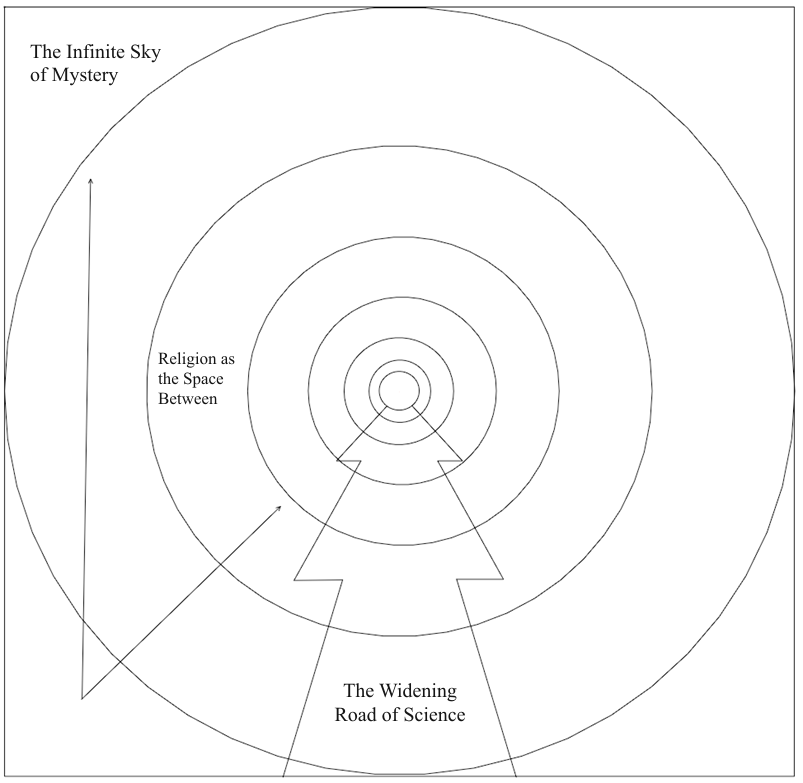
As the diagram shows, we humans are walking along this very road, long and narrow yet continually widening. The ground is a metaphor for falsifiable science; the sphere of religion is like the air; and what touches the atmosphere is the mystery that remains. At this stage, there is still so little we can touch. Yet one day, we will set out toward that wide sky. That is what I think.
Sidebar: A World of Magic and a World of Abundance
As this essay has examined, the Eastern world that still uses Chinese characters remains captivated by their bewildering magical and mystical qualities. For this reason, our spiritual world remains immature. There have also been disasters brought about by this immaturity, as we can see in the work of many scholars of the East.
Yet with the emergence and decipherment of oracle-bone script, a chance to bring this obscurity to an end may be arriving. Through Shizuka Shirakawa’s research on oracle-bone and ancient scripts in fields such as anthropology and mythology, a rich ancient world appears before our eyes. The world of thought hidden in writing comes back to life. I recommend Shirakawa’s work.
This Essay’s Contributions and Limitations
Because many of its arguments have already been developed in other books, this essay has been able to proceed smoothly to this point.
Its main contribution is to use the findings of Wouter J. Hanegraaff’s research on esotericism to distinguish and analyze mystical phenomena in the Eastern world, and, by placing these findings in the context of Masachi Osawa’s work, to derive the Eastern world’s condition of non-overcoming of modernity.
Its limitations are the still-weak connections among its parts, and its failure to delve deeply into Eastern mysticism. Future exploration will focus on analyzing representations related to mysticism and subjectivity.
References
-
Wouter J. Hanegraaff. 2013. Western Esotericism: A Guide for the Perplexed. Bloomsbury.
-
Masachi Osawa. 2021. 〈世界史〉の哲学 近代篇1 〈主体〉の誕生 [The Philosophy of “World History”: Modernity, Vol. 1—The Birth of the “Subject”]. Kodansha.
-
Masachi Osawa. 2014. 〈世界史〉の哲学 東洋篇 [The Philosophy of “World History”: The East]. Kodansha.
-
Wu Guosheng. 2006. 时间的观念 [Ideas of Time]. Peking University Press.
-
Yuan Ke. 2015. 中国神话史 [A History of Chinese Mythology]. Beijing United Publishing.
-
Katsuhiko Tanaka. 2017. 言語学者が語る漢字文明論 [A Linguist on Chinese-Character Civilization]. Kodansha.
-
Shizuka Shirakawa. 2003. 中国の古代文学(一) 神話から楚辞へ [Ancient Chinese Literature, Vol. 1: From Myth to the Songs of Chu]. Chuokoron-Shinsha.
-
Eiji Oguma. 2022. 基礎からわかる 論文の書き方 [How to Write a Paper, from the Basics]. Kodansha.