
Medieval Evangelion.1
From Copies to Simulacra: The Modern Turn in Cultural Consumption
English-edition note: Quotations are translated from the wording quoted in the Chinese essay, not substituted from existing English editions. Notes distinguish material differences; the essay’s original references and page numbers are retained.
I. Introduction
In the early twentieth century, Walter Benjamin lived through the enormous changes that large-scale industrialization brought to culture and art. In “The Work of Art in the Age of Mechanical Reproduction,” he argued that industrial mass reproduction shattered the artwork’s original “aura”—its authenticity and unique status. Artistic creation merged with culture-industry production, embedding itself deep in the fabric of society and becoming a political operation.
The new artistic media of Benjamin’s time included printed matter, photographs, motion-picture film, and celluloid sheets. The reproductions circulating through these media gradually escaped the old imperative to “copy reality” and turned instead toward reproducing themselves. The result was a continual expansion of the virtual; through cultural diversion, the logic of capital seemed already to have secured “covert control” over the masses.2 In short, whether the political agent was capital, fascism, or communism, art had in a certain sense become its instrument for influencing the masses. It was in this sense that Benjamin proposed confronting fascism with “politicized art.”
With the information age, artistic media took a digital turn: digital cameras, the internet, computer software, and electronic screens became the new media of artistic creation. Through this transformation, mechanical reproductions lost their “original” altogether and became “simulacra” that proliferate in the form of code. At the same time, the openness of digital technology gave the masses the capacity to create literature and art, once again overturning the existing mode of cultural consumption. This raises an important question: how does technological change in cultural media affect cultural production, transforming cultural consumption and even society’s cultural forms?
II. Reproductions as Code
1. The Myth of Integral Realism
In “The Work of Art in the Age of Mechanical Reproduction,” Benjamin analyzed the changes that technologies of reproduction brought to artistic creation, perception, and even politics. Bernard Stiegler’s philosophy of technics continued this inquiry. Stiegler characterized reproduction as an ever-expanding fiction:
“Technoscience-fiction” is itself a major revolution in the problem of transmission—that is, the problem of reproduction. This “technoscience” is an industry of reproduction, and reproduction is fiction. Some characterize it as an industry of fictional reproduction that threatens the world like a devil.34
Stiegler approaches the fictive nature of technical reproduction from the standpoint of human subjective reception; more precisely, his concern is the question of “what we want.” Under large-scale production by the technological industries, people’s desire to know “reality” is overwhelmed by the “invention” of possible things. This is why technoscience’s industry of reproduction appears as a devil threatening the world. From the standpoint of a simple Enlightenment faith, science’s mission ought to be to reveal “the truth of nature,” satisfying people’s essentialist pursuit of “reality.” Technical reproduction, however, depends on the “possibility” of things. It is not constrained by reality; rather, it turns possibility into reality. It produces reality. This inversion brings about a ceaseless proliferation of fiction, drawing society into a symbolic space governed by cultural production. Stiegler calls this kind of reproduction “reproducibility”: production that is reproduction from the outset, or serial production without an original work.5
Yet when Benjamin wrote “Little History of Photography,” photography as a technology of reproduction seemed to fulfill the very myth of truth people were pursuing. The “shock” photographs gave their viewers arose from their immediate, complete “copying” of nature. André Bazin wrote with utter confidence:
A set of lenses forming the camera’s eye takes the place of the human eye; its name is objectif—the French word for a photographic lens, sharing a root with “objectivity.” For the first time ever, only another physical object intervenes between the original object and its representation. For the first time, an image of the external world comes into being automatically, according to strict determinism, without human intervention in its creation.67
On this basis, Bazin held that “photography’s aesthetic character lies in revealing the real.”8 In another essay, he gave this myth a name: the myth of “total cinema”—cinema that reproduces an all-encompassing illusion of the external world.9 If cinema had not yet fulfilled this myth of integral realism, that was merely because its technology remained incomplete.
Here we encounter two senses of “reproduce”: transitively, to reproduce something else; intransitively, to proliferate on its own. The photographs Benjamin discusses in “Little History of Photography,” in which some aura still lingers, are undoubtedly reproductions in the first sense. The artworks in “The Work of Art in the Age of Mechanical Reproduction,” which have broken with “authenticity” and can be exhibited anywhere and possessed by anyone, are reproductions in the second. These two senses are by no means separate, of course. We can imagine the reproduction of something else—of an “original”—as the precondition for self-proliferating reproduction. More specifically, that original might be reality, a photographic negative, original film material, or an original literary or artistic work.
Yet the logic of reproduction is not loyal to the original. At first glance, photography’s fidelity to reality seems guaranteed by a kind of “automatic” operation. But what it captures is precisely not reality: it is the “optical unconscious.” Photography produces images in which intentionality has not yet intervened. It lets us see things we never intended to look at, bringing us into direct contact with our unconscious drives. “Shock” arises from this encounter. In other words, the photographic image constructs “another reality.” The viewer’s identification with the image leads him into this dream, where he accepts the image’s orchestration of his unconscious. Benjamin writes in “Little History of Photography”: “Photography materially reveals the appearance of all images, including the most delicate details, the clear details hidden in the refuge of waking dreams. Yet when these details grow large and readily expressible, they can establish between technology and magic a difference that is entirely one of historical change.”1011 The “difference that is entirely one of historical change” brought about by the image as a “waking dream” is precisely an inversion of technology and magic: the image constructs reality by “remaking” rather than “representing” it. The myth of perfect reproduction is ultimately exposed as “fabricating reality.” However closely an image’s content resembles reality, it completes itself within its own field. The image first fabricates itself; resemblance to reality becomes derivative.
2. The Database of Simulacra
In Symbolic Exchange and Death, Jean Baudrillard proposed three orders of “simulacra” to describe the historical development of technologies of imitation:
—Counterfeiting is the dominant mode of the “classical” period, from the Renaissance to the Industrial Revolution.
—Production is the dominant mode of the industrial era.
—Simulation is the dominant mode of the present phase, governed by code.12
First-order simulacra depend on the natural law of value; second-order simulacra on the commodity law of value; third-order simulacra on the structural law of value.
The Industrial Revolution brought mass-produced industrial simulacra into being. The universal law of equivalence followed by reproduction can establish itself only by eliminating reference to the original. This means that “production,” in its essential logic, excludes the “original.” With no original left, imitation becomes the imitation of itself: “The true ultimatum is reproduction itself; production has no meaning. Production’s social purpose is lost in seriality. Simulacra prevail over history.”13
When the mass repetition of an original finally becomes the mass repetition of copies, when primitive accumulation finally becomes capital’s self-expansion, we enter the era of third-order simulacra. Their production resembles a word-chain game: one written character connects to another without needing any definite meaning. The continuation of the string is itself the purpose of production.
Here there are only models, from which all forms emerge through differential modulation. Only incorporation into a model has meaning. Nothing develops according to its own ends anymore; everything proceeds from models, from “referential signifiers,” as though these were a kind of prior finality, the only verisimilitude.
Today, the “genesis of simulacra” finds its perfect form in the genetic code. At the edge of the ever more complete extinction of reference and finality, at the edge of the loss of resemblance and designation, we discover the signs of numbers and programs. Their “value” is purely tactical, situated at the intersection of other signals—particles of information/tests—and their structure is that of a micromolecular code of manipulation and control.14
If we find marble statues, the Baroque style, or Impressionist painting among first-order simulacra, and political propaganda images and film posters among the second order, then all we find in the third order are combinations of signs. Such things appear in otaku consumption, a characteristic mode of consumption in the digital age. Take the game project Hyperdimension Neptunia. From the outset, this project was based on personifications of several sponsoring companies: first the “characters” were designed, and only afterward were the other elements making up the game’s main content filled in. Although this promotional project offered neither a particularly exciting plot nor especially good game mechanics, it won widespread acclaim among otaku. The design of its protagonist, Neptune,15 reveals the mechanism of consumption at work: the consumption of codes. A personified game console, purple hair, a loli character—a deliberately young-looking girl—and pajama-like “moe” clothing: these elements point either toward gaming culture, which inhabits the same otaku cultural circle, or toward “moe-elements,” familiar features that inspire attachment and have acquired something like a “tradition” through their repeated use in anime and manga character design. What is consumed is less the game’s content itself than this continual extension toward another textual chain. The example reveals a generative model behind the theory of simulacra: the textual chains left by the continual translation and reproduction of codes themselves become the sites where simulacra are generated.
In Otaku: Japan’s Database Animals, the Japanese critic Hiroki Azuma argues that although Baudrillard’s theory of simulacra addresses the disappearance of the original, it portrays the generation of simulacra merely as disorderly proliferation. It fails to see that, after the collapse of the tree structure centered on the original, a so-called “database” model takes its place, establishing new rules and “traditions.”16
“Database”17 is an apt description of the source of simulacra. Just as we can break down the character described above into a combination of codes, we can dismantle almost any modern cultural product in the same way. Certain fragmentary features recur throughout works, acquiring the status of a “tradition” and consequently being cited again and again in later works. Over time, a set of fixed, emblematic signs develops within similar cultural circles—like Che Guevara T-shirts. These signs can be recombined at any moment to produce new objects of cultural consumption. In this sense, we can say that The Avengers series is a work of the same kind as Hyperdimension Neptunia, born from the cultural circle/database of American comics and Marvel.
This mode of cultural consumption consists in continually reading data from the database, like clicking links online and browsing related pages, articles, and videos one after another. We can say that the database’s structure is precisely that of the internet. Azuma calls it a “hyperflat” structure: the plane still exists, while things exceeding that plane exist alongside it18—hyperlinks. Clicking a link does not elevate us from browsing a plane to some higher realm; it merely takes us to the next plane. Although the grand nonnarrative—the database—produces small narratives, reading those small narratives cannot lead us back to the former. The grand nonnarrative cannot even be adequately described. It consists of countless planes woven together by hyperlinks, always changing, always establishing new connections. We might say that the grand nonnarrative is “virtual,” like “pure memory” in Bergson’s sense. Through mechanisms such as metonymy, it flows through all the texts produced—the most fitting image of this process is “Related Content / You Might Also Like.” The creation of a work is nothing more than the actualization of this virtual current: new connections are established among drifting elements, or signifiers, turning them into readable sentences. New planes thus form within the database; fan-made reworkings and play with memes and familiar references can all be understood as such planes. Being “readable” does not mean “having meaning.” Just as a word-chain game can proceed without anyone understanding what the words mean, readability guarantees only that a text can connect to another text. “Meaning,” by contrast, always connects with something outside the text. This also means that our browsing is nothing more than an endlessly continued word-chain game.
Modern people staring at electronic screens do nothing but compulsively repeat this “reading”: reading data stripped of meaning, reading data for its own sake—the pure “reproduction” of feeding one string of text into another. This is precisely the experience that artworks in the age of mechanical reproduction—or, more accurately, digital reproduction—bring us. Yet this conclusion comes from analyzing changes in the form of the artwork alone. We must not neglect to reconsider the problem against the broader background of changes in social structure. The two films discussed below sketch the modern subject’s new predicament. Ultimately, we will see what kind of cultural ecology consumers in this predicament have formed around the artistic forms described above.
III. The Cultural Consumer’s Predicament
1. Two Images of “the Masses”
The continual expansion of reproduction overthrows the rule of the “original.” With the disappearance of aura, the worship of “the real” associated with Plato’s theory of Forms collapses. As the form of artworks changes, so does the paradigm of artistic production/cultural production. Moreover, once aura, with its air of mystery, disappears, the foundation of the artwork’s existence shifts from a particular ritual setting into the political sphere. The “original work,” for example, becomes “copyright” protected by bourgeois law; the production of works shifts from private commissions to culture-industry production informed by forecasts of market demand—and thus by the logic of capital.
These changes connected the masses with art in an unprecedented way, allowing art to penetrate the fabric of society. Benjamin writes: “The masses are a source from which all traditional attitudes toward artworks appearing today in new forms are born. Quantity has become quality. The enormous increase in mass participation has brought about a change in the mode of participation.”19 He did not hastily conclude that participation in artistic production had given the masses a means of expressing themselves through art. On the contrary, what he saw first was artistic diversion’s “covert control” over the masses; only on that basis did he explore the possibility of mobilizing them.
The masses appear in artistic production not as a subject but always as an object to be represented and shaped. They have not acquired “powers” of their own through artistic production. We can readily see the divided image of the masses in the following two examples. In the Soviet film Battleship Potemkin (1925), which depicts the Russian Revolution of 1905, the representation of “the masses” runs throughout, becoming the most powerful instrument for propagating the revolutionary spirit. Two montage sequences in Eisenstein’s third part, “Blood for Blood,”20 are especially characteristic. The first comprises three shots of people passing beneath a bridge on their way to the harbor to mourn a sailor killed for launching the uprising. Eisenstein makes full use of the bridge above, the stairways on either side, and the passage below. Dense, orderly streams of people, arranged across distinct spatial layers, express the firm, unified will of “the masses.” The second sequence depicts the crowd’s outrage before the murdered sailor’s body and its decision to resist tsarist tyranny. In the first shot, a speaker-like figure stands slightly elevated, delivering an impassioned speech toward the right. In the second, the crowd faces screen left, answering the direction of the previous shot. The third moves into close-up: a strong arm and a hand tightly gripping the edge of a garment express the people’s long-suppressed anger. The fourth shot answers the third in turn, showing that anger erupt.
The crowd is effectively organized into marching masses, motionless masses, shouting masses, and masses with arms raised high: powerful, unified “masses” represented as a subject of action. Eisenstein’s montage constructs an image for the masses, imposing order on what was a disorderly collection of people. Through a particular arrangement of shots, it establishes a grammar of images that expresses abstract “concepts.” Similar uses appear in many films characterized by Soviet montage. The audiences watching these films may have overlapped substantially with the masses shown on screen—so much so that we might call this “self-display.” Yet the displayed image of the masses has necessarily already been orchestrated by the grammar of cinema and made to serve the idea that the montage seeks to express. This is also the sense in which Benjamin argues that cinematic diversion “covertly controls the masses” and may mobilize them. “The masses” must first be constructed on screen before the people sitting before it can find their own image in those “masses.” Although self-expression by the masses remains possible, more often spectators are simply shaped through their identification with the screen’s “image of the masses.”
The other example presents precisely the opposite. In the Italian neorealist film Bicycle Thieves (1948), the masses always appear in disarray, while the protagonist is stripped of every halo and reduced to one of their number. Deleuze comments:
Identification is subverted; the character becomes a spectator. He moves, runs, and acts in vain. The situation in which he finds himself exceeds his motor capacities in every respect, making him see and hear things that can no longer be resolved by a response or an action. He seems to be recording rather than reacting. He becomes the captive of a vision, either pursued by it or pursuing it.2122
This description captures remarkably well the protagonist’s sense of loss throughout the film. His actions are no longer guaranteed by traditional cinematic narrative; he has lost his command of the situation. The old pattern—“the character acts, the situation responds”—has ceased to work. The balance between character and situation breaks down. Caught in a “pure optical and sound situation,” the protagonist discovers that he can only look on helplessly, submerged in the crowd. Consider the following sequence, in which he searches for his stolen bicycle. The transition from the first to the second shot takes us into his point of view, confronting us with a disorderly crowd. In the objective third shot, he seems suddenly to have disappeared among the people. Only when we notice someone in the middle, hesitating on the spot in the pouring rain, do we recognize him. The high-angle fourth shot intensifies this powerlessness, finally making us realize that the protagonist is merely one person in the crowd. It is only because his bicycle was stolen that he has had this experience of running from place to place.
Crowds occupy an even greater proportion of Bicycle Thieves than of Battleship Potemkin, discussed above. Yet these noisy people moving in all directions have nothing to do with “order” or “unity.” The film presents no “image of the masses,” because we cannot even identify what “the masses” refers to. All that appears is unbearable, excessively real and inert everyday life: objects and people refuse to offer any meaning beyond themselves. Bicycle Thieves uses many long takes, but often they merely show the protagonist walking from one end of a street to the other, or some inconsequential detail of daily life. These long takes make the film’s time sluggish, deprive it of a definite theme, and leave the audience at a loss. To spectators, it seems only common sense that film editing has a duty to guide them, to indicate “what this passage is expressing.” But the neorealist long take cancels precisely that duty, seeking thereby to show something more “real,” something unmanipulated. The audience’s bewilderment is the protagonist’s bewilderment: that of a powerless individual who has lost the promise of subjecthood held out by “the masses.” The grammar of cinema no longer envelops the protagonist, giving meaning to his every action. He therefore finds himself helpless, forced merely to watch and record, unable to make any effective response. This is the exact opposite of the montage discussed above. There, editing’s “magic” gives the protagonist’s speech expression on the level of concepts—or, rather, the protagonist’s image itself becomes an expressive apparatus that elicits identification. Seen in this light, neorealism’s pure optical and sound situations and long takes are precisely a disenchantment of montage’s magic.
We can thus see that a divided image of “the masses” inhabits the individual in the age of mechanical reproduction. On the one hand, social/political entities promise sovereignty to the individual, subsuming every citizen within the myth of a powerful, unified mass. On the other, the individual discovers himself among a strange, disorderly crowd/mass of people, helplessly forced to watch and record everything before him without being able to make any effective response. Under the new logic of artistic production, cultural production is brought under the command of political power. In these circumstances, it is less that the individual still cannot secure a voice than that he is held captive by cultural production itself. Only by identifying himself as a member of the first kind of “masses” can he avoid the terrible predicament of helplessness.
2. Members of Postmodern Cultural Tribes
In a lecture titled “The Proletariat of Sensibility,” Stiegler argues that the development of the culture industry has proletarianized consumers’ sensibility. This “proletarianization” means a loss of knowledge:2324 people who listen to music on the radio lose their knowledge of performance, while those who appreciate paintings in printed reproductions know nothing of the skills of painting. These technological developments impoverish amateurs’ knowledge, reducing them to cultural consumers.
Yet the replacement of industrial technology by digital technology has brought about a second machinic turn of sensibility. The tools of cultural production, previously controlled by capitalist marketing and the culture industry, have been digitized and opened to the public. Anyone can learn to use computer software and acquire skills in video editing, postproduction, digital drawing, and so on. This transformation has brought about a revival of the amateur. Cultural consumers have finally regained part of their control over the libidinal economy:
What is the amateur, if not a symbol of the libidinal economy? The amateur “loves”—amat, from the Latin verb amare, “to love.” This is precisely what makes an amateur an amateur. What amateurs of art love is the artwork. And insofar as they love artworks, those works also act upon them.
Every artwork is, to a certain extent, a disclosure of itself. It can truly disclose itself only by presenting itself as a revelation, thereby forming a kind of doctrine. In some cases, this produces schools, small groups, certain sects, and sometimes even schisms. Kant says that when I judge an artwork beautiful, I necessarily believe that everyone ought to find it beautiful. Yet deep down I know that things will not be as I want them to be, and never can be.25
What Stiegler first reveals here are the political conditions under which artworks take shape in the digital age: it is precisely because amateurs love it that art becomes art. Culture and its adherents are constructed together in this process. The passage also reveals the tribalism of digital-age culture. Precisely because culture arises from amateurs’ fetishistic attachment, corresponding “congregations” form beneath culture as an “idol.” Internally, these congregations repeat certain doctrines; externally, they oppose other congregations. Combining this with our earlier analysis of the “database” form of culture, we can say that each congregation shares a smaller database internally. This database in turn lies within a larger database, in opposition to the other databases contained within it. This is a set-theoretical structure of nested discursive systems.
Thus, although the “helpless subject” identified above must identify with some form of “the masses,” under postmodern conditions those “masses” need not be “the People as a whole,” with a capital P. They can be broken down into countless lowercase “masses.” If this helpless subject throws himself into culture’s embrace and becomes an amateur of a particular culture, then the “masses” with which he identifies will be some “club of fellow enthusiasts” or “cultural circle.” There he can form ties with others, use the same discursive system, and share—even jointly create—cultural products.
Yet this mode of cultural consumption brings about the tribalization of culture:
Unlike “grand narratives,” exemplified by history, the “small narratives” generated from the database possess no such basis for making distinctions—that is, the “public standards” laid down by the sovereign. To defend their legitimacy and their habitats—to exclude noise and mismatching elements from their identity, to distinguish more rigorously between friend and enemy, inside and outside—these small narratives must therefore reject and attack other narratives. The commonality of small narratives generated from the database is consequently exclusionary.26
The Japanese critic Tsunehiro Uno takes up Azuma’s discussion of database culture and exposes the problem of the exclusionary society it produces: how can people in different cultural circles/small narratives communicate? Continuing his database theory, Azuma argues that products generated within the database—“characters”—are connected to one another, and that the network of relations among codes opens up the possibility of communication between different small narratives. Uno criticizes precisely this point. Although characters can be reduced to signs that have something in common, the very process by which a character comes into being is a denial of its constitutive elements. Only by denying its composite origin can an exclusionary narrative come into being and worshipful identification with it become possible:
Strictly speaking, a character is not a sign. For a character to come into being, the commonality of its defining attributes must be acknowledged, because commonality is determined by the story—the narrative. A character becomes independent of its original work and is then altered and consumed in fan-made reworkings. At a metalevel, this process further strengthens both the commonality that acknowledges those attributes and the story—the narrative—that determines that commonality.
Azuma’s discussion fails to notice this. He proposes the concept of the “character” in database consumption as a kind of “critique of narrative.” Yet characters often provide and supplement commonality. It would not be an exaggeration to call characters the source of “small narratives.”
Technically, a community connecting the whole world may indeed be possible; on the level of narrative, it is impossible. This is a small narrative without internal errors, in which only those who acknowledge a character’s defining attributes can connect. Azuma regards characters as free beings capable of transcending “small narratives”—or as signifying elements representing such beings. His argument overlooks the points above.2728
From the standpoint of producing works, postmodern digital technology seems to offer a vast cultural space of connection and sharing. People can freely draw codes from all kinds of databases, add their own creativity, and produce new images–characters–works. Seen this way, a character assembled from multiple codes seems able, by virtue of some degree of [universality],29 to become a “sign” connecting different cultural circles. But Uno points out that this logic is precisely inverted. At the moment of its birth, the work/character-image pieced together from fragments of code denies the fact that “it has been pieced together.” It fashions an image of its own essence, presents itself as unique, and becomes the source of an exclusionary narrative—an “idol.” To regard characters as existing independently of small narratives is to misunderstand the logic of database cultural consumption entirely. For the “believers,” the commonality between characters visible at a metalevel cannot become a channel of communication. On the contrary, resemblance between characters can even provoke exclusion in defense of the faith: only the character with which one identifies is allowed to occupy those signs. If resemblance causes someone to mistake one character for another, the result will only be mockery for “not knowing their stuff.” What this reflects is tribal exclusionism.
The postmodern mode of database cultural consumption is not in itself critical of discursive systems. In other words, “members of cultural tribes” absorbed in small narratives cannot find within them the possibility of “communication” with others. In fact, cultural tribes are constituted precisely by excluding this possibility. Genuine “communication” is nothing more than a myth of our age. In the postmodern situation, with culture’s grand narratives in decline, people need no longer identify with the Political Aesthetics—with capital letters—displayed by Battleship Potemkin. Yet modern people released from that obligation can live only within closed cultural tribes.
On its own, the sweeping charge that “the culture industry under capital’s control will manipulate individual taste” still misses the point as a critique of cultural consumption. The more immediate problem is that the cultural ecology itself is moving ever further toward isolated, exclusionary tribalism. This is not merely a problem of production, an “external” problem. It is first of all a problem of cultural reception, an “internal” problem. It is not some gigantic capitalist machine imagined by conspiracy theory that separates people; rather, members of cultural tribes must refuse communication. Or, to put it another way, cultural reception is founded on the refusal of communication, and cultural form encourages this exclusionary disposition. Worse still, the artistic images and discursive systems fashioned by the culture industry may overwhelm the weak tribes, each fighting alone, and bring about a “third machinic turn of sensibility.” Large cultural machines would bring amateurs’ creativity under their command, establishing “unified” social standards of taste and culture. Although aesthetic standards can never be genuinely unified, they can be “sovereign.” They will use the immense image of “society as a whole” to suppress every narrative outside themselves. Literature and art will once again bear the stamp of politics—only this time not in the name of political ideology, but in the name of “mass taste.”
IV. Conclusion
In the contemporary context, aesthetic experience and cultural consumption are more closely intertwined, and their political character has not diminished in the slightest since Benjamin’s time. They have become a new form of social connection following the dissolution of traditional interpersonal bonds. They also provide something for people to “believe in,” although this function has lost its original sacred meaning. The cultural consumer remains that powerless figure, held captive by images and compulsively repeating the act of looking. Yet the database model has also brought new possibilities for cultural creation. Perhaps, like Deleuze, we can hope that the differentiated repetition of cultural codes will trace lines of flight, escaping capture by dominant discourse. But we must also acknowledge the conservative character of this process of differentiation itself, and the closure and exclusion implied by the word “aesthetic” in the modern context.
This closure does not arise from the subjectivity of sensuous aesthetic experience. People do not reject one another because they feel differently about the same work. If, in the “experience of shock” described by Benjamin, people receive successive novel stimuli through the senses, then in the contemporary aesthetics of simulacra, the function of sensibility has almost entirely receded into the background. The function of “reading” takes its place: the elements composing a work are translated into words, extending textual chains through the database. Every expressive mechanism becomes “quotable.” What breeds exclusion here is not the general ability to read, but the contexts and objects of reading: particular databases and cultural circles. In other words, closure is brought about not by aesthetic experience itself, but by the situation of the aesthetic subject. That subject is still held captive by the work—but this time not merely passively, overwhelmed through the senses, but actively…


- Upper left: “A deliberately childlike appearance.”
- Middle left: “Purple hair, eyes, and dominant color scheme.”
- Lower left: “Exaggerated bodily proportions.”
- Upper right, beside the hair ornaments: “Hair ornaments shaped like game-controller buttons indicate that this character personifies a game console.”
- Middle right, beside the hoodie: “The character’s name is incorporated into the clothing to make a stronger impression.” The visible emblem is N.
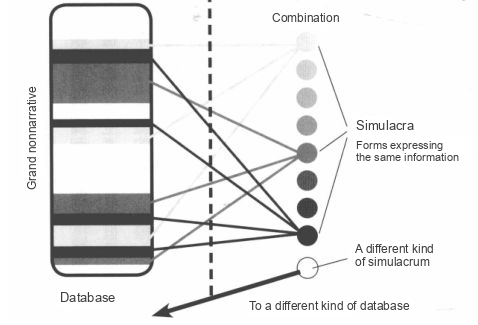
- Left reservoir: “Database” below; “Grand nonnarrative” along its left edge. Horizontal bands divide the reservoir into elements.
- Above the right-hand column: “Combination.” Thin lines cross the dashed divider, linking selected bands to circles; several bands converge on a single circle, and a band can connect to more than one circle.
- Beside the shaded circles: “Simulacra” and “Forms expressing the same information.” The circles range from pale at the top to dark at the bottom, with diverging guide lines grouping the column.
- Bottom outlined circle: “A different kind of simulacrum.” Its separate thick arrow crosses back over the divider and points down-left, labeled “To a different kind of database.”


