0 How to Interpret FGO Part 2, or What Kind of Reading of Dystopian Works Do We Need?
As one of the most influential cash-grab mobile games of recent years, Fate/Grand Order has become an important—and perhaps the most controversial—part of the TYPE-MOON empire’s body of work. By the middle of FGO Part 2, the narrative model that the Lostbelt universe is trying to present has become clear. In a sense, the seven Lostbelts are the present-day realizations of seven imagined dystopias, each based on a possible history within TYPE-MOON’s universe. The controversies these imagined dystopias have provoked are also worth discussing: take the Chinese Lostbelt in 2.3, hailed on its Japanese release as “an expression of China’s strength,” then accused of “insulting China” after its Chinese release. We could, of course, dismiss all this as the mistaken opinions of a vulgar public that does not know how to appreciate dystopian works, directed at commercial dystopian works that are themselves none too clever. But it is hard to say that understanding and consuming the possibilities to which a dystopian story points is an adequate way to engage with a text of this kind.
The famous philosopher Slavoj Žižek—whom Graham Harman, a leading figure in speculative realism, counts among the three philosophers in history who could have made a living as stand-up comedians—argues in his discussion of The Handmaid’s Tale that it amounts to a nostalgic fetishization of the present. The work is not intended to indict religious fundamentalism and explore the threat it poses. Rather, it uses the possibility of a dystopian future under religious totalitarianism to fetishize and celebrate a “pluralist, open, progressive” present. In my view, that accusation applies even more aptly to FGO Part 2. However much cutting down the Trees of Emptiness is described as an unavoidable struggle for survival, and however much the writers emphasize the Lostbelts‘ “wrongness” in comparison with Proper Human History to spare players the guilt of “doing evil,” all this remains an apologia for the world as it is. In other words, these texts are really insisting on one thing: “How wonderful to have been born into Proper Human History, where there is still hope!” In a sense, this is like the sentiment so often expressed by Japanese people: “How wonderful to live in Japan!” The clash of ideas with the Lostbelts’ dystopias thus degenerates into a contest over which history is less awful. Criticism of dystopian possibilities likewise degenerates into an apologia for a reality whose dominant values couple neoliberal ethics with multiculturalism. The sole advantage is that this conflict does not claim legitimacy by appealing to the decidedly totalitarian notion of a “correct history” adjudicated by the Counter Force. Instead, it appeals to the Lostbelts‘ own oppressive character and the internal contradictions that make them unsustainable. Yet this slight improvement only shows an even greater eagerness to flatter the dominant ideology.
But can these texts do nothing except sustain ideological reproduction? If The Handmaid’s Tale amounts to nothing more than a “nostalgic fetishization of the present,” why does Žižek try to discuss it further? After pointing out that its specific scenes cater to readers‘ and viewers’ obscene enjoyment of male domination, and that the work is in fact an apologia for the present, Žižek raises a further question worth considering: why would the present-day United States, nostalgically celebrated as “free, progressive and respectful of women,” develop into the Republic of Gilead, a religious totalitarian state that brutally oppresses women? Likewise, when we yearn for “the good old days,” we need to ask why they developed into a present we can bear only by taking refuge in nostalgia. The ideological elements that dominate dystopian fantasies are structures inherent in our reality—indeed, they are one side of that reality. They are by no means other worlds opposed to ours, available as foils to show how good our reality is. On the contrary, they always share its structure. In interpreting dystopian works, we must remember that the point is not to guard against our quiet, harmonious reality sliding into that terrifying possibility. On the contrary, we are already within its bounds. What we need is precisely a radical reading of dystopian works whose texts lack radicalism, to reactivate their critical force.
1 The Final Dark God, or the Final Dark Human?
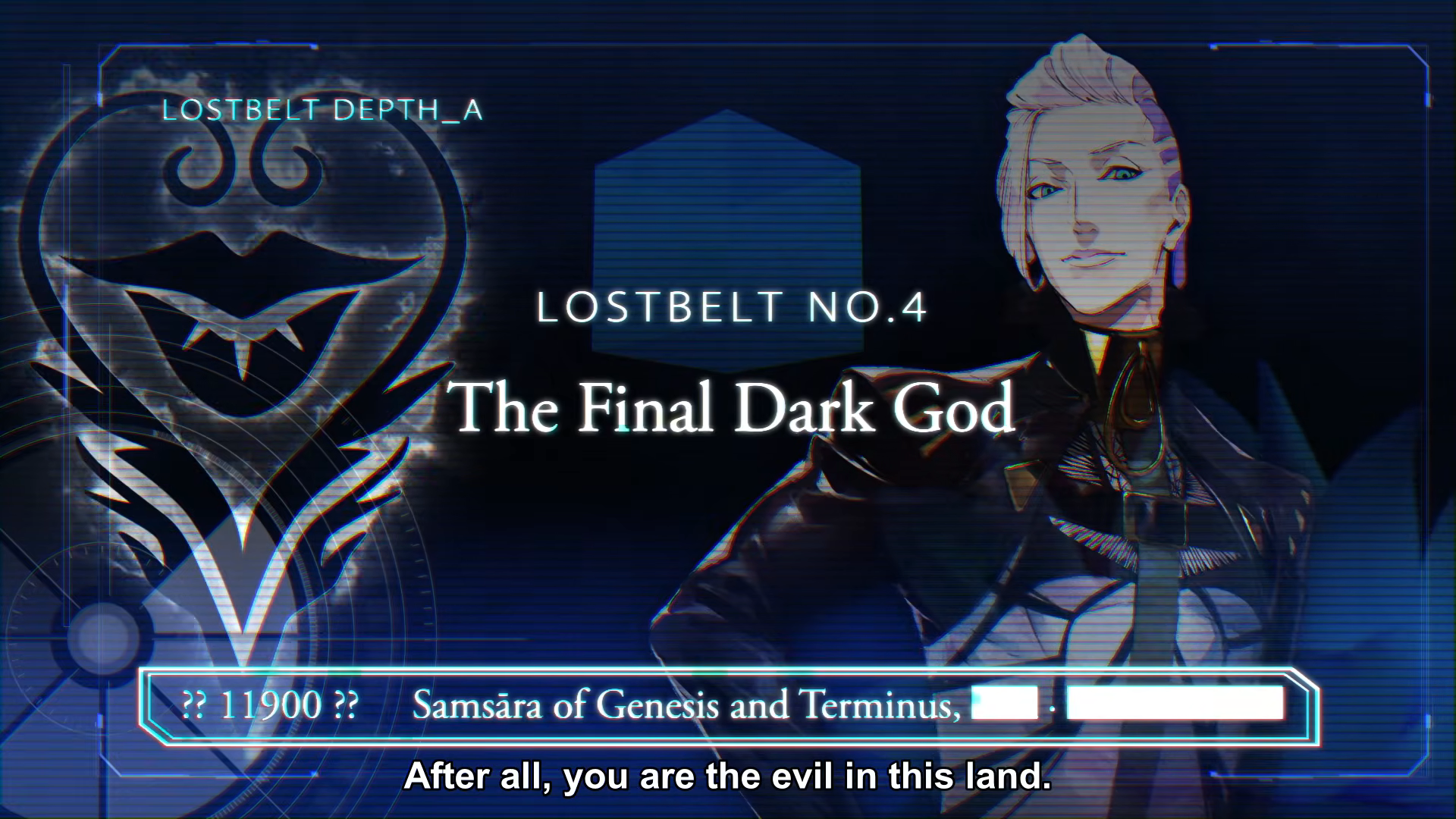
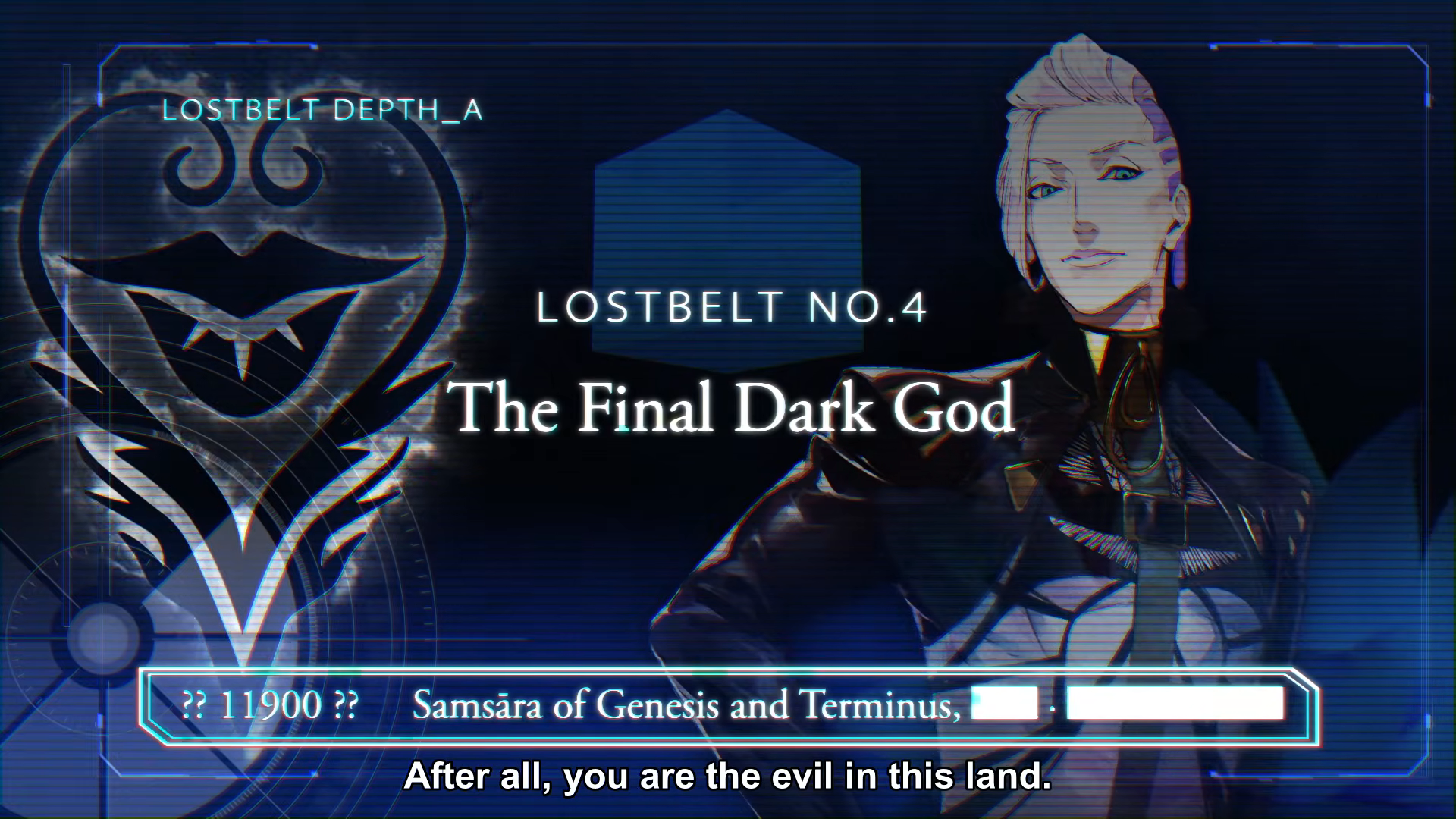
Intuitively, when discussing the shared structure of reality and the dystopias of the Lostbelt universe, most people would surely think of Lostbelt No.3: The Synchronized Intellect Nation, SIN. In my view, however, the most important of the four Lostbelts released so far on the Chinese server is Lostbelt No.4: Saṃsāra of Genesis and Terminus, Yugakshetra. Although its setting is more overtly mythological, it does reveal an important ideological structure and its fate.
The story of Lostbelt No.4: Saṃsāra of Genesis and Terminus, Yugakshetra bears the title “The Final Dark God.” Yet in light of what Section 19 reveals, we must regard this “Arjuna as god” as precisely “the Final Dark Human.”
The Indian Lostbelt’s historical divergence occurs after the Kurukshetra War in the Mahabharata. Repelled by the war and reflecting upon it, Arjuna attributes its bloodshed and misery to the fact that evil in the human world—that is, “the imperfect and unneeded”—has not yet been eradicated. He therefore resolves to unite the powers of the gods and build a perfect world without evil through repeated yuga cycles. As an incarnation of Indra, Arjuna keeps seizing the divinity of other gods, eventually devouring the entire Indian pantheon to become the sole god: “the Final Dark God.” The nameless god Arjuna uses the divinity of Brahma, Vishnu and Shiva to shorten the four yugas from 1,728,000,000, 1,296,000,000, 864,000,000 and 432,000,000 years to four days, three days, two days and one day respectively. Every ten days, he completes a cycle from the world’s creation to its destruction, using the power of destruction to remove from each cycle all beings he deems “imperfect and unneeded.” For the first four days of each ten-day cycle, the inhabitants enjoy life in a paradise. Then the world itself steadily degenerates, until on the last day they face an age of decline and incessant attacks by Kali demons. He then resets the world, and beings judged evil by the god no longer exist in the new age.
Yet, as the Chaldean Servant Karna says in Section 19 to refute Arjuna: “If you really are already a perfect god, why do you react so strongly to my name?”1 Having acquired all the divinity of the Indian pantheon, Arjuna has lost most of his humanity and resembles an automatic machine that sustains creation, destruction and judgment. At its core, however, is not an inhuman divine machine. On the contrary, it is the human Arjuna’s fixation on the Kurukshetra War that governs the actions of this sole god formed in his shape. What sustains the divine will is Arjuna’s desire. That desire is directed precisely at the Kurukshetra War, that proof of evil; it is itself the evil that the god can judge but cannot remove. A justice that desires evil is evil at its core.
The fact that the Final Dark God’s core driving force is a human rather than a divine desire cannot, however, be taken as proof that his divinity remains incomplete, as the text would have it. On the contrary, we must say that the sole god’s law is not a divinely ordained law at all: it belongs to humans. The god’s judgment of evil is not a sacred matter categorically separate from humanity, but a human ideological structure. The sacred realm comes into being for humans, and the mechanism that excludes evil is also human, all too human. Perhaps we can discuss this mechanism through a concept Giorgio Agamben introduces in Chapter 9 of The Open: Man and Animal: the anthropological machine.
2 God’s Eyes… Have Seen
Before discussing the similarities and differences between Arjuna’s cycle for excluding evil and the divisions made by Agamben’s anthropological machine, we must point out something obvious: having become the sole god, Arjuna occupies the position of the big Other within the Lostbelt. All social activity there revolves around the sole god. People act and pray according to his demands, obtaining his protection through their virtue and piety. Those who do not sufficiently conform to the god’s goodness either fail to survive the Kali demons‘ attacks as the age declines into Kali Yuga, or are deemed “imperfect” because of their injuries and erased from existence. We can say that Arjuna is the big Other mediating all intersubjective activity. By occupying this position, he makes all intersubjective activity, lawful or unlawful, possible, and passes judgment on everything.
Yet the big Other cannot see all evil. Only where there is an obscene supplement that the big Other cannot see can the symbolic order function smoothly. And the big Other’s judgment is often triggered by seeing a being whose existence it does not permit. We can see this in Arjuna’s words before he unleashes his world-destroying Noble Phantasm.
“The god… has seen. Imperfect… and unneeded. This… is evil. Be extinguished, evil… In the new yuga, the new world… you shall not… exist. I shall… bring down… the sword… of the god of the end. What it severs… is the world. In the cleft… of this blade… overflowing… thorough… purification… Destruction… and creation… shall cycle anew—Maha Pralaya.”
When Žižek discusses ideology, he often points out that the inherent transgressions which must be kept out of the big Other’s sight are precisely the key to sustaining the symbolic order. What, then, if the position of the big Other is occupied by an agent capable of—and intent on—removing those “non-existents” that do not conform to its overt rules? We know that, when it comes to inherent transgression, there are two kinds of beings excluded by the symbolic order. One manifests the symbolic order’s own inconsistency; the other is an obscene supplement included through exclusion. The latter is in fact a necessary structure sustaining the symbolic order, just as the Third R*ich cannot really exterm*nate all the J*ws.2 The J*ws must always be in the process of being exterm*nated, but never completely exterm*nated, if the Third R*ich is to sustain its ideological reproduction. The question, then, is this: if the Na*is wiped out all the J*ws at one stroke, what would they do? The answer is very clear: they would have to identify new J*ws among those previously deemed Ary*n. What Agamben calls the anthropological machine produces the division between human and nonhuman, and always identifies the nonhuman within the human. Or rather, it produces the human by identifying and excluding the nonhuman. Just as excluding homo sacer—the “sacred man,” who may be killed but not sacrificed—is a necessary condition for the formation of a community, if those excluded were really erased from existence altogether, new objects of exclusion would have to be identified.
This is also why Arjuna cannot identify all evil within a single cycle and destroy it at one stroke. Each time he unleashes his Noble Phantasm, he really does eliminate everything identifiable as “imperfect and unneeded” by that world’s standards. New evil is then endlessly identified among beings previously deemed good. This is also why Agamben says in his book that the purpose of discussing the anthropological machine is to think about how to stop it. In an essay on the concept, Wu Guanjun writes: “This machine’s meat grinder is about to turn on humanity itself.” And in the final battle between Karna and Arjuna, isn’t the fact that this machine ultimately turns even on Arjuna himself precisely what is used to make the sole god negate himself? Moreover, continually producing divisions and removing the nonhuman can only exhaust humanity and the world completely. The fate of the little girl whom the protagonists first meet on arriving in the Lostbelt is a microcosm of this process. In a sense, the Craft Essence awarded for completing this Lostbelt resembles the wedding photograph at the end of May 18: apart from the unsmiling bride, every smiling person in that photograph has been killed by the martial-law troops of Chun Doo-hwan’s regime. Here, apart from the girl smiling in an unknowable dream, everything that makes her smile has been destroyed in the cycles.

Family Portrait — English text accompanying the source screenshot
The Indian Lostbelt completion Craft Essence, Family Portrait. Source screenshot preserved; English text below.
On-screen labels
Title, twice: Family Portrait — above the panel and on the card.
Category, twice: Craft Essence — below each title.
Tabs: Status; Details (selected). Control: Close.
Card: Four stars. ATK 0; HP +2250.
English reading of the Chinese screen
Ah...I see. So that’s how it is.
I...really have forgotten something, haven’t I?
I’ve had that feeling all along.So, please, tell me.
Tell me about the important things I’ve forgotten.—This is a painting of a dream.
Kind parents, loving older brothers and sisters, an adorable little sister, a beloved dog... A family that vanished entirely in the cycle of madness—an image of a world that could never be.
And yet you still picture it in your mind:
that the prayer of a girl who can no longer remember anything could blossom and bear fruit at the end of all things.Published English game text
The English edition differs from the Chinese screen: it does not explicitly call this an impossible world or a painting. The source-aligned reading above retains those details; the game text below is unchanged.
Ah...I see. I get it now.
So I really was forgetting something.
I had a feeling that was the case.So tell me...
What is this important thing that I’ve forgotten?This is but a vision of a dream.
Kind parents, friendly older brothers and sisters, a cute younger sister, and a beloved pet dog...
This is a scene of a family that disappeared, victims of the cycle of madness...
Yet, you still imagine it...you see the prayer of the young girl who had forgotten everything, coming to fruition at the end of it all.English game wording: NA game-data record for Family Portrait, no. 1018.
Quite apart from the fact that continually dividing society and destroying part of it can only end in society’s self-destruction, this model is absolutely unacceptable to those whom the anthropological machine marks for removal once set in motion, and to their sympathizers. William Tell, a Servant summoned by Arjuna, realizes that his memory of being forced by the governor to shoot an apple off his son’s head has been erased during the cycles. Because that memory interfered with his execution of Arjuna’s rules, it was judged “imperfect and unneeded.” When the protagonists face the world’s destruction for the second time, he rebels against Arjuna and attacks him for this reason. A woman among the villagers in the rebel army led by the Servant Lakshmi Bai, the Rani of Jhansi, resolves to resist the god after discovering a love letter from her now-vanished lover. She finds it through the manipulations of TV Koyanskaya, an apostle of the Alien God who has been making trouble for Chaldea ever since the freezing of Human Order. Even when faced with the Servants summoned by Arjuna and fused with divinities, the woman screams hysterically: “How dare you say that my lover is an imperfect being!”
There are also clear grounds on which the Servants summoned to the Lostbelt who join the protagonists can be deemed imperfect and nonexistent. Lakshmi Bai, the Rani of Jhansi, not only leads the villagers in rebellion against Arjuna; the divinity fused with her is Alakshmi, Lakshmi’s elder sister, the goddess of ill fortune who brings misfortune. Moreover, because the Indian uprising was ultimately crushed, Lakshmi Bai regards herself, the ruler of a fallen kingdom, as an unworthy queen. The god Ganesha has no objectionable powers, but his vessel, whose consciousness predominates, is Jinako Carigiri, Karna’s Master in Fate/Extra CCC. She is a NEET—not in education, employment or training—and under the capitalist work ethic, she is unquestionably a useless person.
After experiencing the world’s reconstruction for the second time, the protagonists establish that they cannot weaken the god’s power by shaking the people’s faith and obedience: those who no longer conformed to the god’s goodness were deprived of existence in the previous divine judgment. At the proposal of Aśvatthāman, a Servant who has come over to their side, the protagonists—already designated “evil” by the god—try to send members of their party back to hide in the time before Arjuna began presiding over the world’s cycles. To do so, they use Aśvatthāman’s Noble Phantasm, activated through Shiva’s authority: “O Great Time, Turn Back Here (Mahakala Shakti).” By demonstrating that what the god has deemed evil can remain beyond his sight, they seek to undermine Arjuna’s perfect powers at a conceptual level. Lakshmi Bai undertakes the task of becoming the shell that conceals them. Inside it, Jinako Carigiri, as the god Ganesha, remains conscious to complete the proof.

3 Even a NEET Has the Right to Look Up at the Sky
In discussing the protagonists‘ plan to undermine the god’s powers by exploiting his inability to see, I do not want to emphasize the significance of seeing in the process by which the god sees and punishes the imperfect and unneeded within a perfect symbolic order, making that order appear to approach “perfection.” We have already discussed this sufficiently in the previous section. Nor do I want to discuss Jinako’s immense sacrifice: spending thousands of years alone, exhausting every game she can access through her powers as the god of wisdom until she is sick of them all, and finally suffering a mental breakdown in her solitude as her consciousness blurs. That is merely a device for milking emotion. What I want to discuss here is the password the protagonist agrees on with Jinako.
The protagonists rush to the so-called “God’s Skyboulder”—the disguise that Lakshmi Bai has become—to rescue the two who have endured an unknowably long wait from the past to the present. The protagonist places the hand bearing the Command Spells against the bottom of the boulder and speaks the agreed password: “Even a NEET has the right to look up at the sky!”
If we are content with the preceding use of the Indian Lostbelt’s mechanism to illustrate how Agamben’s anthropological machine works, we may fall into precisely the problem Zhong Zimo raised on Douban about writing criticism of works in the TYPE-MOON universe. These are works that already “give representational form to abstract concepts.” Catering to their desire to be interpreted theoretically sacrifices the seriousness of the concepts, and criticism itself becomes a conceptual game. What I am looking for in this text—a point from which to move beyond that conceptual game—is this password.
The judgment that Jinako Carigiri is “imperfect and unneeded” does not come from the warped Indian Lostbelt. It is her own judgment, made according to the social consciousness of Proper Human History: NEETs are not needed by anyone; they are a surplus that society does not need. This judgment, drawn from certain received opinions and commonsense assumptions, has been internalized by the game character. When we speak of the excluded who are deemed “imperfect and unneeded,” NEETs will undoubtedly come to mind. The password then expresses the attitude of the protagonists—or rather, of the work’s dominant ideology—toward this structure that relentlessly and mercilessly removes the excluded: even beings deemed unneeded must be tolerated!
If we say that homo sacer is included in the system through exclusion, then, following Wu Guanjun’s reading of the humanized nonhuman in Agamben, the humanized nonhuman—artificial intelligence, for example—is, conversely, excluded through inclusion. Even a NEET has the right to look up at the sky. This amounts to saying that NEETs really are inferior and unneeded, and can be accepted and granted basic rights only through the system’s great mercy.
Here we must distinguish several kinds of exclusion for ourselves. First, in the preceding discussion, I distinguished non-existents wholly external to the symbolic order from non-existents included through exclusion, which serve as the obscene objects of inherent transgression. The difference is that the former are fissures in the big Other itself and have never been seen by it. The latter are incorporated by the big Other through abjection as a foundation that sustains it: they are the part to which it deliberately turns a blind eye. The former can genuinely threaten the symbolic order, but can be co-opted into the latter. Those excluded through inclusion, however, are not on the same level as either of these. The symbolic order symbolizes them in a form that does not correspond to what they really are, excluding their fundamentally heterogeneous core.
Wu Guanjun argues that anthropomorphizing a fundamentally nonhuman entity such as artificial intelligence is precisely such an operation: ostensibly accepting AI as human serves to exclude its fundamentally nonhuman core. In my example of NEETs being excluded through inclusion, we see a second pass of the anthropological machine. First, it identifies NEETs as a heterogeneous element within humanity and excludes them as nonhuman. Then, by saying that NEETs are human too, it fixes this excluded group in the position of an inferior group that can be accepted only through forgiveness and tolerance. Through exclusion, the anthropological machine forms the definition of the human and produces the surplus it must separate out to form that definition. When the excluded are accepted back, the surplus inherent in them is completely excluded from the symbolic order. This is also why I think the best Chinese translation of BLM is not “黑人的命也是命” (“Black lives are lives too”), but its literal translation, “黑人活得更好” (“Black people live better”).3 Black people should be accepted as human while retaining their otherness, rather than on the grounds that “although they don’t really meet the standard of the ‘human,’ they’re human after all.”
Karna’s attitude toward Jinako Carigiri differs from that of the protagonists, whose position in fact excludes the excluded once more by accepting them back. From the outset, he does not regard her as unreliable or unneeded. It is precisely because her hero entrusts her with the task that Jinako Carigiri enters the fight herself and keeps fighting, always stepping forward despite immense pressure and fear. The Hero of Charity simply disregards the anthropological machine’s division of people into those worthy and unworthy of being human. Instead, he simply assumes that everyone can take responsibility for themselves. If we become enamored of classifying the excluded as marginal groups and minorities, and see the acceptance of marginal cultures and minorities as a demand for the system to be just, we in fact entrench their inferior and effectively nonhuman status. At the same time, we entirely rule out the impact their heterogeneity could have on mainstream existence—on the existence of those whom the anthropological machine identifies as qualified to be human.
Once we take the anthropological machine’s identification and exclusion further, to “exclusion through inclusion,” we can see more clearly the structural correspondence between the Indian Lostbelt’s dystopia and the dominant social consciousness of the Proper Human History that competes with it—a projection of reality. Identification and exclusion by the anthropological machine are not features peculiar to dystopia, but a structure that exists in reality. Accepting the excluded back and then further excluding their otherness likewise affirms the results of the anthropological machine’s operation and proceeds according to its principles. In this way, we have unearthed a structure in the Indian Lostbelt’s text that permits a radical reading, while pointing out the ideological problems of both the Indian Lostbelt and Proper Human History—the reality outside the game.
4 Nous ne sommes rien, soyons tout!
Comparing Karna’s and the protagonist’s attitudes toward Jinako Carigiri is not a matter of morally condemning the protagonist’s position. In fact, the sentiment the protagonist expresses even panders to otaku. But truly accepting excluded people such as NEETs never means cheap tolerance: it means accepting them in a common struggle.
The text of a commercial game cannot, after all, express a fundamental revolt against reality, so struggle always becomes a contest between reality and an erroneous reality over which world is less awful. Yet there is always something in it that can be interpreted as a radical position. Here, I choose Karna. In my view, Karna’s trust in Jinako Carigiri and the charge he gives her serve a function similar to the one Žižek attributes to Lenin’s stance as a master in the revolution. Through his own actions, Karna authorizes himself, then uses his authority to demand that those who follow him assume responsibility for their own actions. Such a master’s command permits action to take place. It acknowledges that the excluded are entitled to their existence, and allows them to win that existence through radical action. We must, of course, ask whether we need to explore a new model without such a “revolutionary master.” If we cannot move beyond the need for a master’s coercive command to make things both permissible and possible, perhaps we will never see that final victory in Hegel’s master–slave dialectic, in which truth belongs to the slave.
Faced with the anthropological machine’s production of the excluded, the most basic stance is this: we absolutely must not accept its division and then try to include the excluded again; we must render that division inoperative. The point is not that the excluded “too” deserve a minimum of recognition, but that they “are” part of all that exists. As in that line from “The Internationale” that Badiou likes to quote: “We are nothing, but we shall be everything! (Nous ne sommes rien, soyons tout!)”4