Love Triangles and “Byakuyakō” in Anime, Manga, and Games

Interests: ACG cultural studies / gender / space / intellectual history. An observer on the margins, overflowing with empathy.
Introduction
As viewers, we inevitably go through something like this: we finish watching, feel a sudden urge, replay the video, and start tapping away at the keyboard, hoping to say something about a popular work—whether it belongs to ACG culture (anime, comics, and games), is a film, or takes the more traditional form of a novel. But once the general introduction is over and we begin to analyze the plot, a difficulty confronts us: how do we give a convincing, logically consistent account of each character’s personality and function? Characters are the soul of a work; they largely determine its overall direction. Without interpreting them in depth, we cannot fill in the many gaps that may exist in a work’s plot, and our explanation ultimately suffers.
Critics approach character analysis in ACG works with different emphases. One common approach today digs into a character’s individual life history, looking for clues in their lived experience. Another uses functional analysis of film and television, asking what function a character serves within a particular narrative structure. The former displays a kind of empathy, seeking to endow characters with the appeal of personhood; critics intermittently work their own fantasies of transference into the discussion. The latter tries to understand characters as devices serving the narrative intentions of the author (or the market), removing them from abstract humanity and assigning them a reified, generic identity in a database. Yet when weighing the merits of these methods, we easily overlook three important points. First, whatever else may be true, a work is created by an author: the fact that its characters are imagined by someone else does not change. Their growth bears on the growth of real people; the two are not wholly severed. Second, works themselves are heterogeneous, which poses a challenge to anyone using a single, inflexible method of character analysis. Third, there is one thing about characters that closely connects them both to one another and to their audience. It draws us into the fictional situation while supplying the characters with a rich supporting background. That thing is this essay’s subject: relations.

To define relations, we must distinguish them from personal history and structure. An analysis of personal history naturally mentions the plot and the intricate relationships among its characters. But it approaches a single character’s growth historically; on the page, this usually means a separate subheading for each character, followed by a discussion in story-time order. A relational approach, by contrast, proposes folding historical time into space, abolishing diachrony and treating relations as already-given geographical positions. It explores what Simmel calls “social synthesis,” avoiding a perspective confined to records of a character’s experience—for example, by supplementing separate accounts of a man’s and a woman’s experiences with the types of roles they play when dating. On the other hand, the “social synthesis” in ACG works is not a structural product of the culture industry, nor is it cold, unfeeling material for analysis. It contains abundant emotion and an internally consistent logic of its own. Unless we understand this “human” element in relations, we cannot grasp the side of characters that feels real to us, or what the story does to us.
Relational analysis attempts to remedy the empiricist shortcomings of characters’ personal histories and the functionalist arrogance of database analysis. By connecting situations in ACG works with situations in real life, it offers a new approach to character analysis. The two parts of this essay will discuss, respectively, “relations among characters” and “relations between works and audiences.”
I. Toward Relations Among Characters: The Triad and Its Variants
If, as we have said, relational analysis rests on ACG works’ “heightened mapping” of real life, then formal analysis of real life can be creatively appropriated to analyze relations among fictional characters. Simmel’s formal sociology offers a lively and engaging approach. He sought to extract the purest social forms from concrete social reality, distinguishing his approach both from the analysis of individual action advocated by nominalists and from the macro-level functional analysis advocated by realists. Society is expressed in the mathematical language of geometry.
Within this framework, Simmel acutely identified the most basic unit of social analysis: the triad—a relation among three people. The triad can be understood as the starting point of all society. The individual is the point of departure for the philosophy of the subject, which explores the inner self but cannot address the diminution of subjectivity brought about by social coexistence. The dyad does involve interaction between subjects, but because each has only the other, it acquires a privacy and particularity that lack the elements of reality needed for generalization: it is a romantic illusion. In a triad, the introduction of a third party qualitatively changes the dyad’s privacy. Each person must be answerable to two others at once, and must act in radically different ways to maintain the group’s delicate balance. Family relations work precisely this way. Excessive intimacy between either parent and the child puts the emotional contract between the spouses to the test. Appropriate distance and coldness, replacing satisfaction with desire (lack), therefore lend powerful support to the triad’s stability. This lack constitutes a basic property of social form. Thus the triad can also be seen as the endpoint of social analysis: every complex form of social interaction evolves from it. On this basis, Simmel proposed a typology of the third party: the “mediator,” the “arbitrator,” the “third who benefits,” and the “one who divides and rules.” I will not continue to use this classification in discussing triads in ACG works. Instead, I will try to establish a new paradigm for triads in fiction.
(1) The Love-Triangle Model: A Special Form of the Triad
Audiences delight in discussing love triangles in ACG works, especially school romances. But triadic analysis differs for works aimed at different gendered audiences. In heterosexual works aimed at men, the story usually revolves around the emotional bonds between a male protagonist and two heroines. (Why not a male protagonist competing with another man? Because when that happens in a male-oriented work, audiences prefer to call it NTR—having your lover taken by someone else. This has something to do with gender and culture.) On the one hand, these bonds place viewers in a voyeuristic position: through embodied imagination, they take the male protagonist’s place, derive enjoyment from the relationship, and invest transference in the objects of desire. Fierce shipping wars ensue. On the other hand, the bonds obstruct the characters’ emotional progress, keeping the plot suspended in negation until the story nears its end. Only when the climax calls for a symbolic marker—an object or episode linked to an earlier time and place—to be reinserted does the protagonist make a choice on that basis. The love triangle is therefore the most exceptional form of the triad. Its ending often rewrites the relation among “three people” as a triangle of “the pair–society (the world).” The plot generally ends there, of course, leaving an empty signifier: “The princess and the prince lived happily ever after.”

Here I will discuss a love-triangle formula that some authors know very well. Love triangles in certain male-oriented works have an interesting feature. Their male protagonists vary in personality, but tend to exhibit, to some degree, a structure of sexual perversion (and often suffer from depression, too). This manifests in their refusal to give up any one object lightly in their dealings with others, whether they adopt the passive stance of the avoider or the active stance of the nice guy. The former corresponds to a Hachiman Hikigaya–style melancholic temperament. Pretending that “youth” is already dead, he maintains harmony in the overall environment by renouncing his power as a subject and his desires through self-castration. At the same time, he blocks narcissistic fantasy and prolongs the period of transference onto “Dumpling”—the fan nickname for Yui—or Yukino. The latter corresponds to the sanguine temperament of Haruki Kitahara in White Album 2. By lavishing indiscriminate care on his objects, he entangles himself in the enjoyment of the relationship in a seemingly proactive way. For example, confronted with the traumatic kernel of Setsuna’s sudden confession after the school festival, Haruki finds his budding feelings for Touma thrown into disarray. Players can directly sense the character’s repeated oscillations within this complex psychological state.

Compared with the male protagonist, the portrayal of the two central female characters is more intriguing. Women in male-oriented works are often depicted as objects of desire. Leaving aside database analysis of moe elements, and considering relational form alone, the two heroines often occupy positions near to and far from the male protagonist, creating a contrast in psychological distance. That contrast offers readers a novel experience. For now, I will call the nearer heroine the “next-door type” and the more distant one the “mysterious type.” The next-door type has personality traits that naturally make people want to approach and protect her. Structurally, she is tied to the ordinary here and now, and usually does not transgress the everyday. The mysterious type, by contrast, acquires aesthetic sublimity through her distance. Often surrounded by an aura of cool pride or dignified composure, she remains elusive, provokes a sense of unfulfilled desire, and has the potential to bring danger into the story. There must be substantial differences between the next-door and mysterious types in their ways of life and the relationships forming their backgrounds, introducing an unsettling element into the love triangle.
This classification has long been familiar in real-world culture. Plenty of sleazy straight men make just such comments about female stars. When they see someone innocent-looking, petite, and sweet, they call her the girl next door and pronounce her suitable wife material. A talented, sexy, mysterious star, by contrast, becomes the ideal mistress. Fan Wei’s television drama Brother’s Happiness depicts both types: Mei Hao, who comes to work in foot massage after a family upheaval, is the next-door type, while the career woman Xin Wen is the mysterious type. The eldest brother played by Fan Wei even solemnly “objectifies” these two women orbiting him, calling Mei Hao “a better-fitting shoe”—a hint at men’s domination and compromise once they enter marriage. In school romances, of course, the illusion of “pure love” reins in this male chauvinism. The most typical triangle consists of the male lead, his childhood friend, and the school beauty. And almost without exception, once this relationship is established in a boy-meets-girl form, the childhood friend tends to be sacrificed in the ensuing game.

For the next-door character, what matters is that she is psychologically closer to the male lead: a “phenomenon” he has grown so used to that she may be overlooked in the workings of his intentionality. She need not be gentle; she may even have traits outside the everyday—the spacey denpa type, or the silent, expressionless, emotionless type. But she must occupy a marginalized position or a position under others’ gaze within a larger social group. This indirect arrangement emphasizes the special nature of her relationship with the male lead. At the same time, their families often have similar or comparable material circumstances. She may have family members who depend on one another for survival, or an intact family with a caring mother and a humorous father, enjoying ordinary love within these relationships. All this establishes a sense of closeness and similarity between her and the male lead. Yui Yuigahama in My Youth Romantic Comedy Is Wrong, As I Expected (Oregairu), for example, plays this role. Although cheerful, helpful, and popular with the boys, she remains relatively peripheral within the group led by Yumiko Miura, and suffers from seeing through the atmosphere—the aura—of interpersonal relations. Her own family is a warm, harmonious nuclear family. In True Tears, the “chicken girl” Noe is similarly marginalized because of her denpa traits. She also has a very close relationship with her older brother and receives his care. Muxin in Gaokao.Love.100Days is another example. These family backgrounds, and the characters’ positions within them, lay down a mark of “ordinariness.”

By contrast, the mysterious type stands at a greater psychological distance from the male lead. As a “crafted object” that sends a shudder through him, she occupies the position of an object of the desiring gaze. She thus often becomes his “sublime.” Mysterious characters frequently have exceptional talent or outstanding grades. Coolly proud or dignified in temperament, they occupy another kind of marginal position within the larger social group: their excellence makes them unapproachable. Equally importantly, they often come from well-off families but bear unexpected family pressures. Either a stern big Other—a mother or father—keeps them locked in a cold, ongoing game with family members, or a broken family forces them prematurely to become self-reliant and care for others. As one might imagine, authors devise these family backgrounds expressly to leave a gap in the goddess-type character’s inner life, creating a possible point of entry for the male protagonist. This description fits Yukino Yukinoshita in Oregairu, Hiromi Yuasa in True Tears, and Luo Xiaohan in Gaokao.Love.100Days.
Female-oriented love-triangle stories—one woman and two men—depart to some extent from this male-centered model. The heroine does not have to accept the castration expected by the author and audience, and consequently has a richer personality. She can choose to disguise herself as an object of male desire, becoming a next-door or mysterious woman, like Hagu in Honey and Clover. Or she can make men her objects of desire and construct several male types, taking up the contradictory position of both independent observer and direct participant. The former appears more often in male-oriented works by women writers; the latter is more common today, reflecting, to some extent, women’s sense of independence and their aesthetic sensibilities. These heroines often have little schemes and real weaknesses of character. Their manner is anything but gentle, though it does not usually become an eye-catching spectacle. Yet there is no denying that most “heroine-centered” narratives in female-oriented works reproduce real-life heterosexual relations, expressing a passive expectancy in romance. Their protagonists are often in a rush and clumsy in love, and in this way attract the attention of their objects of desire.

When a love triangle develops, the male characters can likewise be classified by their “nearness” or “distance.” The nearer man can also be called the “next-door type,” but unlike the girl next door in male-oriented works, the boy next door in female-oriented works often has an active, outgoing personality. He may be noisy and flippant, perfectly at ease in his daily interactions with the heroine. In fact, though, he is merely following the rules of everyday language games, burying his desire for her deep inside while letting readers glimpse it indirectly. What moves us about this character is that his jokes are only a disguise for pain. The “mysterious boy,” by contrast, is even more perfect than the “mysterious girl” described above. Some mysterious men have no major traumatic experience: they are mysterious for mystery’s sake. He can be a literary youth, a teacher, a rational geek, a domineering CEO—someone who rides roughshod over his professional field without losing his elegance. Unlike the next-door guy, whose nerve occasionally fails him, the mysterious man is exceptionally capable and more assertive, yet sexually frigid at precisely the crucial moment. In Daytime Shooting Star, the heroine Suzume Yosano’s desk neighbor Daiki and her first love play these respective roles. Similarly, Riku in Shortcake Cake seems frivolous but is actually devoted to one person—a loyal puppy. The literary boy Chiaki’s refined bearing also conveys his mysteriousness in the work’s early stages. Regrettably, the heroine Ten Serizawa’s emotional shift from her initial quick-wittedness and wariness to being swept up in love leaves a faint sense of unease, especially once she decides to dress herself up properly and become a girlfriend worthy of Riku.

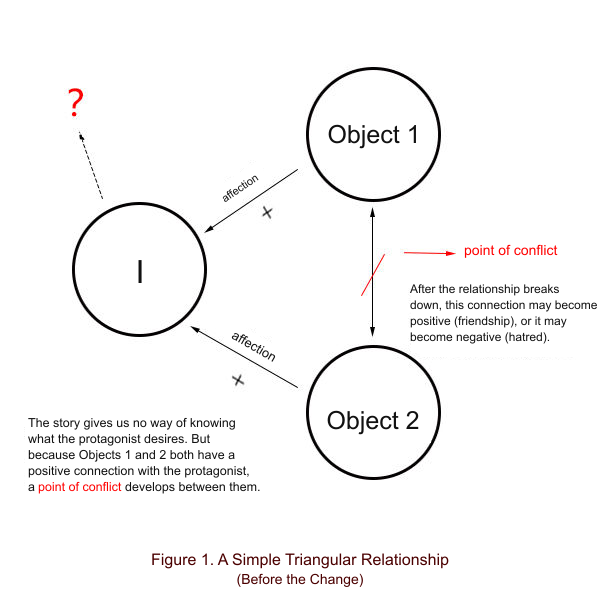
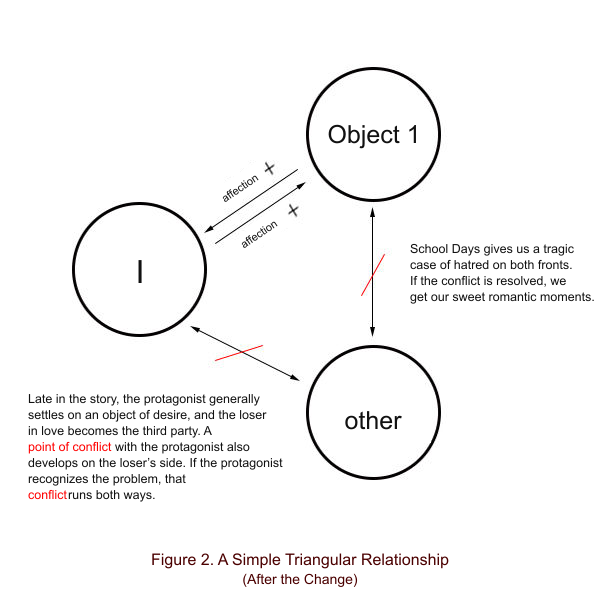
This analysis makes it easy to see that love triangles in heterosexual works are both anchored in the central protagonist, male or female, and held in check through that same center. Romantic relationships under the influence of a culture of private property are exclusive. Falling in love with the same person adds a latent threat of rupture to the relationship between the two heroines or heroes who are the central protagonist’s objects of desire. Yet the presence of the central protagonist, or of an existing social relationship, prohibits this jealousy. When I want to tear my rival apart, I still have to keep asking, “What would the person I love think of me tearing them apart?” Or I become anxious about whether to turn against someone who was once my friend, someone with whom I have a shared past. Whatever the outcome of a showdown, it will lead to the “dissolution of the relationship.” The loser in love will return to the position of the “other” outside the pair’s intimate relationship. To postpone this traumatic event for as long as possible, the subject chooses to maintain a delicate relationship of compensation and satisfaction with the other subject who is also an object of the central protagonist’s desire—a masquerade—and tries to dignify it as “preserving a good relationship.” More concretely, a character may remain in a prolonged psychological game with their jealous rival, layering the complex feelings of letting go, loathing, reconciliation, and gratitude. At times they go against their own desire, exiting to preserve the protagonist’s happiness: “As long as they’re happy.” (This can very easily trigger depressive perversion.) At other times, a kindness from the beloved makes them feel uniquely special. Most viewers who identify with the central protagonist fail to notice that this situation also lays the groundwork for same-sex desire. In fact, the most shocking part of a love triangle is not the protagonist forming a stable romantic relationship with one object of desire, but the protagonist exiting to make way for a homosexual relationship between the two objects of desire.
As stated at the beginning of this discussion, the central conflict in a love-triangle story lies in the triangle’s dynamic interplay, and this relationship moves toward dissolution at the story’s end. The protagonist will ultimately move toward reality and accept their genuine inner feelings. One of the objects of desire must exit, returning to the “other” among the anonymous multitude. The love triangle thus returns to a state in which “a world for two” and “the real world” are separate. For another group of works, however, this state of relations is where the story begins.
(2) The “Byakuyakō” (Lovers on the Run) Model: The General Form of the Triad
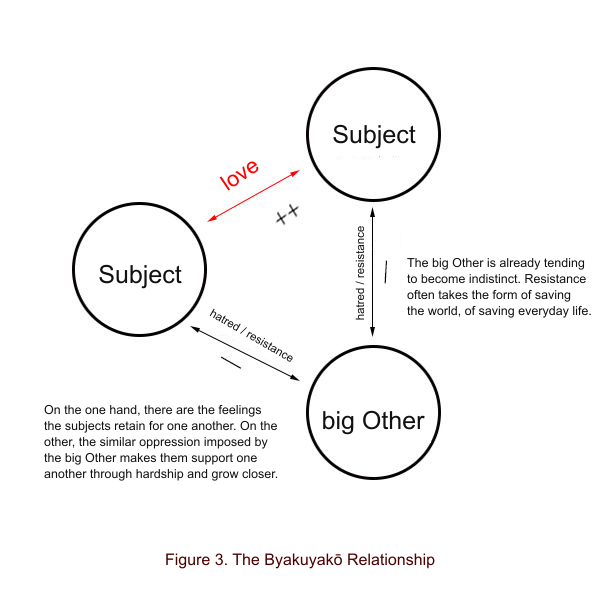
A more general relational form now enters the analysis. Once two people establish an intimate relationship fairly early in the plot, they must deal with the imbalance between their bond and harsh reality. For both partners, the crucial question is how to get along with this society. This situation comes closer to the original discussion: a triad is not a relation among three concrete individuals, but a relation among three positions. These positions are occupied not by individuals in the biological sense, but by symbolic representations of the human.
Some works have only two central protagonists, bound by an extraordinary intimacy—as lovers, for instance, or sworn companions. The third party in the story is not a specific interloper but politics, society, the atmosphere, the whole world, the Ninety-Nine Agency (oh, get out!). This third party tests the intimate pair and drives the plot forward. Stories with this relational model lend themselves to heart-wrenching plots, but can also bring out their protagonists’ appeal to perfection. Their protagonists are often not “everyday people.” (The everyday person is common enough in real life: distinctive in speech and behavior without overstepping the bounds.) Some degree of psychological distortion; unusual, perhaps oppressive or broken family relationships; a horrifying experience—kidnapping, murder: these are all important attributes of such characters. “Lovers on the run” or “Romeo and Juliet” would be more generic labels, but here I prefer to call this relationship the “Byakuyakō model,” after Byakuyakō (Journey Under the Midnight Sun). For one thing, most people know the work, and its three-character Chinese title is concise enough to evoke the relationships in the story. For another, Ryoji’s meticulousness and Yukiho’s cruelty have left a deep impression on many. This type of story throws the contradictions in the “pair–society” relation into extreme relief. It also wraps a core of individual heroism in a tragic shell, finding substitute satisfaction for humdrum daily life and providing a novel experience. Works such as Byakuyakō and Kurai Heya (The Dark Room) are particularly characteristic of the cruel lovers-on-the-run story.

As for what makes such works moving, Baudelaire noticed long ago the sublime aesthetic significance retained by marginal social groups. On the one hand, they preserve an aristocratic bearing and a political-aesthetic expectation—a purely formal search for redemption and resistance. On the other, they have already become groups excluded by society: utterly vulgar, even intolerable to society’s mores. Here exclusion becomes abjection: the remainder of a negative element, a trauma that belongs to society yet is absolutely unacceptable to it. The mad board the Ship of Fools; prisoners are sentenced to confinement; the “subject” becomes an other; a person recognized by law becomes homo sacer. The historical significance of the negation these marginal groups embody then becomes something we can look to with anticipation.

Of course, there is no denying that once this significance reaches the big screen or enters popular novels, its element of resistance is finally sutured into fantasy. What I want to reveal here, however, is that their relational form also survives in these works. Much as Baudelaire empathetically depicted life among marginal groups, I want to show how the partners’ interactions in the Byakuyakō model move audiences under the big Other’s threats and inducements. Today, under the sway of narratives of the everyday, the sign relations of commodities have replaced the symbolic and emotional exchanges that once passed between people. The communicative significance of exchanged glances has also suffered a historical defeat with the advent of technologies for communicating at a distance. “Standing together through hardship” has become quite a luxury. Yet the heroic spirit of the past still retains an aesthetic significance in people’s hearts—a shudder that transgresses everyday life. Once a story displays this element of resistance from the margins, the protagonists’ intimate relationship becomes an object of longing. Their personalities and backgrounds are so unusual, and the suffering inflicted on them by the third party so heavy for ordinary people, that we must believe this is true love. Whether or not this is fantasy-kitsch, it is enough to explain how readers and viewers fall in love with the characters.

In ACG, the Byakuyakō model differs in degree between school stories and more hardcore stories of sexual abuse and humiliation or suspense, but its essence is the same. The “adolescence syndrome” confronting the former and the “murders and kidnappings” of the latter are merely two sides of the same third party. Indeed, many Japanese stories do not even draw a line between school drama and suspense—Lying Mii-kun and Broken Maa-chan, for example, or CARNIVAL. Likewise, in neither genre does the Byakuyakō model involve an especially complex background of symbolic order. Works that explicitly address the interplay between the pair and politics are actually very rare. More often, this triangular relation is realized through school bullying, kidnapping and crime, or grand but empty organizations of the sekai-kei kind. Perhaps it is precisely this lack of political imagination that allows Japanese stories focused on complex human nature or obsessive states of mind to be so engrossing.

At the same time, we find that under this model—whether in harrowing plots of sexual abuse and humiliation or serious dramas exploring the meaning of existence—the pair’s relationship is often restricted to a narrow space and time: confined spaces such as a rooftop, a warehouse, or a basement; a private secret that you and I know, but the world does not. Family relations are already among the most clearly defined symbolic orders these works can name. An implicit resistance to social analysis is at work here: the works seem to have to make the third party nebulous before they can portray the compelling pair with full seriousness. A reproach is therefore inevitable: how can the appeal of the Byakuyakō model make up for its lack of political imagination? An answer is hard to find. We can at least detect the phenomenon in the fissures exposed when some writers portray the third party. Strictly speaking, Romeo Tanaka’s scripts possess a sociological tension. As we lose ourselves in the wild fantasy of “chūnibyō falling in love”—adolescents with grandiose fantasy identities—Aura: Koga Maryuin’s Last War and Yume Miru Kusuri: A Drug That Makes You Dream undoubtedly deliver a rude awakening. Of course, Romeo’s works about school bullying and chūnibyō do not address the wider problems of the symbolic order. But by introducing a mediating agent—a specific bully—they bring in the contradictions of social relations as well, producing dissonance. The Byakuyakō model in Aura rests on an affinity for chūnibyō pursuits, yet is drawn into the following facts: Ichiro Sato has already experienced bullying and mockery for his chūnibyō, and the heroine Ryoko Sato is in fact being bullied now. This is undoubtedly a fierce collision between the symbolic order and chūnibyō’s narcissistic fantasy. The story’s reconciliation likewise takes place on a rooftop, in a highly romanticized fashion. But its result is that Ryoko wants to “be an ordinary girl.” Viewers are left in an atmosphere of insecurity. Chūnibyō imaginings are supposed to be “perfect”: that perfection consists in containing every element of good and evil; the one thing they cannot contain is reality. Romeo presents the reality of social relations openly and unapologetically. This is not a strategy for “light-novel writers” to champion. Unlike A Silent Voice, the work does not keep its Byakuyakō relationship directly within the social order of “school violence”; nor, like Love, Chunibyo & Other Delusions!, does it keep the relationship within romantic fantasy. The triad that viewers and readers see arises neither from real-life conflicts among the characters nor from romantic conflict between boyfriend and girlfriend, but from the conflict between reality and imagination. Too serious for chūnibyō fantasy; too overblown for a work of social criticism. A close look at Romeo’s other works reveals traces of this tension to varying degrees: even when he clearly wants to portray the industry’s wasteland seriously, incongruous “moe” elements keep getting mixed in. As for why the Byakuyakō model seeks to detach itself from the triadic relation by ignoring and downplaying the third party, that calls for further thought and investigation.
Personally, I would rather see a “Byakuyakō” that breaks through the fantasy of pure love. This is also the key factor in how I judge whether a yuri work is hardcore. Unfortunately, I see very little of it in some of the familiar, widely discussed works…

Conclusion
In short, this essay has tried to explore a basic paradigm for analyzing relations among ACG characters and social relations. Rather than investigating individual life histories or narrative structure, it focuses on the basic forms of character relations. In the second section of the discussion, I borrowed Simmel’s concept of the triad to examine two typical triangular relations in ACG: the love-triangle model and the Byakuyakō model. The love triangle is actually a special form of the triad, because one of its relational subjects must exit at the story’s end, transforming the original relational field of the love triangle into that of “the pair–society.” If this relational field is taken as the starting configuration for a new story, it forms what we have called the Byakuyakō model. That model embodies a characteristic of Japanese-style works: removing or downplaying political mediation so that a “triad” looks like a “dyad.” What produces this textual characteristic remains to be analyzed from other dimensions.
In discussing relations within the story here, I have already mentioned the connection between the work and the audience outside it. In the next part, I will focus on this “work–audience” question.
